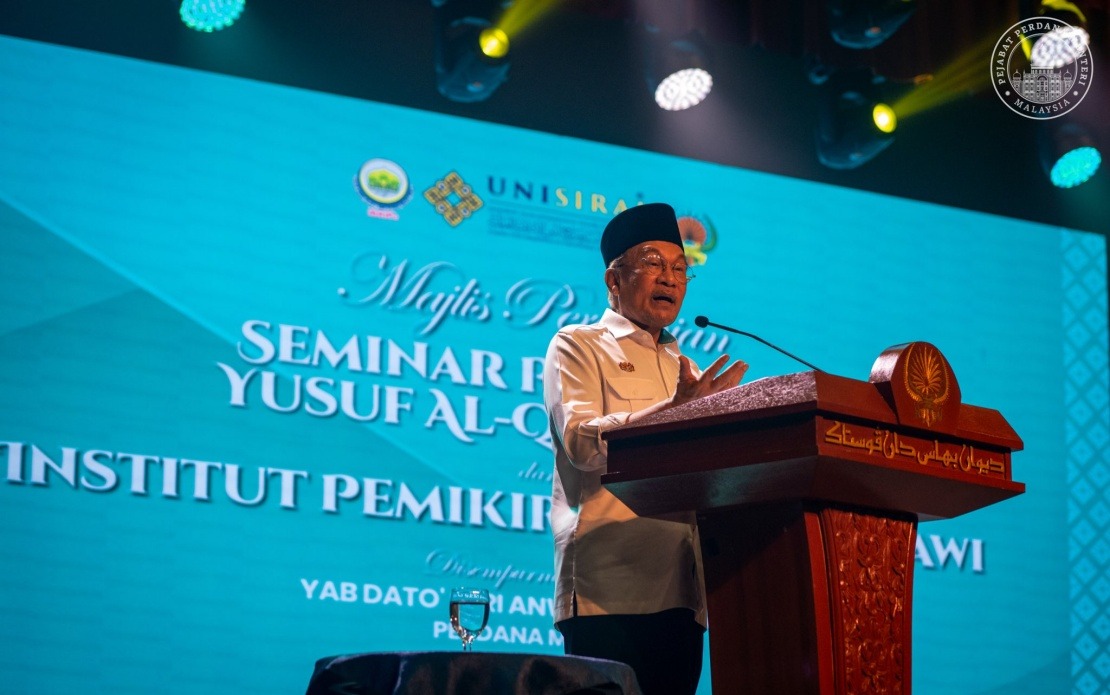
Prime Minister Datuk Seri Anwar Ibrahim has pledged RM2 million in government funding toward the Al-Qaradawi Thought Institute, underscoring the MADANI administration's commitment to advancing scholarly research into the intellectual contributions of one of modern Islam's most influential thinkers. The announcement came during the inauguration of both the Yusuf Al-Qaradawi Thought Seminar and the institute itself at Wisma Dewan Bahasa dan Pustaka in Kuala Lumpur on July 21, marking a significant investment in Islamic intellectual heritage.
The Prime Minister's personal tribute to Al-Qaradawi revealed the depth of influence the late scholar wielded over Malaysia's contemporary political and religious landscape. Through a statement shared on social media, Anwar expressed his profound indebtedness to Al-Qaradawi across multiple dimensions—intellectual inspiration, moral guidance, and the bonds of genuine friendship. By framing this contribution as part of efforts deserving divine blessing and societal enlightenment, Anwar positioned the funding within a broader spiritual and educational mission benefiting the broader Muslim community.
Anwar's recollection of his formative years with the Malaysian Islamic Youth Movement, or ABIM, illuminated the practical relationship between the two figures during a transformative period in Malaysian Islamic activism. The Prime Minister's account emphasised how Al-Qaradawi engaged directly with ABIM's leadership during the early 1980s, a crucial juncture when Islamic resurgence was gaining momentum across the region. This historical backdrop contextualises the institute's establishment as more than ceremonial recognition; it represents a deliberate institutional memorialisation of a particular philosophical approach to Islam.
Central to Anwar's narrative was Al-Qaradawi's advocacy for wasatiyyah, or moderation in Islamic thought and practice. During an era when rigid ideological positions and closed-minded approaches dominated many Islamic discourse spaces, the scholar's counsel to ABIM proved particularly prescient. Anwar credited this guidance as essential during a time when fervent Islamic sentiment sometimes manifested as insularity, with movements resistant to engaging with alternative viewpoints or contemporary realities. The Prime Minister's emphasis on this aspect suggests the institute will likely champion a moderate, intellectually open approach to Islamic scholarship.
Al-Qaradawi's characterisation as an agent of change and embodiment of the Zeitgeist speaks to his role as a bridge-builder between traditional Islamic values and modern challenges. Rather than viewing Islam and contemporary life as inherently incompatible, the scholar sought synthesis—demonstrating how classical Islamic principles could address contemporary problems without abandoning foundational teachings. This interpretive framework has become increasingly relevant across Southeast Asia, where Muslim-majority societies navigate rapid development, pluralism, and evolving social dynamics.
The RM2 million allocation reflects governmental recognition that Islamic scholarship deserves institutional infrastructure and sustained funding. For Malaysia, where Islam holds constitutional significance and Islamic education extends from schools to universities, supporting centres of Islamic thought contributes to the intellectual foundations of the nation's religious and civil life. The investment also signals confidence in research-based approaches to understanding Islam, positioning scholarly inquiry alongside traditional religious authority.
From a regional perspective, establishing such an institute in Malaysia carries implications for Southeast Asian Islamic intellectual discourse. As a multicultural democracy with established Islamic institutions, Malaysia often serves as a reference point for other nations navigating similar questions about modernisation, pluralism, and religious identity. An institute dedicated to Al-Qaradawi's thought—particularly his moderate, inclusive methodologies—could influence how Islamic scholarship develops across the region, potentially strengthening voices advocating for tolerance and rational engagement with contemporary issues.
The timing of this initiative also reflects broader MADANI Government priorities. The administration has consistently emphasised principles of inclusivity, reform, and pragmatic governance, themes that resonate with how Anwar described Al-Qaradawi's legacy. By institutionalising research into the scholar's contributions, the government demonstrates commitment to intellectual frameworks that balance religious values with progressive governance approaches.
For Malaysian universities and research institutions, the institute offers opportunities for collaborative scholarly work and interfaith dialogue rooted in serious Islamic intellectual traditions. Students and researchers will gain access to resources dedicated to exploring how Islamic principles address issues ranging from economics and law to ethics and social policy. This infrastructure-building approach recognises that sustained intellectual advancement requires more than occasional seminars; it demands dedicated spaces, trained researchers, and long-term funding commitments.
The establishment also honours a figure whose influence on Malaysian and broader Muslim politics remains significant, even after his death. Al-Qaradawi's extensive writings, fatwas, and public statements shaped how millions of Muslims thought about contemporary issues. By creating an institution dedicated to studying his work systematically, Malaysia contributes to preserving and analysing an important intellectual legacy for future generations, ensuring that his contributions remain accessible for continued scholarly engagement rather than fading into historical obscurity.

