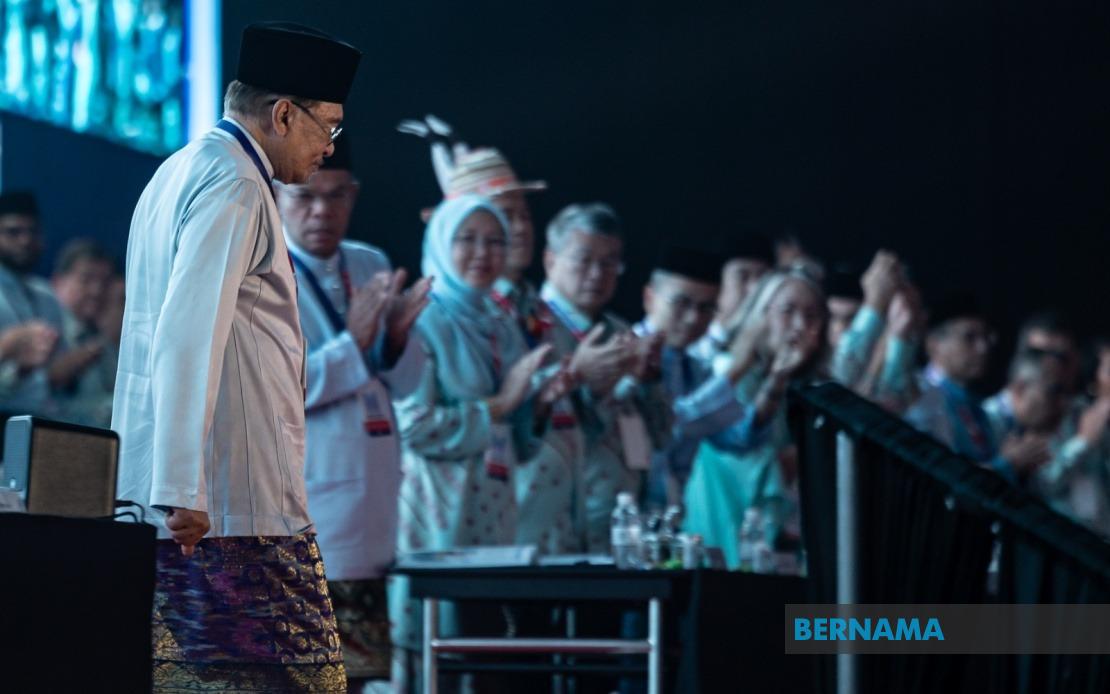
Prime Minister Datuk Seri Anwar Ibrahim has firmly rejected allegations that his administration is marginalising particular states, countering critics by pointing to substantial year-on-year increases in federal allocations across multiple regions. Speaking at the 2026 PKR National Congress in Melaka, Anwar emphasised that budgetary differences between states reflect varying development priorities rather than political bias or discriminatory practices. The clarification comes amid ongoing scrutiny of how the MADANI Government distributes resources among Malaysia's 13 states and three federal territories since assuming office.
Citing concrete figures, Anwar highlighted the dramatic growth in Sabah's federal expenditure, which has surged 35 per cent over the three-year period of his tenure. The East Malaysian state's allocation jumped from RM13 billion in 2022 to RM17.6 billion in 2026, a substantial injection of resources that the Prime Minister suggested should silence suggestions of neglect. He also pointed out that previous state administrations, despite claiming grievances today, never raised similar concerns during earlier periods when such increases did not materialise, implicitly challenging the consistency of current criticism.
Sarawak has experienced even more dramatic budgetary expansion under the MADANI framework, with federal allocations rising 48 per cent from RM10.2 billion in 2022 to RM15.1 billion currently. This substantial increase underscores the government's commitment to developing Malaysian Borneo's infrastructure, services, and economic capacity. The Prime Minister's emphasis on Sarawak's gains is particularly significant given the state's political importance as a coalition partner and its strategic role in regional development initiatives spanning energy, agriculture, and connectivity projects.
Northern and eastern peninsula states have similarly benefited from enhanced budgetary support. Terengganu's allocation has grown notably from RM6 billion in 2022 to RM8.1 billion this year, while Kedah and Kelantan have also received increased funding under the current administration's budget cycles. Johor, Malaysia's southernmost peninsula state and one of the nation's economic powerhouses, has seen its federal allocation increase from RM10.2 billion in 2022 to RM14.6 billion by 2026. Perlis, often considered among Malaysia's less prominent states, has equally experienced budgetary improvements reflecting the government's stated commitment to equitable resource distribution.
Anwar's intervention at the PKR congress represents a deliberate effort to address political narratives that have circulated regarding unequal treatment of states under his leadership. The timing of such clarifications during a ruling coalition party gathering suggests that concerns about state allocations remain a sensitive political matter capable of influencing voter sentiment, particularly in states where opposition parties have capitalised on grievance narratives. By presenting detailed numerical evidence, the Prime Minister aims to shift discourse away from perception-based criticism toward measurable outcomes.
The allocation framework reflects a broader MADANI Government principle that federal resources should align with specific development needs and strategic priorities rather than being distributed uniformly across all states. Under this logic, variations in funding between states represent rational planning rather than favouritism. Some states require greater investment in basic infrastructure and service delivery, while others may benefit from concentrating resources on specialised sectors or addressing specific demographic challenges. This approach, while theoretically sound from a development perspective, inevitably generates friction with states receiving smaller allocations or perceiving their increases as insufficient relative to their populations or economic contributions.
The political significance of state-level allocation debates extends beyond simple budgetary mechanics. In Malaysia's federal system, state governments wield considerable autonomy over land, education, and local services, making them crucial partners in implementing national development agendas. When state administrations perceive themselves as inadequately resourced, they may resist federal initiatives or emphasise their grievances to electorates, potentially shifting voting patterns in state and federal elections. Conversely, states receiving visible improvements in infrastructure and services tend to reward governments with political support, creating a feedback loop that influences both budgetary decisions and electoral calculations.
For East Malaysian states particularly, budgetary allocations carry heightened political weight. Sabah and Sarawak negotiated constitutional arrangements at independence that guarantee them substantial autonomy and revenue-sharing mechanisms. The substantial percentage increases cited by Anwar can be interpreted as recognition of these states' strategic importance to maintaining the stability of the federal coalition. However, such increases must also accommodate rising costs of service delivery in geographically dispersed territories with smaller populations, meaning that nominal budget growth may not always translate to proportionally enhanced per capita spending or services.
The MADANI Government's emphasis on transparent allocation comparisons serves multiple purposes simultaneously. First, it provides factual counterarguments to political opponents claiming neglect. Second, it demonstrates the administration's capacity for financial management and growth across multiple jurisdictions. Third, it establishes benchmarks against which future budgets will be measured, effectively raising expectations for continued increases. Fourth, by highlighting improvements across states governed by both coalition and opposition parties, the government attempts to depoliticise allocation decisions and frame them as technocratic rather than partisan.
Looking forward, the sustainability of these allocation increases will depend on Malaysia's overall economic performance and fiscal health. Budget allocations are constrained by total government revenue, and as interest payments on public debt consume increasing shares of federal budgets, the room for discretionary spending on state development projects may narrow. States expecting continued double-digit percentage increases may face disappointment if economic growth decelerates or fiscal consolidation becomes necessary. This dynamic means that current budgetary commitments, while politically valuable in the short term, may create long-term expectations that become increasingly difficult to maintain.
The broader context of Anwar's statements reflects Malaysia's evolving political landscape, where federal-state relations have become more contested as opposition parties improve their foothold in state-level governance. When different political parties control federal and state governments, resource allocation becomes a battleground for competing narratives about competence, fairness, and development priorities. The MADANI Government's strategy of highlighting aggregate improvements across states regardless of partisan control appears designed to transcend such divisions by framing allocations as evidence-based and universal rather than selective and discriminatory. Whether this approach succeeds in neutralising political criticism ultimately depends on whether tangible improvements in service delivery and infrastructure become visible to ordinary citizens.

