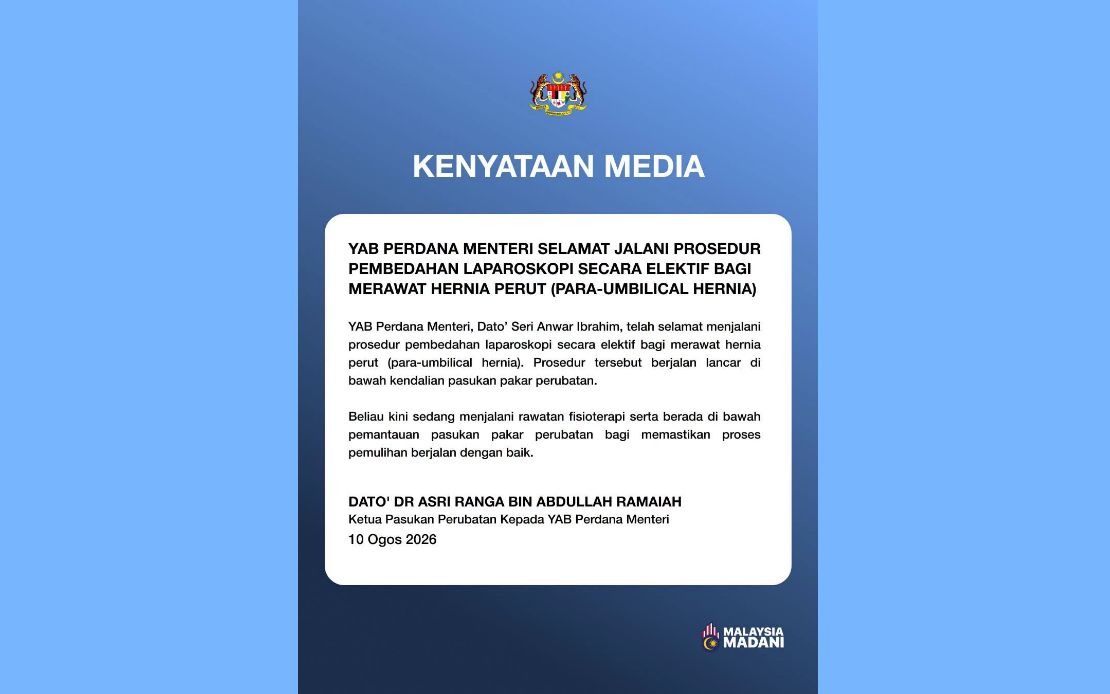
Prime Minister Datuk Seri Anwar Ibrahim underwent a planned laparoscopic procedure on August 10 to address a para-umbilical hernia, a condition affecting the abdominal wall near the navel. The surgical intervention proceeded without complications, according to the Prime Minister's Medical Team head Datuk Dr Asri Ranga Abdullah Ramaiah, who confirmed that specialists managed the operation successfully.
The decision to pursue surgical treatment reflects a pragmatic approach to managing what, while not emergent, could pose complications if left unattended. Para-umbilical hernias occur when abdominal tissue protrudes through weakened muscle, and though often manageable through conservative measures, elective surgery eliminates the risk of strangulation and other serious complications. Anwar's medical team selected laparoscopic techniques—minimally invasive keyhole surgery—which typically involve smaller incisions, reduced tissue trauma, and faster recovery compared to open surgical approaches.
Following the procedure, the Prime Minister entered a structured recovery phase combining physiotherapy with continuous monitoring by medical specialists. This multidisciplinary approach underscores the protocol applied to senior government officials, prioritising both rehabilitation and early mobilisation to prevent post-operative complications. The medical team's statement emphasised that recovery progression remains the central focus of this supervised observation period.
Prime Minister Anwar's senior press secretary Tunku Nashrul Abaidah indicated that a two-day observation window had been scheduled to allow the medical team to monitor vital parameters and ensure no unexpected complications arose during the immediate post-operative phase. This relatively brief hospitalisation reflects both the routine nature of the procedure and the patient's overall fitness level. The press secretary appealed to Malaysians to offer prayers for the Prime Minister's successful recovery and restoration to full health.
The timing and transparency of the announcement carry broader implications for governance continuity and public confidence. By conducting elective surgery during a planned schedule and promptly communicating details to the public, the government demonstrates proactive health management rather than reactive crisis response. This stands in contrast to situations where leaders' medical conditions emerge suddenly or remain shrouded in opacity, creating uncertainty within markets and diplomatic circles.
For Malaysia's political landscape, such planned medical procedures highlight the importance of succession planning and institutional resilience. While Anwar's condition required treatment, the controlled surgical environment and clear recovery timeline minimise disruption to the Prime Minister's office and cabinet functions. Senior government officials continue performing their duties, demonstrating that the executive branch maintains operational capacity despite the Prime Minister's temporary focus on recuperation.
Regionally, political leaders throughout Southeast Asia frequently navigate the balance between personal health management and public duties. The Malaysian approach—balancing transparency about the procedure with confidence in rapid recovery—reflects contemporary standards of responsible governance communication. Citizens increasingly expect candid health disclosures from their leaders, recognising that physical well-being directly correlates with capacity to execute demanding roles.
The medical procedure itself represents routine healthcare that many Malaysians pursue through private and public sectors. By normalising such treatments at the highest levels of government, the Prime Minister's willingness to undergo elective surgery potentially encourages other officials and citizens to address similar health concerns proactively rather than postponing necessary interventions. This has positive implications for preventative health culture within Malaysia's leadership circles.
Anwar's expected resumption of full duties in the near future suggests confidence from medical specialists regarding the procedure's success and his recuperative trajectory. The Prime Minister has maintained an active schedule despite various health considerations throughout his political career, and this surgical intervention appears positioned as a discrete, manageable episode rather than a significant challenge to governmental continuity. The clarity provided by medical authorities helps stakeholders—from cabinet colleagues to international partners—assess operational stability.
As Malaysia continues navigating complex economic, security, and diplomatic challenges, the government's institutional mechanisms and leadership succession protocols remain under informal public scrutiny. While a routine surgical procedure typically occupies limited political or economic attention, the transparency demonstrated during this episode reinforces institutional norms around responsible communication during periods of executive unavailability. The rapid recovery timeline projected by medical specialists suggests minimal disruption to the Prime Minister's agenda or broader government operations.

