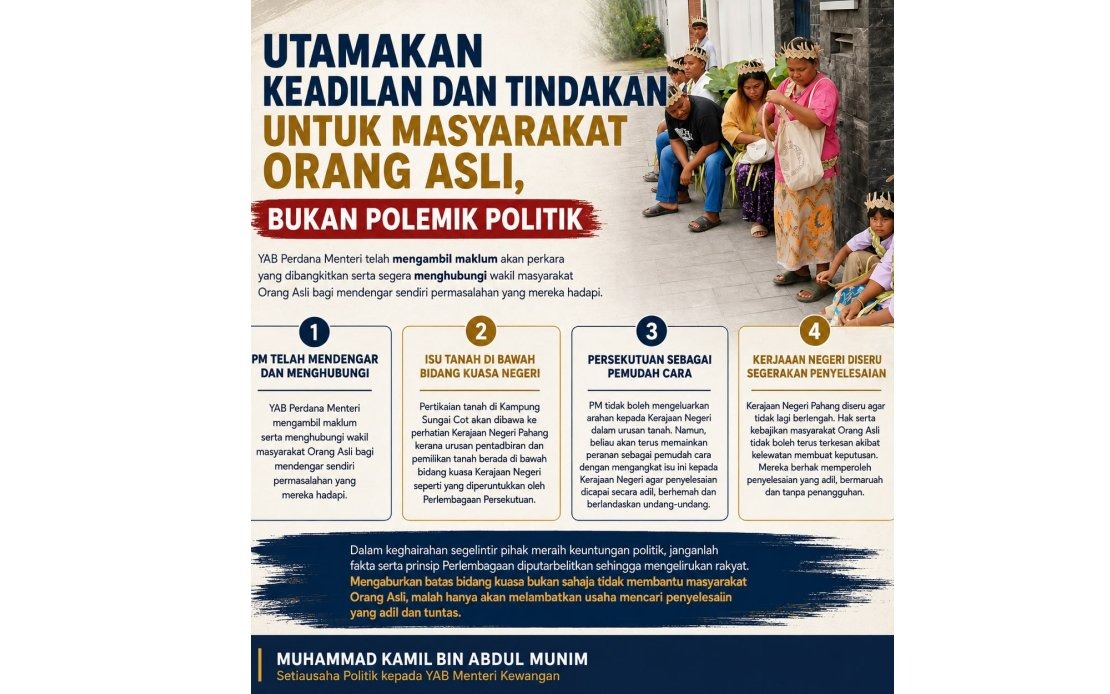
Prime Minister Datuk Seri Anwar Ibrahim has committed to facilitating a resolution to the contentious land dispute affecting the Orang Asli community in Kampung Sungai Cot, located in Maran, Pahang. Through his political secretary Muhammad Kamil Abdul Munim, the Prime Minister signalled that whilst he has no direct constitutional authority over land administration, he remains actively engaged in seeking a fair and lawful outcome for the indigenous community caught in this protracted dispute.
The land question in Kampung Sungai Cot represents a longstanding grievance within Malaysia's Orang Asli communities, who have historically faced marginalisation in property rights and territorial recognition. This particular case has gained heightened visibility in recent months, drawing attention from civil society advocates and political figures alike. The involvement of the Prime Minister at this level underscores the growing political salience of indigenous land rights as a national governance issue, particularly given Malaysia's international commitments to protecting indigenous peoples and the constitutional protections theoretically afforded to Aboriginal groups.
According to Muhammad Kamil's statement, Anwar has personally engaged with community representatives to understand the specific circumstances and obstacles they confront. This direct outreach represents a departure from purely bureaucratic handling, suggesting the Prime Minister views the matter with sufficient urgency to warrant personal intervention. The willingness to listen directly to affected parties signals a recognition that standard administrative channels may have proven inadequate in addressing the community's concerns, a reality that often characterises land disputes involving marginalised groups in Malaysia.
The constitutional architecture governing land administration in Malaysia creates a particular constraint on federal intervention. Under the Federal Constitution, land matters fall squarely within state jurisdiction, a principle Muhammad Kamil emphasised repeatedly in his statement. This arrangement means the Pahang State Government holds ultimate responsibility for determining land ownership, boundaries, and utilisation rights. The Prime Minister's role is therefore circumscribed to advocacy and facilitation rather than directive authority, a distinction he appears keen to clarify given occasional public confusion about federal powers.
However, Muhammad Kamil's statement also contained a veiled criticism of political actors seeking to weaponise the issue for partisan advantage. He cautioned against distorting constitutional principles or misrepresenting facts to score political points, suggesting that some stakeholders may have oversimplified or mischaracterised the Prime Minister's capacity to unilaterally resolve the dispute. This framing reveals underlying tensions between popular expectations that the federal government can simply "fix" such problems and the actual distribution of constitutional authority within Malaysia's federal system.
The statement emphasises that whilst the federal government lacks direct land administration powers, this does not equate to indifference. The Prime Minister intends to escalate the matter with Pahang State Government officials, leveraging his position to urge swift and equitable action. This approach reflects a pragmatic middle ground: acknowledging constitutional limitations whilst demonstrating political will to advance the issue through available channels. For the Orang Asli community, such federal advocacy, though indirect, can carry significant weight in influencing state-level decision-making.
Muhammad Kamil's call for the Pahang State Government to expedite proceedings warrants particular attention given the often glacial pace of land disputes in Malaysia. Extended delays in resolving such cases impose real costs on affected communities, perpetuating uncertainty about their livelihood security and territorial claims. The statement's emphasis on "fair and dignified resolution without further delay" acknowledges this accumulated burden and the need for decisive state action rather than bureaucratic procrastination.
The Orang Asli population in Malaysia totals approximately 180,000 people distributed across several ethnic groups, predominantly inhabiting peninsular regions including Pahang. Despite constitutional acknowledgement of their special position, Orang Asli communities frequently encounter difficulties in asserting land rights, accessing development opportunities, and securing equal representation in governance structures affecting their territories. The Kampung Sungai Cot case thus resonates beyond its immediate geographic context, symbolising broader challenges confronting indigenous land security across Southeast Asia and Malaysia specifically.
For Malaysian policymakers and civil society actors monitoring indigenous affairs, the Prime Minister's engagement signals that land rights have achieved sufficient political prominence to warrant federal attention. This represents a modest but meaningful shift in positioning indigenous issues within the national governance agenda. However, the ultimate test will lie in whether federal facilitation translates into concrete action by Pahang authorities, or whether the matter continues to languish within state bureaucratic processes despite elevated political attention.
The statement also underscores the importance of constitutional clarity in federal systems like Malaysia's, where jurisdictional boundaries can become contested or misunderstood in politically charged contexts. Muhammad Kamil's repeated emphasis on state responsibility suggests an effort to establish clear institutional accountability: if the Pahang State Government fails to act expeditiously, responsibility will lie clearly with state authorities rather than the federal administration. This demarcation of responsibility becomes crucial for evaluating whether political commitments ultimately translate into substantive improvements for the Orang Asli community.
Moving forward, the trajectory of this issue will depend substantially on how the Pahang State Government responds to federal appeals. State politicians face their own electoral and governance pressures, and prioritising a land dispute affecting a relatively small indigenous community may compete with other policy priorities. The Prime Minister's public commitment, however, establishes a political marker that could enable future accountability mechanisms should the state government neglect the matter. For the Orang Asli residents of Kampung Sungai Cot, federal interest provides a platform for intensifying pressure, even if it does not directly resolve the underlying dispute.

