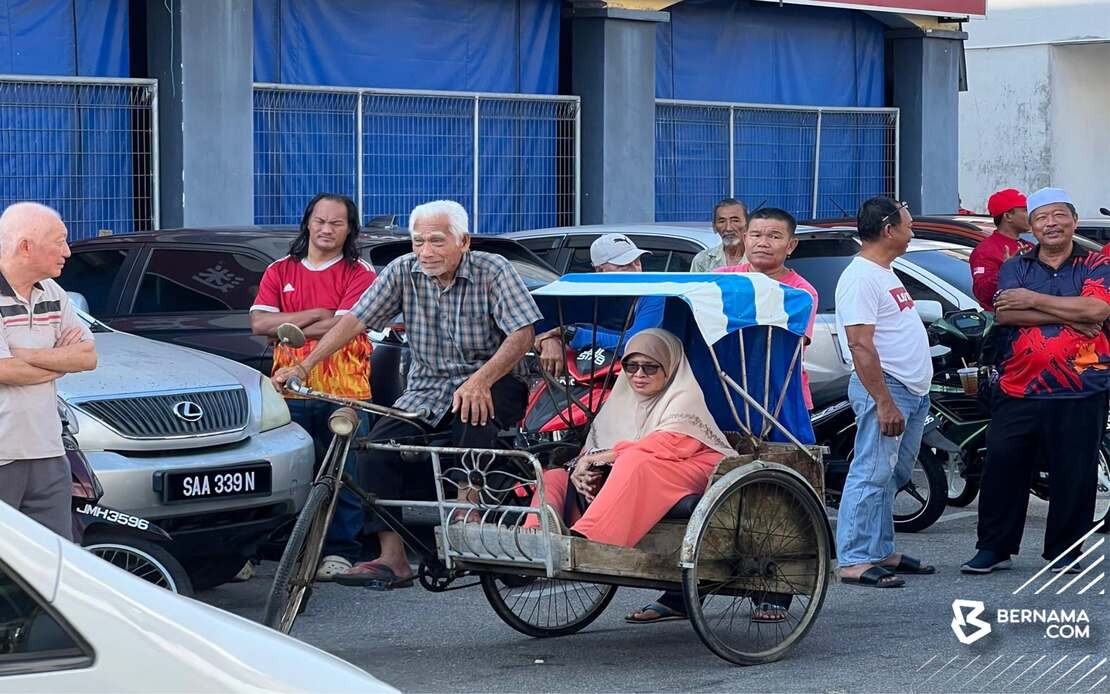
Prime Minister Datuk Seri Anwar Ibrahim has extended his heartfelt appreciation to an elderly couple from Batu Pahat, Johor, whose determination to see him during a recent visit has struck a chord with the nation's top leader. The gesture came to light after Abdul Razak Pelangga, 86, made the deliberate choice to transport his wife, Jamilah Samsudin, 64, nearly a kilometre from their home in Kampung Parit Bugis to Kedai Kopi Hailam Sri Medan in Senggarang, cycling a trishaw to reach the location where Anwar was scheduled to have breakfast. What might appear a modest journey to some carries deeper significance when viewed through the lens of an octogenarian's physical commitment and the couple's shared desire to be present for the encounter.
Anwar's response came through a Facebook post, in which he acknowledged the couple's efforts with genuine regret that circumstances prevented their meeting during his breakfast stop at the eatery. The premier's acknowledgment extended beyond a simple thank you, incorporating well-wishes for the couple's health and wellbeing in the years ahead. His message reflected the growing trend of Malaysian political leaders leveraging social media platforms to maintain direct dialogue with constituents and demonstrate responsiveness to grassroots sentiments. For residents of smaller towns and kampung communities, such acknowledgments from the highest office carry particular weight, serving as validation that their efforts and support are recognised at the highest echelons of governance.
The local imam of Masjid Raudhatul Jannah Parit Bugis provided insight into Abdul Razak's decision-making process, explaining that the elderly man had deliberately selected the trishaw option despite having access to alternative transportation methods. Both a car and motorcycle were available to the couple, yet Abdul Razak reasoned that the trishaw would prove more practical given the logistical challenges of locating parking space in what is acknowledged as a small town with limited facilities. This pragmatic assessment reveals the kind of consideration that characterises long-married couples and the accumulated wisdom that comes with advancing age. The choice also underscores the continued relevance of trishaws in Malaysian towns as a preferred mode of transport for short-distance journeys, particularly among elderly residents who value reliability and simplicity over speed.
Anwar's visit to Senggarang formed part of broader campaign activities in the state constituency, with his itinerary including approximately 50 minutes at the kedai kopi engaged in breakfast and informal interactions with local residents. The meet-and-greet programme served as an opportunity for the premier to connect directly with voters during what was framed as outreach coinciding with the Johor State Election. Such ground-level engagement remains a cornerstone of Malaysian political strategy, allowing leaders to understand local concerns and demonstrate commitment to their constituencies. The fact that Anwar allocated a substantial portion of his schedule to this particular eatery suggests the visit carried importance beyond mere ceremonial value, with emphasis placed on accessibility and the informal setting conducive to genuine conversation.
The encounter between an 86-year-old pensioner and the country's leader, though ultimately unrealised in direct terms, has become emblematic of the everyday experiences of ordinary Malaysians in their relationship with high office. The story invokes reflections on sacrifice, family bonds, and the enduring respect accorded to political leadership, particularly within older demographic groups who have witnessed multiple transitions in national governance. Abdul Razak's willingness to undertake what might be considered a strenuous journey at his age demonstrates values of persistence and family solidarity that resonate across generations within Malaysian society. For many in rural and semi-rural areas, opportunities to see and acknowledge the prime minister in person continue to hold cultural and symbolic significance that extends beyond mere celebrity spectacle.
Anwar's response also highlights the evolving expectations placed on modern political leaders regarding engagement with their constituents. In an era where news cycles are rapidly consumed and social media commentary shapes public perception, the premier's swift acknowledgment through Facebook represents an attempt to close the gap created by their missed encounter. This rapid-response politics has become normalised, with leaders expected to notice and comment on public stories involving their citizens. The gesture, while straightforward, carries implications for how political figures manage their image and maintain what political scientists term "relational capital" with voters across different demographic segments. For the couple involved, Anwar's public recognition transforms a personal disappointment into a moment of national visibility, their story now part of the discourse surrounding the premier's leadership style and accessibility.
The broader context of the Johor State Election frames this personal story as part of wider political mobilisation occurring across the state. As political parties vie for support, individual interactions and encounters between leaders and voters gain magnified significance in shaping electoral sentiment. Anwar's explicit expression of regret at missing the couple signals to broader audiences that the premier values such personal connections and views them as worth acknowledging publicly. This calculated visibility of seemingly spontaneous human moments has become integral to contemporary political communication in Malaysia. The couple's story, circulated through media channels and amplified across social platforms, thus becomes a narrative device through which Anwar subtly reinforces messaging about his approachability and recognition of ordinary Malaysians' lives and desires.
For residents of smaller towns like Batu Pahat, stories such as this carry particular resonance, as they illustrate that peripheral communities remain within the purview of national leadership attention. Smaller municipalities often experience a sense of disconnection from the capital and major urban centres, with residents feeling that development and political focus concentrate disproportionately on metropolitan areas. The fact that Anwar allocated time during a Johor campaign visit to stop in Senggarang and engage with the local community pushes back against such perceptions, however marginally. The visibility afforded to Abdul Razak and Jamilah's journey through the prime minister's acknowledgment potentially elevates the profile of their community, drawing media attention to Senggarang and its residents in ways that might otherwise not occur.

