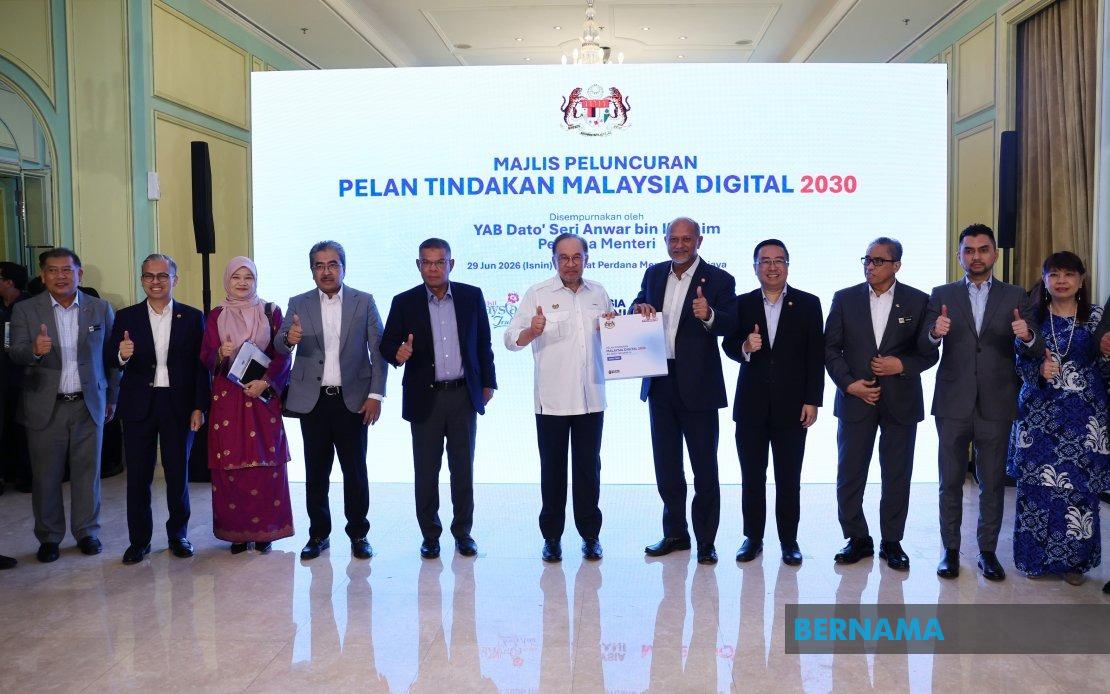
Prime Minister Datuk Seri Anwar Ibrahim has unveiled Malaysia Digital 2030 (MD2030), a sweeping five-year action plan that signals a fundamental reorientation of the nation's approach to technology and digital transformation. Launched in Putrajaya, the plan represents an ambitious pivot away from Malaysia's traditional role as a consumer of foreign technology towards establishing the country as a homegrown innovator and producer of digital solutions. This strategic shift comes as regional competitors accelerate their own artificial intelligence and digital economy initiatives, making the timing significant for Malaysia's long-term economic competitiveness in Southeast Asia.
The roadmap encompasses an extensive array of targets designed to reshape Malaysia's economic and technological landscape by 2030. Most prominently, the government aims to expand the digital economy's contribution to gross domestic product from its current levels to 30 per cent, a figure that would represent a substantial reorientation of Malaysia's economic structure. Alongside this growth ambition, the plan targets the creation of 500,000 high-value digital sector jobs, addressing both unemployment and the country's need to develop a skilled workforce capable of competing in advanced technology fields. Additionally, the government seeks to generate RM4.5 billion in public sector savings through systematic digitalisation of operations, while simultaneously transitioning 95 per cent of government services to fully online delivery.
The governance structure of MD2030 reflects a whole-of-government approach, with responsibility distributed across seven interconnected strategic pillars, each overseen by a relevant minister acting as cluster head. This architecture acknowledges that digital transformation cannot succeed in isolation but must permeate government operations, economic development, physical infrastructure, human capital, social inclusion, security frameworks and innovation ecosystems. Chief Secretary to the Government Tan Sri Shamsul Azri Abu Bakar leads the Government pillar, focused on establishing GovTech Malaysia to modernise public service delivery. Investment, Trade and Industry Minister Datuk Seri Johari Abdul Ghani directs the Economy pillar, tasked with positioning Malaysia as a regional digital innovation hub whilst promoting "Made by Malaysia" digital products and accelerating technology adoption in high-growth sectors.
The Infrastructure pillar, under Communications Minister Datuk Fahmi Fadzil's leadership, prioritises universal high-quality broadband access and sustainable digital infrastructure development, including data centres and smart city deployments. The Talent pillar, guided by Human Resources Minister Datuk Seri R. Ramanan, concentrates on workforce preparation through comprehensive policies and transition initiatives to establish Malaysia as a recognised regional digital talent destination. Women, Family and Community Development Minister Datuk Seri Nancy Shukri oversees the Society pillar, emphasising inclusive digital participation through the Malaysian Digital Inclusion Index and rural community empowerment. Digital Minister Gobind Singh Deo chairs the Trust and Security pillar, balancing innovation with robust data protection through the National Data Commission and a comprehensive digital security strategy.
Science, Technology and Innovation Minister Datuk Chang Lih Kang directs the Innovation pillar, which represents perhaps the most transformative element of MD2030. This pillar aims to construct a robust Research, Development, Commercialisation, Innovation and Economy (RDCIE) ecosystem that would enable Malaysian institutions and companies to transition from primarily importing technology to generating breakthrough innovations for export. By establishing stronger linkages between research institutions, venture capital, regulatory frameworks and market opportunities, the government hopes to catalyse the emergence of Malaysian technology companies capable of competing regionally and globally. This pillar directly addresses a historical weakness in Malaysia's innovation capacity, where research output has often remained disconnected from commercial application.
The Economy pillar deserves particular attention for Malaysian business readers, as it encompasses strategies to unlock value from data, digital assets and intellectual property whilst promoting adoption of cutting-edge technologies in identified high-growth sectors. The emphasis on "Made by Malaysia" branding suggests a deliberate effort to cultivate homegrown champions in digital industries, potentially through targeted investment support and regulatory frameworks favouring local innovators. This approach mirrors successful models in other Southeast Asian nations and reflects recognition that Malaysia must develop indigenous technological capabilities rather than remaining perpetually dependent on foreign technology providers and expertise.
Implementation coordination falls to the Digital Ministry as the designated lead agency, working through established agencies including the National AI Office, GovTech Malaysia, the Malaysia Digital Economy Corporation, CyberSecurity Malaysia, MyDIGITAL Corporation and the Malaysia Centre for the Fourth Industrial Revolution. This consolidated agency structure aims to prevent the fragmentation and duplication that often hampers large-scale government initiatives. Digital Minister Gobind Singh Deo emphasised that the ministry bears responsibility not only for achieving economic targets but for ensuring the transformation rests upon foundations of trust, data security and strong governance, addressing concerns that rapid digitalisation might compromise privacy or create security vulnerabilities.
The timing of MD2030's launch reflects broader regional competition in the artificial intelligence and digital economy space. Neighbouring Thailand, Singapore and Vietnam have launched their own AI strategies in recent years, making Malaysia's articulation of a comprehensive vision particularly timely. The plan's explicit framing around the "Towards an AI Nation 2030" agenda acknowledges that artificial intelligence represents the defining technology of the coming decade, touching everything from government service delivery to business competitiveness to labour market dynamics. Malaysia's commitment to integrating AI across all life aspects whilst managing the inevitable disruptions suggests an attempt at anticipatory policy-making rather than reactive adjustment.
The inclusivity dimensions embedded throughout MD2030 address legitimate concerns about digital transformation's uneven impacts. The Society pillar's focus on rural community empowerment and the institutionalisation of digital inclusion metrics recognises that technology benefits must reach beyond urban centres and educated populations. Similarly, the Talent pillar's emphasis on workforce transition initiatives acknowledges that moving the economy toward higher-value digital work requires supporting workers whose current skills may become obsolete. These social dimensions distinguish MD2030 from purely technocratic approaches and suggest the government's recognition that sustainable digital transformation requires managing its distributional consequences.
The Trust and Security pillar addresses perhaps the most contentious aspect of digital transformation—the balance between enabling innovation and protecting citizens' data and privacy rights. The development of a National Digital Trust and Data Security Strategy for 2026-2030 suggests the government takes seriously concerns about cybersecurity threats, data misuse and surveillance. This pillar's prominence reflects both Malaysia's experience with data breaches and broader regional anxieties about digital governance standards, particularly concerning government access to personal information.
For Malaysian businesses and entrepreneurs, MD2030 presents both opportunities and imperatives. The emphasis on building a robust innovation ecosystem and promoting Made by Malaysia products suggests potential policy support for digital startups and established companies willing to invest in innovation. Simultaneously, the plan's emphasis on technology adoption in high-value sectors implies that companies in traditional industries must accelerate their digital transformation or risk competitive disadvantage. The projected creation of 500,000 high-value digital jobs indicates substantial labour market reorientation, with implications for education institutions, vocational training providers and human resources professionals.
Regionally, Malaysia's articulation of MD2030 positions the country as seriously contending for digital leadership in Southeast Asia. While Singapore has established itself as the region's financial technology hub and Vietnam has attracted significant semiconductor manufacturing, Malaysia's strategy emphasises indigenous innovation and comprehensive digital economy development. The plan's success depends critically on implementation coordination across multiple government agencies, private sector participation, adequate funding and sustained political commitment beyond the current administration. Early performance metrics, particularly on broadband expansion and digital job creation, will indicate whether MD2030 remains an aspirational framework or translates into tangible transformation of Malaysia's digital capabilities and economic structure.

