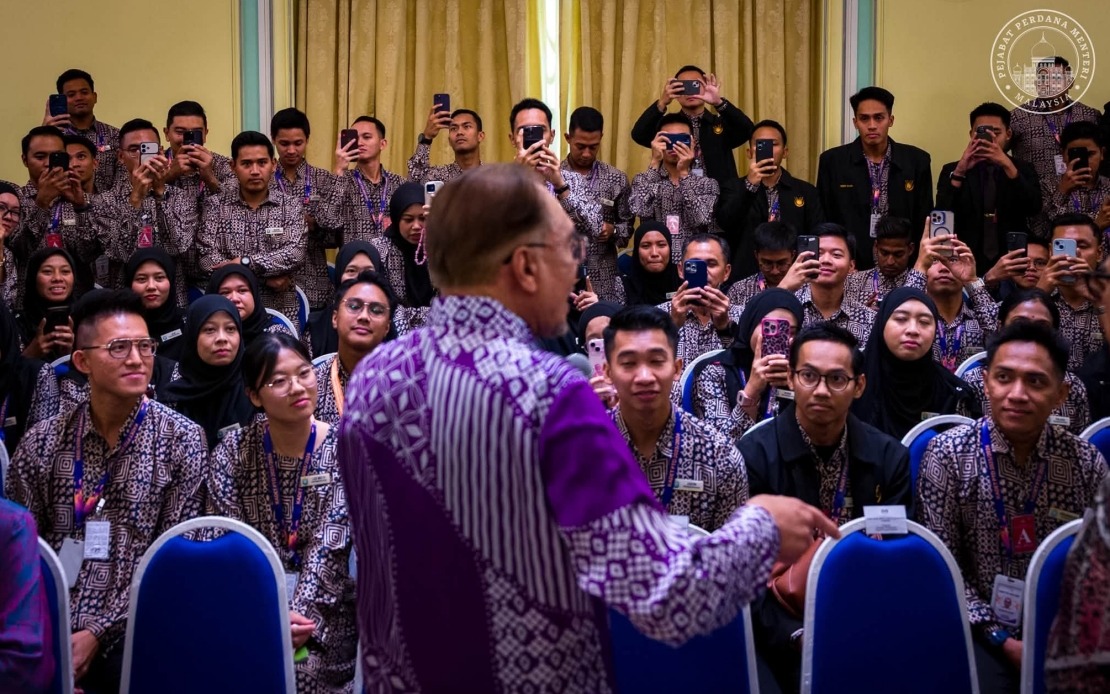
Prime Minister Datuk Seri Anwar Ibrahim has delivered a pointed reminder to Malaysia's civil service that public administration requires more than procedural competence—it demands ethical rigour, operational excellence, and a genuine willingness to adapt to changing circumstances. Speaking to Administrative and Diplomatic Service (PTD) officer cadets undertaking postgraduate studies in public management at his Putrajaya office, Anwar articulated a vision of civil service leadership grounded in principles that transcend individual career advancement or departmental interests.
The Prime Minister's message comes at a moment when Malaysia's bureaucracy faces mounting pressure to demonstrate responsiveness and accountability. The PTD scheme, which develops Malaysia's highest-ranking public administrators, represents a critical pipeline for future governance. By engaging directly with these emerging leaders, Anwar is attempting to embed a particular ethos within the administrative elite before they assume positions of substantial influence across federal and state institutions. This proactive approach to institutional culture-setting reflects recognition that civil service reform cannot succeed through directive alone but requires early cultivation of values among those destined for senior ranks.
Anwar's emphasis on placing national and public interests above all else carries particular resonance in a Malaysian context where patronage networks, political interference, and departmental territorialism have historically complicated policy implementation. The principle sounds straightforward in articulation yet proves notoriously difficult in practice, especially when career advancement depends on pleasing political masters or maintaining factional alliances within agencies. By reinforcing this message to cadets still early in their careers, Anwar appears to be attempting foundational culture-setting that might prove more durable than instructions imposed on already-established bureaucrats.
The commitment to integrity represents another essential dimension of Anwar's address. Public trust in Malaysian institutions has suffered erosion through corruption scandals, wasteful spending, and high-profile failures of accountability mechanisms. Civil servants who demonstrate transparent decision-making, honest financial stewardship, and professional conduct serve as counterweight to these negative perceptions. For a government seeking to restore credibility after political turbulence, ensuring that frontline administrators and mid-level managers exhibit uncompromising ethical standards becomes strategically important, as they represent the interface between government and citizenry.
The third pillar of Anwar's message—embracing change—addresses a widespread perception that Malaysia's bureaucracy moves slowly and resists innovation. The Prime Minister's specific mention of courage alongside change-embracing suggests he recognizes that accepting new approaches often requires pushing back against established practices, departmental resistance, and institutional inertia. In an era where digital transformation, e-governance, climate adaptation, and shifting service delivery models demand rapid institutional evolution, civil servants who possess intellectual flexibility and implementation agility become invaluable. The emphasis on courage particularly matters because it acknowledges that change often carries personal or professional risk, yet remains necessary for national competitiveness.
The broader aspiration Anwar articulates—a governance system capable of delivering progressivity, justice, and shared prosperity—depends fundamentally on the quality of people implementing policy and managing resources. Malaysia's economic competitiveness increasingly hinges on public sector efficiency and service quality. Its social cohesion requires fair and effective administration of programmes affecting different communities. Its environmental sustainability depends on consistent enforcement of regulations and adaptation of administrative practice. The civil service therefore occupies a central position in achieving these outcomes, which explains Anwar's focus on identifying and shaping the values systems of its future leaders.
This intervention also reflects a longer-term strategic concern about the civil service's institutional autonomy and political independence. In systems where bureaucratic leadership becomes overly responsive to political pressure or factional interest, policy consistency suffers, public trust erodes, and corruption risks multiply. By emphasizing that PTD officers should operate according to principled commitment to public interest rather than political direction, Anwar is attempting to fortify professional independence within the administrative hierarchy. This proves particularly important in Malaysia's federal system, where state-level administrators report to state governments that may pursue competing priorities.
The selection of the PTD postgraduate programme as venue for this message demonstrates sophisticated understanding of institutional leverage points. The participants represent Malaysia's future administrative elite—individuals who will lead major departments, chair policy committees, and shape implementation of government priorities over coming decades. Influencing their value systems, work ethic, and professional philosophy at this stage offers greater return on investment than addressing generic civil service audiences. These cadets are also at a developmental stage where professional identity remains malleable and receptive to mentoring from senior political figures.
For Malaysian civil servants generally, Anwar's address transmits clear signals about expected professional conduct and institutional priorities. The emphasis on integrity signals that corrupt or ethically questionable behaviour will face scrutiny. The focus on change-embracing communicates that resistance to necessary reform invites criticism. The stress on people-centred governance suggests that bureaucratic convenience cannot override public interest. These messages carry implicit consequences for career progression and institutional standing, creating incentive structures that reinforce stated values.
The practical implementation of such aspirations requires supportive institutional architecture. Cadets graduating from the postgraduate programme must enter departments where integrity is genuinely rewarded rather than punished, where innovation receives resources and protection from risk-averse senior management, and where public interest genuinely takes precedence over political convenience. The gap between Anwar's exhortations and actual working conditions within Malaysian agencies remains substantial, and whether the Prime Minister's message translates into sustained cultural change depends on consistency of reinforcement and alignment of institutional incentives with stated principles. The coming years will reveal whether this investment in shaping emerging administrative leadership yields measurable improvements in governance quality.

