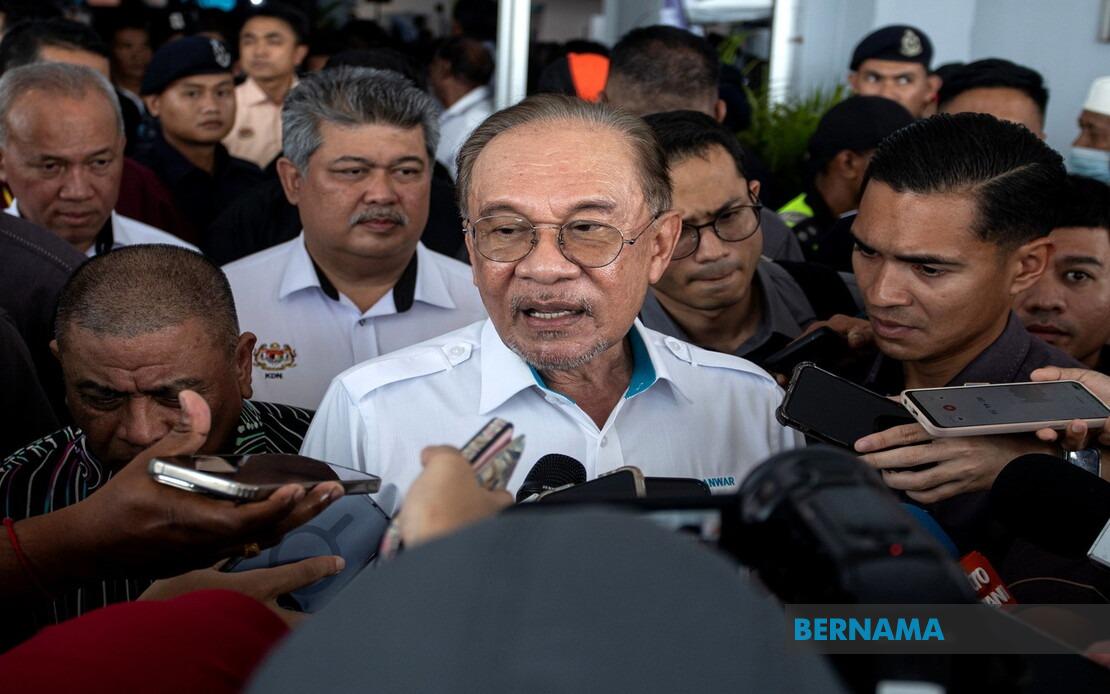
Prime Minister Datuk Seri Anwar Ibrahim has issued a firm directive to all government officials and coalition partners to maintain discipline and avoid publicly criticising the federal administration during state election campaigns. Speaking in Ipoh following a community engagement programme, he cautioned that such attacks would generate a corrosive political atmosphere detrimental to Malaysia's governance and public trust. The warning reflects growing tensions within the Unity Government coalition as allied parties compete against each other in state-level contests while maintaining federal partnerships.
Anwar stressed that individuals holding ministerial positions, deputy ministerial roles, or agency leadership positions cannot use their platforms to undermine federal-level policies or decisions. He made clear that while democratic competition at the state level is natural and acceptable, those who wish to campaign aggressively against their coalition partners must recuse themselves from their federal appointments first. This principle, he emphasised, preserves the integrity of governmental institutions and prevents elected officials from exploiting public office for partisan advantage.
The Prime Minister acknowledged an inherent paradox within Malaysia's power-sharing arrangement: multiple parties that cooperate at the federal level often compete fiercely in state elections. This situation is not uncommon in federal systems, where different tiers of government can be controlled by different coalitions. However, the unique challenge in Malaysia is that these competing parties maintain cabinet positions within the same federal administration, creating potential conflicts of interest when officials campaign against their own government's agenda.
Anwar revealed that he had already discussed this matter with his two deputies, Datuk Seri Dr Ahmad Zahid Hamidi and Datuk Seri Fadillah Yusof, indicating that the issue has reached the highest levels of executive attention. The involvement of the Deputy Prime Ministers suggests that discipline problems may have already emerged, or that preventive measures are being implemented ahead of anticipated state election campaigns. This coordination among the top three national leaders demonstrates the seriousness with which the administration views potential fractures within its coalition framework.
As chairman of Pakatan Harapan, Anwar has also conveyed expectations to the broader coalition parties that they should prioritise maintaining cordial working relationships across both federal and state governance levels. The unity message extends beyond mere diplomatic courtesy; it reflects a pragmatic recognition that a fractured coalition government would struggle to implement policy effectively or respond efficiently to public needs. Coalition instability at the federal level directly impacts service delivery and administrative capacity, ultimately harming Malaysian citizens.
The directive represents an attempt to establish clear boundaries for acceptable political conduct within Malaysia's coalition system. While party competition is fundamental to democracy, Anwar's position holds that those temporarily occupying federal positions cannot weaponise those roles to attack the very government that employs them. The alternative—allowing officials to simultaneously serve federal interests while publicly sabotaging federal policies—would create an untenable administrative situation where government messaging becomes incoherent and policy implementation becomes impossible.
For Malaysian voters, this intervention carries implications about how seriously the federal administration treats the governance system. The warning suggests that without such reminders, coalition partners might prioritise state-level electoral success over federal stability, prioritising short-term electoral gains over longer-term governmental effectiveness. The fact that such reminders are necessary indicates that institutional norms around this issue are still developing within Malaysia's relatively young coalition experiment.
The situation also reflects broader challenges facing multi-ethnic, multi-party democracies in Southeast Asia. Maintaining coalition discipline while preserving democratic competition requires constant calibration and leadership intervention. Singapore and Indonesia have developed different approaches to managing similar tensions, and Malaysia's approach—using explicit directives from the Prime Minister—reveals the ongoing evolution of best practices in the region's institutional frameworks.
Anwar's statement contains an implicit message to federal appointees: if you genuinely believe that attacking the federal government's policies is necessary to win your state election, you must choose between electoral victory at the state level and retaining your position within the federal administration. This either-or framing is designed to force principled decisions and prevent officials from attempting to have things both ways—benefiting from federal positions while simultaneously undermining federal credibility.
The enforcement mechanism—requiring those who violate discipline to step down from their posts—provides teeth to the directive. Without consequences, such guidelines carry little weight. By making clear that persistent attackers would lose their positions, Anwar establishes a genuine cost to indiscipline. However, the practicality of removing cabinet ministers or agency heads during an election campaign would create its own political complications, suggesting that this threat works primarily as a deterrent rather than an anticipated enforcement tool.
Looking ahead, this directive will likely shape how Unity Government officials campaign across various state election cycles. Officials will need to calibrate their campaign messaging carefully, finding ways to distinguish their state-level platforms from federal policies without attacking the federal administration directly. This rhetorical challenge—how to differentiate without denigrating—will test the political acumen of campaigning officials and may lead to more sophisticated, nuanced campaign approaches than simply attacking the federal government's record.
The broader implications extend to Malaysia's democratic maturation and institutional development. As the nation navigates coalition governance, establishing clear norms around discipline and conduct strengthens governmental institutions and reduces the risk of destructive internal conflicts that undermine public confidence. Anwar's intervention demonstrates that coalition management requires constant attention and clear communication of expectations, particularly during high-stakes electoral periods when individual ambitions might otherwise override collective interests.

