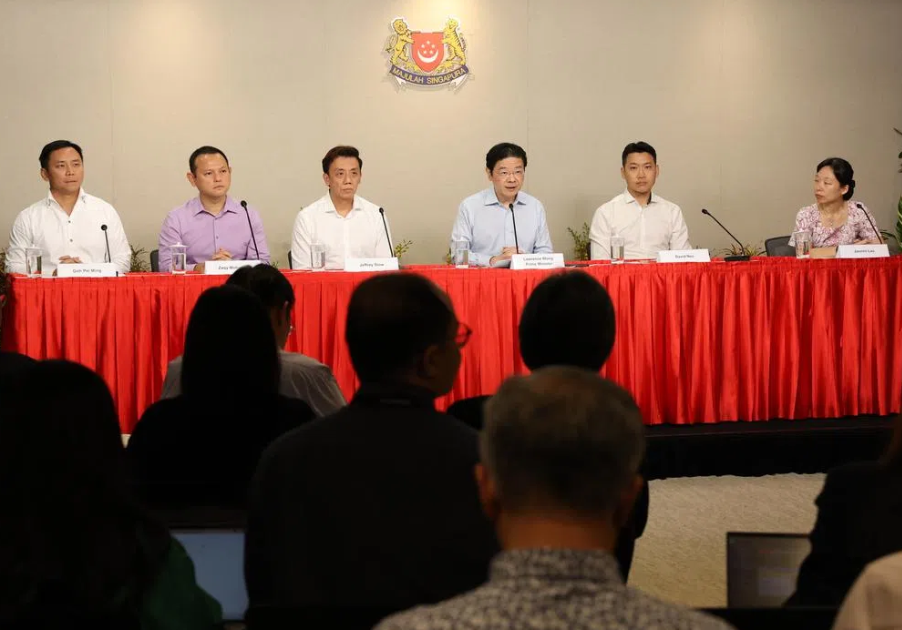
Prime Minister Lawrence Wong has announced a comprehensive Cabinet reshuffle aimed at distributing greater responsibility among newer members of Parliament whilst retaining the counsel of senior figures, responding to a series of unexpected political departures that have marked 2026. The announcement on July 22 underscores Singapore's deliberate approach to grooming a new generation of leaders capable of managing both immediate challenges and the country's longer-term trajectory. The changes reflect a strategic pivot toward embedding fresh talent within the ministerial ranks whilst preserving institutional continuity through the presence of seasoned veterans.
Two figures elected in the 2025 general election have been elevated to full ministerial status as part of the refresh. Jeffrey Siow and David Neo, both first-term parliamentarians who have served as acting ministers since May, will now assume formal portfolios in their respective domains. Siow will continue overseeing Transport, whilst Neo retains responsibility for Culture, Community and Youth matters. Their promotions represent a validation of performance over the preceding months and signal confidence in their readiness to manage substantive government functions independently. The move contrasts with traditional practices in many regional governments, where first-term backbenchers typically require longer apprenticeships before accessing ministerial appointment.
Other restructuring within the Cabinet indicates a deliberate dispersal of responsibilities across the younger cohort. Sim Ann, another first-term politician, has been appointed Second Minister for Foreign Affairs and Home Affairs, positioning her within two crucial portfolios that shape Singapore's regional standing and domestic security architecture. Jasmin Lau, similarly serving her first term, will assume the position of acting minister within the Manpower Ministry, replacing Tan See Leng, who transitions to the Trade and Industry portfolio with expanded authority over energy and industrial affairs. These appointments reflect Wong's stated conviction that the administration requires both seasoned guidance and vigorous new voices to navigate contemporary governance demands.
The reshuffle arrives in the wake of two significant political withdrawals that have necessitated accelerated succession planning. Most notably, Faishal Ibrahim, Minister-in-charge of Muslim Affairs and Senior Minister of State for Home Affairs, stepped down on July 20 following what he characterised as a lapse in judgment regarding personal conduct. Earlier in June, Koh Poh Koon, a senior minister of state, similarly departed political office citing family considerations. These departures, whilst described as unexpected by Wong, have prompted the Government to accelerate its pipeline development and ensure institutional functions remain undisrupted. The timing of the reshuffle demonstrates how personnel changes at senior levels precipitate broader Cabinet reorganisation to maintain coherent governance structures.
Two backbench Members of Parliament selected from former civil service backgrounds have been appointed as ministers of state, further diversifying the composition of ministerial ranks. Foo Cexiang and Shawn Loh, both first-term MPs, transition from backbench roles to junior ministerial appointments, demonstrating a pathway through which experienced administrators can re-enter political leadership. Their backgrounds in the bureaucracy presumably provide them with institutional knowledge and administrative familiarity that accelerates their effectiveness in elected office. This pattern reflects Singapore's systematic approach to talent circulation between the civil service and the political establishment.
Labour movements have also factored into the ministerial reconfiguration. Ng Chee Meng, previously serving as chief of the labour establishment, returns to Cabinet as Minister in the Prime Minister's Office, reintegrating a figure whose constituency work and union background provide counterweight to technocratic perspectives. Concurrently, K. Shanmugam has been elevated to Senior Minister status, positioning him alongside Lee Hsien Loong as among the Cabinet's most extensively experienced members. Wong articulated that Shanmugam and Lee increasingly function as mentors and strategic counsellors to junior ministers navigating expanded responsibilities, embodying a tiered system where seniority translates into guidance roles rather than operational displacement.
Wong's framing of the reshuffle emphasises continuity within change, a principle he described as intrinsically Singaporean. The Prime Minister noted that Cabinet composition undergoes annual review cycles, but that unexpected resignations necessitate flexible approaches to succession. He stressed that institutional strength depends not merely upon ministerial appointments but upon cultivating a robust cohort of capable backbenchers and mid-ranking office-holders who constitute the pipeline for future advancement. This emphasis upon developmental depth rather than superficial appointments reflects concern that rapid elevation without adequate preparation destabilises governance capacity, particularly in a system where specialist expertise matters substantially across distinct policy domains.
The implementation timeline for changes operates progressively, with most modifications taking effect from July 27 onwards, allowing for transitional arrangements and briefings to precede formal responsibility assumption. This staggered approach permits outgoing ministers to brief successors and ensures that critical policy continuity is maintained during the transfer period. Such procedural discipline, though administratively routine, underscores the Singapore system's emphasis upon orderly governance transitions that minimise disruption to policy implementation or civil service coordination. The phased approach reflects institutional maturity in managing succession across large administrative systems.
Wong addressed the question of his continued tenure as Finance Minister since 2021, characterising his search for a successor as an ongoing endeavour rather than an imminent transition. His observation that individuals develop capabilities at differential rates provided rationale for his measured approach to reassignment, suggesting that readiness for senior portfolios cannot be artificially accelerated without compromising governmental effectiveness. This patience with developmental timelines, contrasting sharply with some regional political systems' emphasis upon rapid rotation, reflects confidence in institutional stability and long-term planning horizons. The Finance portfolio's retention by the Prime Minister, though unusual in some governmental contexts, ensures that fiscal policy remains integrated with broader strategic direction.
The decision not to appoint a second Deputy Prime Minister alongside incumbent Gan Kim Yong generated specific explanation from Wong, who characterised the current arrangement as providing robust senior leadership without unnecessary duplication. He indicated that the structure remains subject to review as leadership renewal progresses, suggesting flexibility should institutional requirements shift. The retention of three Coordinating Minister positions, held by Shanmugam overseeing national security and by Chan Chun Sing and Ong Ye Kung directing other governmental sectors, provides horizontal integration across ministerial silos that compensates structurally for the absence of a second Deputy Prime Minister.
The reshuffle's significance for the Malaysian and broader Southeast Asian context reflects broader patterns concerning leadership succession in stable, institutionally mature systems. Singapore's explicit cultivation of younger talent whilst maintaining experienced supervision offers a model that contrasts with regions where succession remains personalised or unpredictable. The elevation of first-term parliamentarians to ministerial rank demonstrates confidence in institutional capacity to accommodate rapid progression, predicated upon rigorous selection and evaluation processes that identify capability early. For neighbouring economies facing similar demographic transitions and the imperative to inject fresh perspectives into established bureaucratic structures, Singapore's managed approach to generational turnover provides instructive example, particularly regarding the preservation of institutional knowledge during transitions.
The Cabinet changes ultimately represent Singapore's continuing commitment to what Wong characterised as continuous leadership renewal, a systematic process rather than episodic event. By balancing the retention of experienced counsel with the elevation of capable newcomers, the administration seeks to navigate immediate challenges whilst preserving the institutional and intellectual capital accumulated over decades of stable governance. The integration of civil service expertise, labour movement representation, and generational diversity within a compact ministerial structure reflects deliberate design aimed at ensuring that governance capacity expands alongside the complexity of challenges confronting the city-state. For regional observers, the reshuffle demonstrates how institutional discipline and long-term thinking in succession planning can sustain effective governance across leadership transitions.

