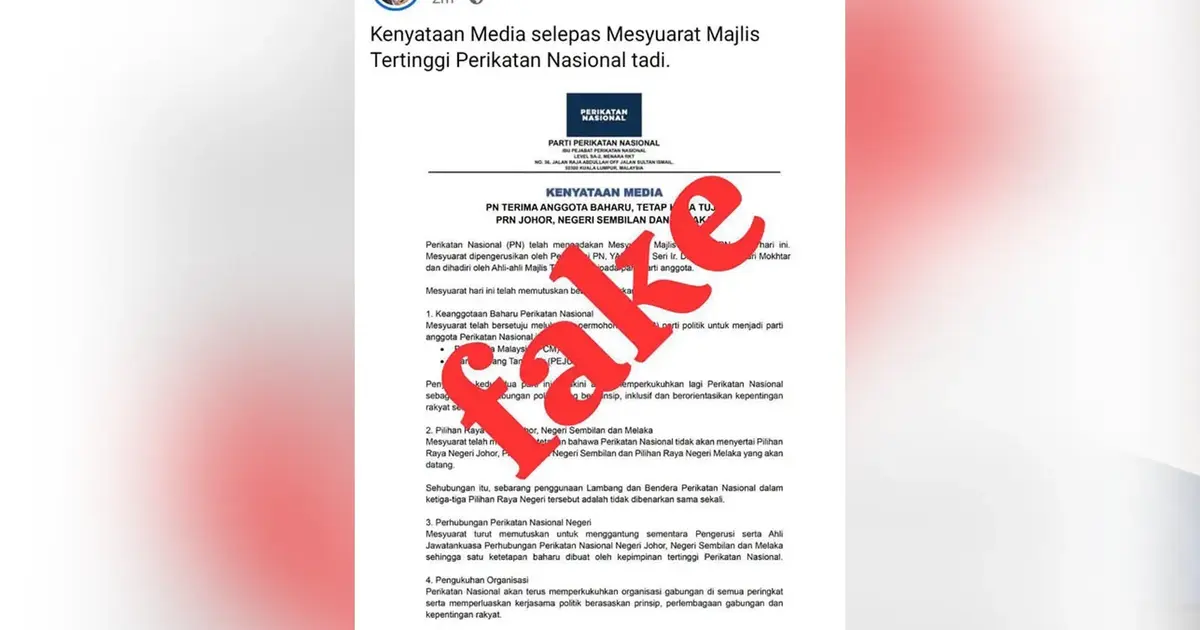
Perikatan Nasional has moved quickly to quash a piece of misinformation that surfaced claiming the opposition coalition intends to absent itself from three state assembly elections. The coalition released a formal statement categorising the circulating claim as patently false and inaccurate, underscoring concerns about the spread of unsubstantiated political narratives ahead of electoral contests.
The emergence of the fraudulent statement highlights the persistent vulnerability of Malaysia's political discourse to deliberate disinformation campaigns. In an environment where digital platforms enable rapid dissemination of unverified claims, competing political actors face mounting pressure to publicly rebut allegations that could undermine public confidence or confuse voters about their electoral intentions. For PN, a coalition seeking to consolidate its positioning as a credible opposition alternative to the ruling Pakatan Harapan government, such false attributions risk muddying its public messaging at a time when clarity matters significantly.
While PN provided no detailed explanation of which elections the fabricated statement referenced or through which channels the misinformation spread, the coalition's swift response indicates awareness of the potential reputational damage posed by permitting such claims to circulate unchallenged. The incident reflects broader regional patterns observed across Southeast Asia, where opposition movements and ruling coalitions alike have grappled with coordinated or spontaneous efforts to manipulate their public narratives through fraudulent statements attributed to party leadership.
For Malaysian voters, the episode underscores the importance of verifying information sourced from unofficial channels before according credibility to political claims. With multiple state assembly elections anticipated across the coming months as scheduled terms expire, the electorate should remain vigilant regarding the authenticity of statements purporting to represent party positions on electoral participation. Official channels operated directly by party machinery represent substantially more reliable sources of factual information than communications circulating through unverified social media accounts or third-party platforms.
The political context surrounding PN's coalition dynamics adds further dimension to the controversy. As the coalition navigates its internal relationships among component parties—including Bersatu, PAS, and various regional parties—maintaining cohesion and projecting unified electoral strategy becomes increasingly crucial. Any suggestion that the coalition might strategically absent itself from particular state races could potentially damage perceptions of PN's electoral viability or expose divisions within the alliance structure itself.
From a strategic perspective, major opposition coalitions in Malaysia have historically sought to contest elections across as broad a geographic and demographic spectrum as possible, viewing electoral participation as fundamental to establishing legitimacy as potential alternative governments. Voluntary withdrawal from state elections would contradict conventional opposition strategy and would likely invite criticism regarding PN's seriousness as a governing alternative. The false statement thus struck at potential vulnerabilities in the coalition's electoral narrative.
The incident also serves as a reminder that misinformation does not circulate in a vacuum divorced from partisan context. In politically competitive environments, actors operating across the ideological spectrum may opportunistically spread false claims about their opponents—sometimes deliberately, sometimes through uncritical repetition of unverified claims. The fact that such a statement gained sufficient traction to warrant an official coalition response suggests it achieved some measure of circulation, raising questions about the mechanisms through which political misinformation propagates within Malaysian society.
Government agencies and independent fact-checking bodies have in recent years established more structured approaches to identifying and countering false political claims, though gaps in these systems remain evident. The PN situation illustrates how political coalitions themselves often function as frontline responders to disinformation affecting their own interests, placing responsibility partly on party machinery to police their own reputational integrity. This decentralized approach to combating political falsehoods creates occasional inefficiencies in reaching all audience segments.
Looking toward the broader electoral calendar, the state elections referenced—however indirectly—in the false statement will provide important barometers of public sentiment and coalition strength. For PN, demonstrating robust electoral engagement across multiple state contests would reinforce its positioning as a serious contender for federal power. Conversely, any genuine strategic decisions regarding where to concentrate electoral resources would require transparent communication directly from party leadership through official channels to avoid precisely the kind of confusion this false statement generated.
Moving forward, voters and observers might reasonably expect both PN and other political coalitions to invest greater effort in establishing direct communication channels that bypass potential points of disinformation injection. Official mobile applications, verified social media accounts operated under stringent authentication protocols, and regular press briefings from identifiable party spokespersons offer more reliable pathways for conveying authentic political messaging. The circulation of false claims, despite their ultimate refutation, still consumes political oxygen that might otherwise support substantive policy discussion.
The broader lesson extends beyond this particular controversy. As Malaysian electoral competition intensifies and state elections continue across the coming years, the country's political ecosystem will likely face continued pressure from malicious or careless disinformation. Building greater institutional and civic capacity to distinguish authentic political communication from fabrication represents an ongoing challenge for all stakeholders committed to maintaining the integrity of Malaysia's democratic processes. PN's response, while necessary, represents merely one defensive move within this larger context of information warfare characterizing contemporary Asian politics.