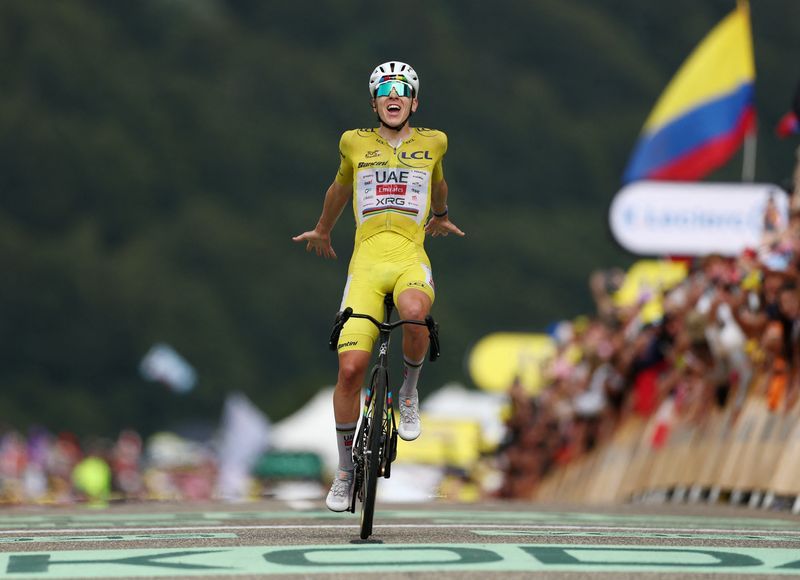
Tadej Pogacar strengthened his grip on the 2024 Tour de France title race on Saturday, capturing a commanding solo victory on the 14th stage that saw the Slovenian cyclist accelerate clear of his rivals during the most punishing section of the Col du Haag ascent. The four-time Tour champion now leads Jonas Vingegaard by four minutes and 30 seconds in the general classification, a substantial advantage with only days remaining before the race concludes in Paris. Pogacar's fourth stage triumph of the year demonstrates a level of dominance that has become characteristic of his performance this summer, suggesting his pursuit of an unprecedented third consecutive Tour title remains firmly on track.
The 155.3-kilometre mountain stage from Mulhouse to Le Markstein Fellering presented a formidable examination of the remaining contenders, incorporating three category one climbs and treacherous descent conditions where persistent rainfall created hazardous riding environments. Such demanding terrain ordinarily favours attacks from multiple challengers, yet Saturday's proceedings unfolded largely according to Pogacar's script. His UAE Team Emirates squad orchestrated proceedings from the early kilometres, controlling the rhythm and positioning their leader for the critical moment that would arrive on the penultimate major climb of the day.
Frenchman Valentin Paret-Peintre of Soudal Quick-Step initiated the stage's early offensive, cresting the Grand Ballon climb ahead of Ecuador's Richard Carapaz whilst the main peloton trailed by nearly two minutes. Four additional riders subsequently joined the breakaway formation, establishing a working alliance that might have threatened to dictate the stage's outcome had the coordination remained intact. However, the complexity of managing a breakaway group across successive climbs and the relentless pressure applied by Pogacar's teammates gradually eroded the escapees' advantage, a pattern familiar throughout professional cycling's grand tours.
As the race approached the decisive terrain, the composition of the leading group fractured repeatedly. Carapaz and EF Education–EasyPost teammate Ben Healy momentarily lost their way navigating onto the Ballon d'Alsace ascent, though they regrouped with the front runners before serious damage accrued. By the time riders embarked on the 11.2-kilometre climb to Col du Haag, the gap between the escapees and the chase group had narrowed dramatically to approximately 80 seconds, a deficit that proved insurmountable for those seeking to contest the stage.
Carapaz displayed attacking ambition during the opening kilometres of Col du Haag, with Norway's Tobias Johannessen responding to maintain contact. Yet such initiatives lacked the explosive power required to create meaningful separation. When the gradient intensified to 16 percent across the final two kilometres, Pogacar unleashed the acceleration that has defined his campaign. The 27-year-old rode away from his rivals with commanding efficiency, achieving a 30-second advantage at the summit before managing the descent and technical final five kilometres to consolidate the victory by 38 seconds over teammate Isaac del Toro.
Del Toro's second-place finish represented a significant moment for the Colombian cyclist, elevating him to fourth position in the overall standings and past Egan Ayuso. The result underscores the structural advantage Pogacar commands through possessing multiple capable teammates capable of executing strong performances. Del Toro's ability to finish second on a gruelling mountain stage, ahead of France's Paul Seixas, suggests the UAE Team Emirates squad retains sufficient depth to manage potential tactical complications should Vingegaard's team attempt coordinated pressure in the coming stages.
Vingegaard, the defending champion and Pogacar's primary rival, crossed the finish line fourth, a result that deepens the psychological momentum tilting toward the Slovenian leader. In grand tour cycling, substantial time advantages of this magnitude with a week of racing remaining traditionally favour the leader, particularly when that cyclist has demonstrated Pogacar's combination of consistency and devastating power on categorical climbs. The Dane's failure to contest Saturday's deciding moment suggests either diminished form or tactical miscalculation by Visma-Lease a Bike in the crucial moments of the final climb.
Pogacar acknowledged the stage's difficulty and the testing conditions created by unpredictable weather patterns, yet expressed satisfaction with his team's execution of their pre-planned strategy. "A really perfect day, we marked this stage since the beginning. I know it very well, it is beautiful and an incredible place for cycling," the race leader noted, reflecting both the sophistication of their preparation and his genuine enthusiasm for the dramatic mountain terrain. Such comments reveal the mental edge Pogacar maintains, combining detailed technical knowledge of the course with the confidence that comes from consistent performances against world-class opposition.
Looking ahead to Sunday's 15th stage from Champagnole to Plateau de Solaison, another mountainous examination awaits the remaining contenders. Pogacar acknowledged the impending difficulty whilst projecting confidence in his team's preparedness. The penultimate mountain stage will provide Vingegaard's Visma-Lease a Bike squad a final substantive opportunity to apply coordinated pressure and reduce the four-minute deficit, though the evidence from Saturday suggests Pogacar possesses reserves of strength and tactical intelligence that his rivals have struggled to overcome. For Southeast Asian cycling enthusiasts following the race, Pogacar's relentless progression toward a historic third consecutive title continues to captivate, even as the Slovenian's dominance limits the dramatic uncertainty that typically characterises the Tour's concluding phases.

