Poland is moving forward with legislative efforts to guarantee that terminally ill patients in hospices and palliative care facilities can be visited by their beloved pets, addressing a gap in current hospital protocols that leaves many dying patients emotionally isolated during their final days. The proposed law, introduced to parliament by a legislator from Prime Minister Donald Tusk's centrist party, aims to formalize what many progressive clinics already permit informally but without explicit legal protection or standardized protocols across the healthcare system.
Ewa Lutka-Krawczyk, a 70-year-old gallbladder cancer patient currently in the palliative ward of a Warsaw hospital, embodies the emotional stakes of this legislative push. When her diagnosis proved terminal, her deepest concern was not for herself but for Gaja, a shelter dog she had rescued and nurtured for three years. The separation has been devastating for both woman and animal; Gaja has barely eaten since her companion's hospitalization, pining for the person who represented her entire world. For Lutka-Krawczyk, the prospect of dying without her faithful companion nearby adds another layer of suffering to an already agonizing situation.
Dr Tomasz Dzierzanowski, director of the Palliative Medicine Clinic at the Medical University of Warsaw, has become the driving force behind this legislative initiative. His advocacy emerged not from abstract policy considerations but from witnessing profound human moments within his ward. A particularly transformative experience occurred when a terminally ill cancer patient named Waldemar expressed his deepest fear not about his own mortality but about the fate of his two cats. Dzierzanowski arranged for the animals to visit, and the moment of reunion—with tears of joy streaming down the patient's face and the visible emotional response from both pets and hospital staff—crystallized his conviction that this issue demanded urgent action.
Dzierzanowski articulates a broader societal diagnosis underlying his mission: Poland, like many developed nations, faces what he describes as "an epidemic of loneliness" that manifests most acutely in hospitals and care facilities. His clinical experience reveals patterns of profound isolation among terminally ill patients. Elderly patients frequently find themselves outliving their peers and support networks, facing death in institutional settings with minimal human connection. Meanwhile, younger patients admitted to palliative care wards often lack the deep friendships that characterized earlier generations, having instead cultivated primarily digital connections and virtual relationships that cannot translate to physical comfort during one's final chapter.
The legislative proposal, now under consideration in parliament's health committee, addresses what lawmaker Katarzyna Piekarska identifies as an unregulated reality already present throughout Polish hospitals. As Piekarska notes, animals are "already there anyway" in many facilities, operating in a legal gray area where they are tolerated rather than formalized. The legislation aims to transform this ad hoc practice into an explicit right, ensuring that all patients—regardless of which hospital or ward they occupy—can access this emotionally vital form of companionship during end-of-life care.
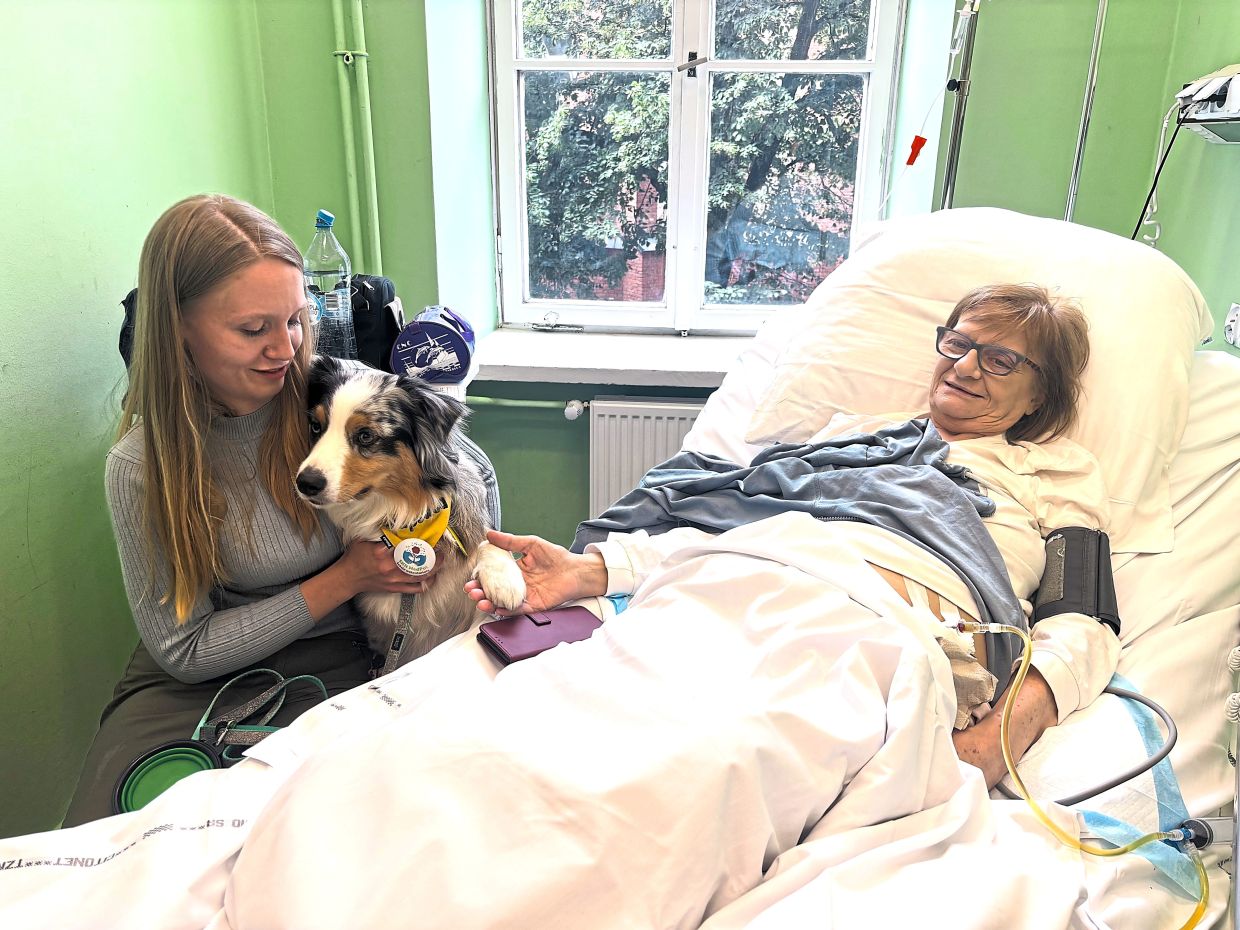
At the Medical University of Warsaw clinic, where Dzierzanowski maintains discretionary authority to permit visits, the benefits extend far beyond the individual patient-animal relationships. The clinic regularly welcomes therapy dogs in addition to patients' personal pets. Kluska, an Australian shepherd whose name means "dumpling" in Polish, has become a familiar presence in the wards, her visits providing tangible moments of joy and distraction for patients confronting mortality. Lutka-Krawczyk, when visited by the therapy dog, visibly brightened, holding the animal's paw and smiling—a stark contrast to the exhaustion and pain that typically dominated her expression.
The therapeutic impact extends across the entire hospital ecosystem, benefiting not only patients but the staff who bear the emotional weight of palliative care work. Nurses, cooks, and other personnel find respite and stress relief in these animal encounters. A cook was observed offering ham to Kluska, a small gesture that provided both the animal and the caregiver with a moment of normalcy and connection outside the usual protocols of terminal care. For staff members regularly exposed to suffering and death, these interactions offer psychological sustenance.
Medical student Malgorzata Brzozowska, who volunteers as a therapy dog handler, articulates a particularly nuanced observation about the animals' own emotional experience. When patients are reunited with their own pets rather than visiting therapy animals, Brzozowska notes, the animals themselves demonstrate measurable calm and reduced stress. This phenomenon suggests something profound: the animals understand, at some level, that their companion's disappearance from home is explained by this institutional setting, and their reunion alleviates the uncertainty and anxiety that separation creates. The benefits flow bidirectionally, with the emotional wellbeing of both human and animal mutually reinforcing.
For patients like Wojciech Zelik, a 58-year-old hospitalized with a tumor, the presence of therapy animals provides both immediate distraction and a connection to normalcy that institutional medical settings cannot replicate. Zelik, who summoned the energy to sit upright and admire Kluska's tricks, experienced a moment of engagement with life beyond his diagnosis and prognosis. The simple act of petting the dog's soft fur and watching her perform tricks restored, briefly, a sense of human pleasure and lightheartedness that terminal illness typically erases.
The proposed legislation arrives at a moment when understanding of palliative care has evolved significantly. Modern end-of-life medicine recognizes that dying encompasses not merely physical pain management but spiritual, emotional, and social dimensions of suffering. Loneliness itself functions as a form of pain, one that medications cannot address but that a beloved companion—animal or human—can substantially mitigate. By codifying pet visitation rights, Poland would acknowledge that terminal care extends beyond medical interventions to encompass the totality of human dignity and emotional needs.
Dzierzanowski's commitment reflects a philosophy that undergirds his clinic's approach to palliative care: no patient should die alone. While this ideal goal is often unattainable when family and friends prove unavailable or unwilling, the presence of a cherished pet offers a meaningful alternative to complete isolation. For patients like Lutka-Krawczyk, awaiting news that Gaja will soon be permitted to visit, this legislation represents far more than administrative procedure—it promises a profound source of comfort during the most vulnerable period of existence.
The broader implications for Southeast Asian healthcare systems warrant attention. As aging populations expand across the region and end-of-life care becomes an increasingly pressing policy concern, the Polish model—grounded in both empirical observation of patient benefits and formal legal recognition—offers a template for other nations considering how to humanize palliative care facilities. The legislation demonstrates that honoring patients' emotional bonds and social connections need not involve expensive medical interventions, yet can substantially enhance dignity and quality during final days.

