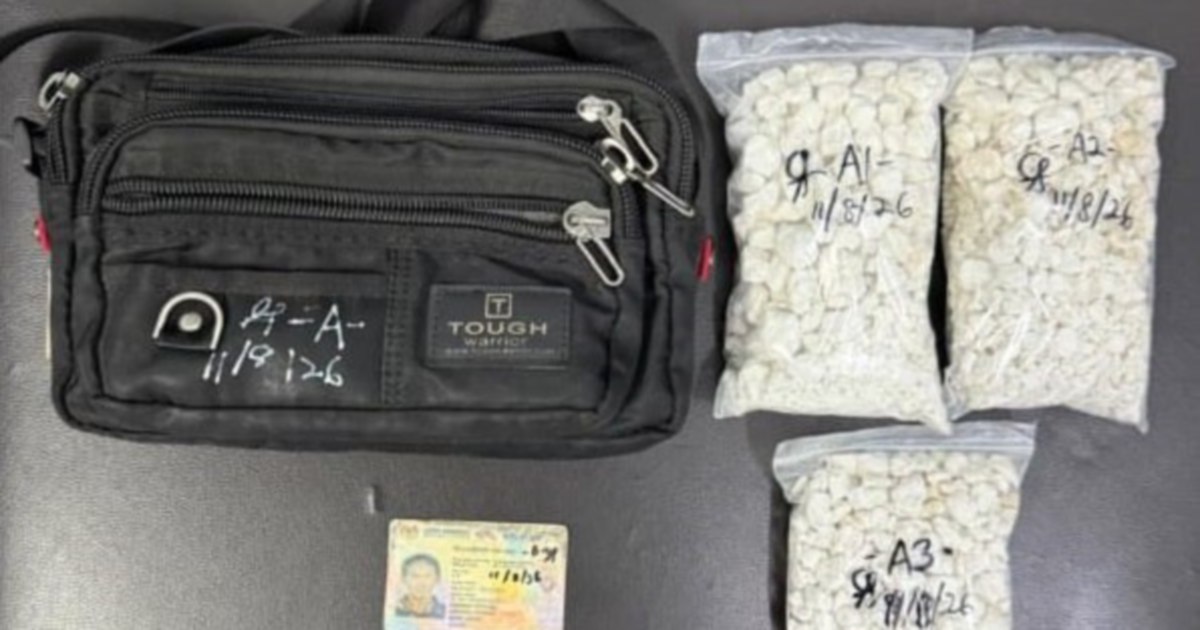
Police have struck a significant blow against the narcotics trade in the Kluang district, successfully executing a pre-dawn raid that yielded a substantial haul of illicit substances in the Simpang Renggam locality. The operation, conducted by narcotics enforcement personnel, resulted in the apprehension of a 42-year-old man and the confiscation of 1.055 kilogrammes of what authorities identified as heroin, with an estimated street value of RM10,128.
The timing of the raid, launched during the early morning hours, reflects operational tactics commonly employed by Malaysian police in targeting drug distribution networks. Such coordinated early-morning strikes aim to catch suspects off guard and minimise the opportunity for evidence destruction or suspect flight. The location of Simpang Renggam, situated within the Kluang administrative area in Johor, has long been recognised as a critical transit and distribution point given its proximity to major transportation corridors connecting Peninsular Malaysia's interior regions to urban centres.
The seizure volume represents a substantial quantity by local enforcement standards, particularly when considered in the context of street-level operations. The calculated value of RM10,128 reflects typical local market pricing for heroin, which fluctuates based on purity levels, distribution chain position, and regional demand dynamics. This valuation methodology helps police quantify the scope and significance of individual drug busts within their broader anti-narcotics strategy.
The arrest of the 42-year-old individual suggests police had developed actionable intelligence through either informant networks, surveillance operations, or intelligence fusion protocols. The suspect's age profile corresponds to a common demographic in mid-level drug distribution operations within Malaysia, where handlers occupying this position in the supply chain typically operate independently while maintaining connections to larger trafficking organisations.
The Simpang Renggam locality has historically presented particular challenges for law enforcement owing to its geographic characteristics and transportation infrastructure. The area serves as a convergence point for multiple road networks, creating both vulnerability and opportunity for clandestine operations. Police resource allocation in such locations reflects this vulnerability assessment, with enhanced presence during peak trafficking periods.
This seizure contributes to the broader regional context of heroin interdiction efforts across Southeast Asia. Malaysia remains a critical transit jurisdiction for narcotics trafficking throughout the region, with the country serving as both a destination market and a transshipment hub for drugs destined for Thailand, Singapore, and other neighbouring territories. The magnitude and frequency of seizures thus provide meaningful indicators of trafficking patterns and enforcement effectiveness.
The confiscated quantity, while significant at the street-distribution level, represents only a fractional element of the broader heroin market operating across the country. Enforcement agencies assess that substantial quantities continue circulating despite interdiction efforts, suggesting the need for enhanced coordination between federal and state-level narcotics units. Such intelligence sharing and collaborative operations have become increasingly essential as traffickers adapt distribution methodologies in response to enforcement pressures.
The investigation into the arrested individual will likely focus on identifying upstream suppliers and downstream distribution networks. Narcotics cases in Malaysia frequently evolve beyond initial arrests, with interrogation and forensic analysis generating intelligence that allows authorities to disrupt larger organisational structures. The suspect's cooperation, or intelligence derived from surveillance prior to arrest, may yield additional leads.
For Malaysian communities, particularly those in proximity to known drug hotspots like Simpang Renggam, such operations underscore the persistent nature of the narcotics challenge. The Johor police, under broader state and federal anti-drug directives, continue intensifying enforcement within high-risk localities. Residents in these areas often experience elevated police presence and checkpoint activity as authorities attempt to disrupt supply chains before drugs penetrate residential neighbourhoods.
The broader implications extend to public health planning, as sustained heroin availability feeds addiction epidemiology requiring coordinated response across law enforcement, public health, and social rehabilitation sectors. Malaysian policy continues attempting to balance punitive enforcement measures with treatment and harm-reduction approaches, though enforcement remains the dominant operational pillar.
Looking forward, this seizure exemplifies how intelligence-led policing continues yielding tangible results within Malaysia's complex narcotics landscape. The sustainability of such operations depends upon maintaining investigative momentum, protecting informant networks, and ensuring adequate resource allocation to high-vulnerability areas. The effectiveness of any individual seizure ultimately depends upon whether it disrupts supply continuity or merely represents replacement losses that trafficking organisations can readily absorb.

