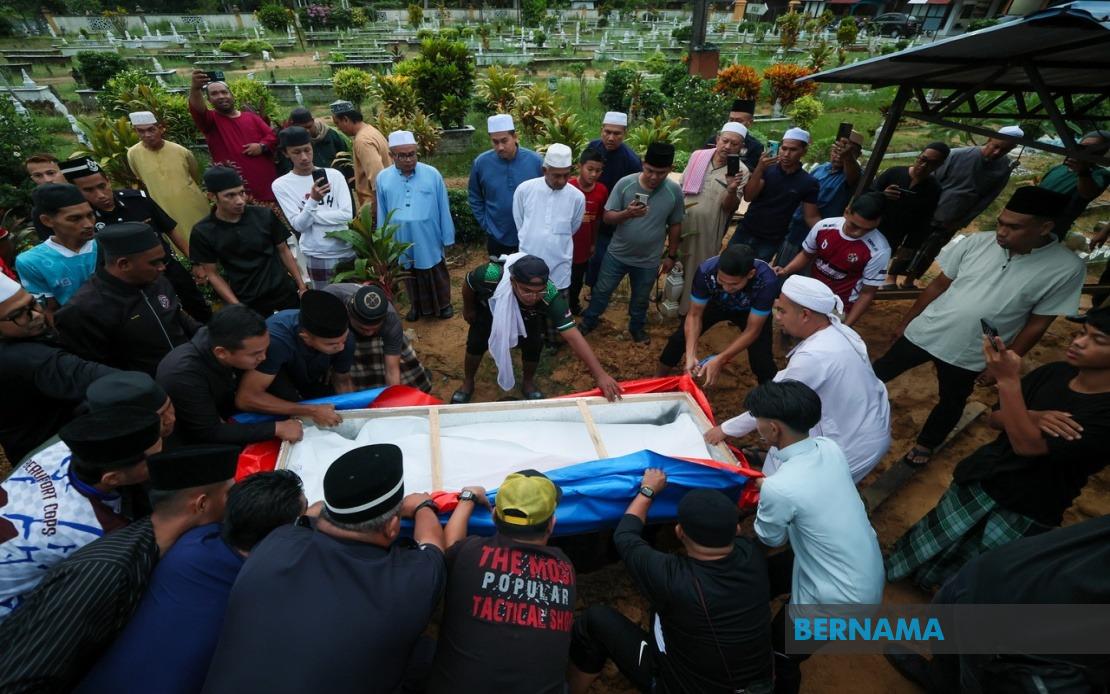
Corporal Mohamad Nur Hafiz Rahim, a 29-year-old police officer, was buried this morning at the Kampung Pangkal Kuang Muslim Cemetery in Ketereh, Kota Bharu, three days after an electrocution accident claimed his life at a police station in Beaufort, Sabah. The funeral service took place at his family home in Kampung Hutan Pasir before the interment, marking the conclusion of funeral rites for the slain officer who had been stationed hundreds of kilometres away from his home state of Kelantan.
The circumstances surrounding Mohamad Nur Hafiz's death paint a tragic picture of workplace safety gone wrong. He was among three Royal Malaysia Police personnel who were fatally electrocuted on August 7 at approximately 5.50 pm while handling a 29-foot-long metal pole designed to harvest coconuts outside the Weston Police Station near Sekolah Kebangsaan Weston. The pole, which was positioned near school grounds, came into contact with electrical lines, creating a fatal hazard for the three officers engaged in the task. Alongside Mohamad Nur Hafiz, Corporal Chiu Teck Siong, a 40-year-old from Sarawak, and Constable Muhammad Raimi Ismarubee, a 26-year-old from Terengganu, perished in the incident, marking one of the most devastating workplace tragedies within Malaysia's police force in recent memory.
Family members gathered at the cemetery to bid farewell to the fallen officer, with his eldest sister Nurlella Rahim, 34, speaking to reporters about the profound loss that has struck their close-knit household. Nurlella, who resides in Ipoh, Perak, expressed gratitude towards the Royal Malaysia Police for their coordinated efforts in transporting her brother's remains from Sabah to their home state. The body arrived at the family residence at 4.45 am, having travelled through the night in an operation that demonstrated institutional support during a period of acute grief for the Rahim family.
The family's recollections of Mohamad Nur Hafiz reveal an officer who, despite the geographical distance between his posting and his home, maintained close emotional bonds with his relatives through modern communication channels. Nurlella described how the five siblings formed a tight unit that transcended the physical distance imposed by postings across Malaysia. Daily video calls were the norm rather than the exception, with the family utilising WhatsApp to create a digital space where they could share their lives in real time. The deceased officer had participated enthusiastically in this routine of connection, even during brief respites in his working day, suggesting a deliberate commitment to family relationships despite the demands of his police duties.
The last moments of contact between Mohamad Nur Hafiz and his mother occurred on Thursday afternoon, just hours before his death. During this video call, his mother detected signs of fatigue in her son, noticing his reduced responsiveness during their conversation. Despite his evident tiredness, he managed to convey reassurance to his mother, telling her everything was fine and suggesting they continue their discussion later once he had completed his work duties. This conversation would ultimately be the final exchange between mother and son, making it a poignant memory for a family grappling with unexpected loss.
Nurlella's most recent video interaction with her brother took place on the Sunday preceding the tragedy, when Mohamad Nur Hafiz shared a moment of family leisure with his wife Fatimah Shahira and their child. The family was enjoying time together at a beach location, a scene that encapsulated ordinary happiness before catastrophe intervened. These details, recounted by grieving relatives to the media, serve as testament to a life that was being consciously lived with attention to family obligations and personal relationships, yet was cut short by an incident that raises serious questions about workplace safety protocols and electrical hazard management.
Prime Minister Datuk Seri Anwar Ibrahim has responded to the tragedy by ordering a comprehensive, transparent, and expedited investigation into the circumstances that led to the three officers' deaths. In a Facebook statement, Anwar emphasised the critical importance of determining the root causes of the electrocution incident to facilitate systemic improvements and prevent such tragedies from recurring. This intervention at the highest level of government signals the severity with which authorities are treating the incident and reflects broader concerns about occupational safety standards within government institutions and police operations nationwide.
The incident raises significant occupational health and safety questions that extend beyond the individual tragedy. The fact that three trained police officers died while performing what appears to be a routine maintenance or operational task suggests potential gaps in risk assessment, safety training, or equipment handling protocols. A 29-foot metal pole positioned near electrical infrastructure represents an obvious electrical hazard that should have been identified and mitigated through proper safety measures. The proximity of the work site to a school compound adds another dimension to the incident, highlighting how lapses in workplace safety can have consequences that extend to the surrounding community.
For Malaysian police personnel stationed in remote locations like Beaufort, this tragedy underscores the occupational risks that extend beyond the conventional duties associated with law enforcement work. Officers serving in smaller stations far from major urban centres often take on diverse responsibilities, including maintenance and operational tasks that may fall outside their primary training. The lack of specialised safety protocols or external expertise for such tasks may leave officers vulnerable to accidents that could be prevented through proper planning and resource allocation.
The aftermath of this incident will likely trigger broader institutional discussions about workplace safety reforms within the Royal Malaysia Police. Questions about electrical safety awareness, hazard identification training, and emergency response procedures for officers working at remote stations will undoubtedly form part of the official investigation. The visible family support for the police institution, as demonstrated by Nurlella's public gratitude, suggests that the tragedy has not eroded confidence in the organisation itself, though demands for systemic change are inevitable.
For Malaysian workers more broadly, the Beaufort police station incident serves as a sobering reminder of the constant occupational risks that persist even within disciplined, hierarchical organisations where safety protocols should theoretically be well-established. The three officers who died—representing different regions of Malaysia and varying levels of experience—embodied the diversity of Malaysia's police force and were individuals with families depending upon them. Their deaths, while tragic at the personal level, also carry implications for how Malaysia approaches workplace safety regulation and enforcement across both public and private sectors.

