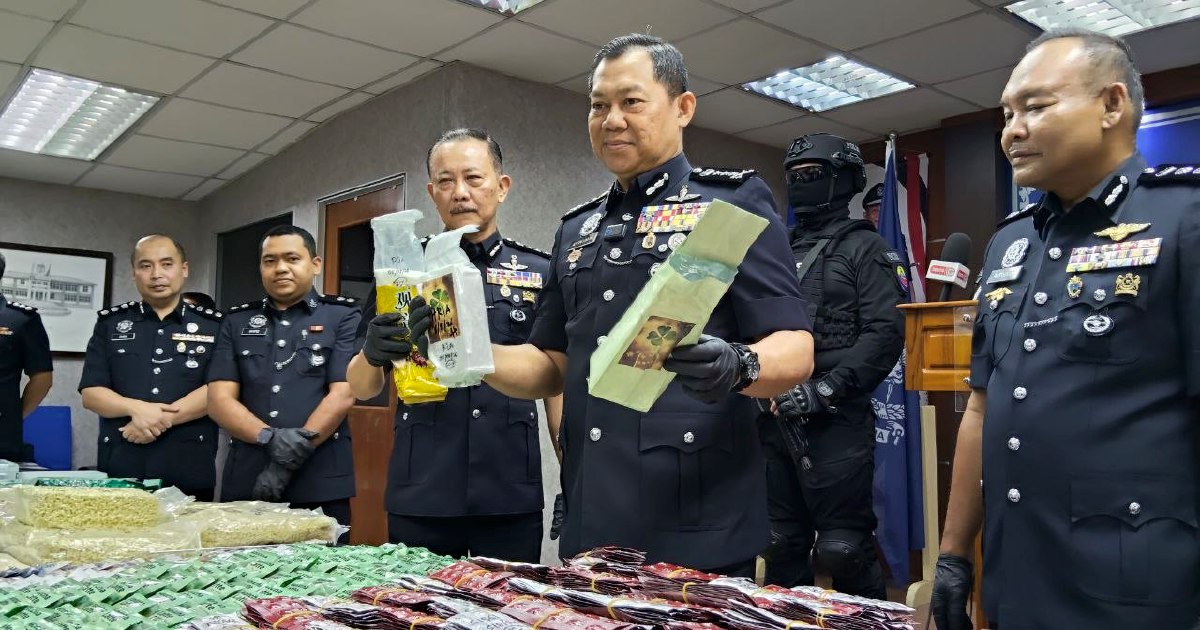
Johor police have successfully dismantled a significant drug trafficking operation in the southern state, culminating in the seizure of nearly 100 kilograms of assorted narcotics from a residential apartment in Masai. The raid on the premises at Persiaran Senibong recovered drugs valued at RM8.49 million, representing one of the more substantial hauls in the region in recent months. Two individuals were apprehended during the operation, though further details regarding their identities and roles within the suspected syndicate remain under investigation.
The apartment, located in what authorities describe as a residential neighbourhood, had been deliberately rented and utilised exclusively as a storage and distribution hub for the illegal narcotics operation. This particular modus operandi—establishing nondescript residential locations as drug depots rather than operating from more visible commercial or industrial spaces—reflects an evolving tactic employed by trafficking networks seeking to evade law enforcement detection. By situating their operations within ordinary apartment buildings, syndicates reduce visibility and exploit the relative anonymity afforded by residential complexes, particularly in densely populated urban areas like Johor Baru.
The 96.76 kilograms of drugs recovered encompassed multiple varieties of narcotics, though the specific breakdown of substances has not been publicly disclosed pending forensic analysis and ongoing investigations. The estimated street value of RM8.49 million underscores the substantial financial dimensions of the operation and the significant profits these illicit networks generate. For context, such seizures typically comprise a mix of substances—potentially including methamphetamine, heroin, or synthetic drugs—that cater to different market segments and consumer demographics across the region.
This bust arrives amid escalating concerns about drug trafficking through Johor, which remains a critical transit point due to its strategic geographic position bordering the southern tip of Peninsular Malaysia and proximity to international trafficking routes. The state has become increasingly important in the regional drug trade, with criminal organisations leveraging established smuggling corridors and ports to move contraband northward through Malaysia or southward toward regional markets. International enforcement agencies have consistently identified Johor as a significant hub in broader Southeast Asian narcotics networks.
The successful operation demonstrates the capability of Johor police in identifying and acting upon intelligence regarding major trafficking activities. Surveillance efforts and informant networks likely contributed to authorities pinpointing the apartment as a distribution centre. The coordination required to execute such raids—from initial intelligence gathering through warrant acquisition to the actual enforcement action—reflects considerable investigative groundwork preceding the dramatic seizure moment.
For Malaysian readers, the implications of this arrest extend beyond the immediate criminal matter. Narcotics trafficking significantly impacts public health, security, and social cohesion throughout the nation. Drug-related crime perpetuates cycles of addiction and criminal behaviour that strain healthcare systems, correctional facilities, and community resources. The RM8.49 million in seized products represents criminal profit that would have otherwise circulated through illicit networks, funding further trafficking activities and associated crimes.
The arrest of two individuals raises questions about the operational structure of this particular syndicate. Their roles—whether they functioned as storage managers, distribution coordinators, or active traffickers—will emerge through investigation and prosecution. Often, such busts reveal connections to larger networks, potentially leading authorities to pursue additional targets and dismantle further layers of the organisation. Intelligence derived from these two suspects could facilitate future operations against collaborating syndicates or higher-level coordinators.
Johor's location presents particular challenges for drug enforcement. The state's extensive coastline, maritime boundaries, and land borders create multiple potential entry and exit points for contraband. Criminal organisations exploit these geographic realities, employing sophisticated methods including maritime smuggling, vehicle concealment, and utilisation of sympathetic individuals to move drugs across checkpoints. Combating this requires sustained intelligence-led policing, inter-agency coordination, and regional cooperation with neighbouring authorities.
The apartment seizure illustrates another concerning trend: the domestication of drug distribution infrastructure within Malaysia itself. Rather than immediately transiting contraband across borders, syndicates establish local storage and distribution systems to serve domestic markets. This suggests expanding consumer demand within Malaysia and the region, with trafficking organisations responding by establishing permanent operational bases rather than conducting purely transactional movements of goods.
Looking forward, this operation may catalyse broader investigative efforts targeting the syndicate's supply chain, retail networks, and financial apparatus. Authorities typically pursue multiple investigative threads simultaneously—tracing the origin of the seized narcotics, identifying downstream distribution points, and mapping financial transactions associated with the operation. Such comprehensive approaches disrupt not merely a single transaction but entire networked systems of criminality.
The case underscores the persistent challenge posed by narcotics trafficking to Malaysian law enforcement and regional security. While individual seizures represent tactical successes, the underlying supply and demand dynamics sustaining these networks remain formidable. Effective responses require not solely enforcement action but also investment in drug prevention education, addiction treatment capacity, and community-based interventions that address root drivers of drug use and trafficking involvement.

