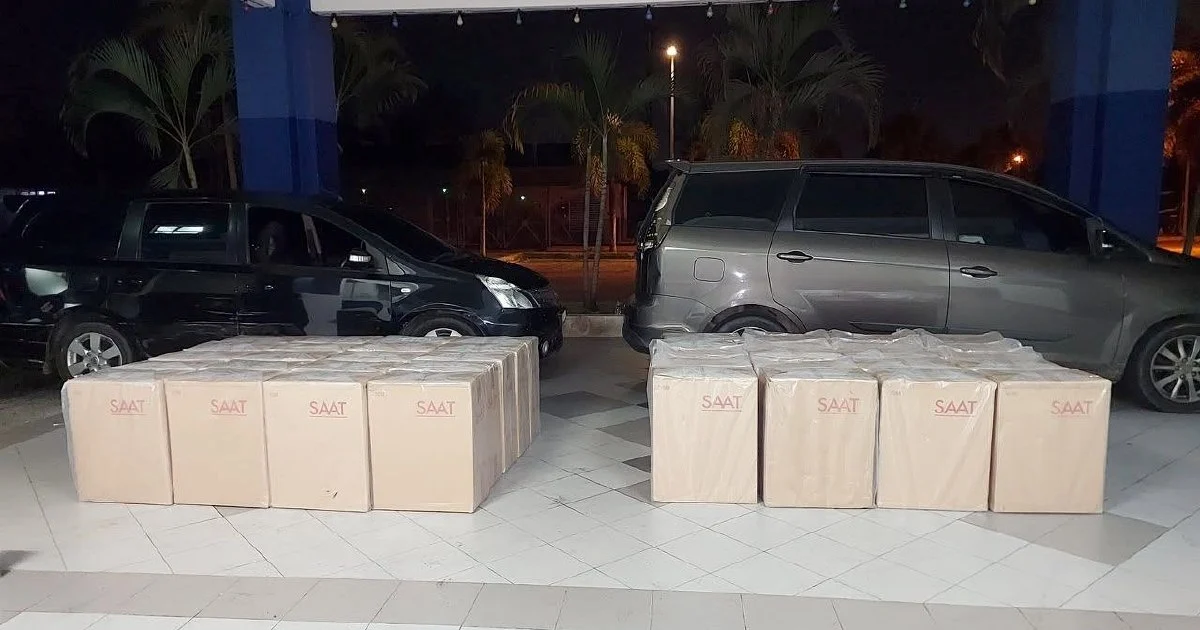
Police in Kota Baru successfully apprehended a 29-year-old man transporting a substantial cache of contraband cigarettes following an overnight pursuit at Kampung Pulau Panjang. The operation yielded approximately 400,000 cigarette sticks with an estimated street value of RM813,000, marking a significant seizure in the ongoing battle against cigarette smuggling in the northern region.
The arrest underscores the persistent challenge of illicit tobacco trafficking across Malaysia's border regions, particularly in Kelantan where proximity to Thailand facilitates cross-border contraband operations. The sheer quantity of cigarettes recovered suggests an organised smuggling network rather than petty trading, indicating that law enforcement agencies remain focused on dismantling larger distribution chains involved in moving banned or untaxed products.
Cigarette smuggling remains one of Southeast Asia's most lucrative illicit trades, depriving governments of substantial tax revenue while undercutting legitimate retailers. For Malaysia specifically, the trade represents both a revenue loss and a public health concern, as smuggled cigarettes often bypass quality controls and regulatory oversight. The RM813,000 valuation in this case hints at the significant profit margins driving such operations, with criminal networks exploiting price differentials between jurisdictions and tax arbitrage.
The chase element of this operation reveals how enforcement agencies are adopting more dynamic, proactive tactics beyond static checkpoint operations. Rather than waiting at fixed points, mobile units pursue suspect vehicles, demonstrating an escalation in operational intensity. This tactical shift reflects growing pressure from authorities to disrupt supply chains at the transportation stage, preventing contraband from reaching distribution networks in towns and cities.
Kelantan's geography makes it particularly vulnerable to smuggling activities. The state's extensive coastline and land borders with Thailand create multiple entry points for contraband. Local enforcement agencies have intensified operations in recent years, conducting raids and vehicle checks, yet the volume of seizures suggests that only a fraction of the total contraband flow is being intercepted. Industry observers estimate that smuggled cigarettes constitute a significant portion of the total cigarette market in some border states.
The detainee's arrest will likely lead to further investigations into his supply sources and distribution network. Police typically focus on unravelling the entire chain, from initial smuggling operations through transportation to retail outlets. Such intelligence can prove valuable in identifying warehouses, drop-off points, and retail collaborators. The suspect's cooperation or intelligence gathered during interrogation may enable authorities to execute simultaneous raids against connected networks.
This seizure carries implications for Malaysia's tax revenue and broader fiscal policy. Cigarette excise taxes form a meaningful component of government revenue, and smuggling directly erodes this income stream. Additionally, tax evasion through smuggling distorts market competition, allowing illegal sellers to undercut legitimate tobacco retailers who comply with taxation requirements. The resulting market pressure forces legitimate businesses to either reduce margins or risk bankruptcy.
Public health dimensions also merit consideration. Smuggled cigarettes often lack proper regulation, potentially containing higher tar and nicotine concentrations or substandard components. Without tracking mechanisms, health authorities cannot monitor consumption patterns effectively. The proliferation of cheap, untaxed cigarettes may also encourage increased consumption, particularly among price-sensitive demographics including youth, complicating national smoking reduction objectives.
Regional cooperation remains essential in combating this trade. Thailand and Malaysia share responsibility for controlling their shared border, and intelligence sharing between customs and law enforcement agencies helps identify trafficking patterns and key actors. ASEAN member states have periodically discussed coordinated approaches to cigarette smuggling, recognising that unilateral efforts achieve limited success when smugglers operate across multiple jurisdictions.
The broader context reveals how transnational organised crime exploits regulatory and tax differences to generate illicit profits. Unlike narcotics trafficking, cigarette smuggling involves lower enforcement priorities in some jurisdictions, making it an attractive alternative for criminal entrepreneurs. The relatively light penalties compared to drug offences provide additional incentive, though Malaysia has progressively increased sentences for serious smuggling cases.
For Malaysian consumers and policymakers, this arrest signals continued vigilance against smuggling operations. However, the RM813,000 seizure likely represents merely a snapshot of weekly trafficking volumes. Enforcement agencies must balance detection efforts with broader strategies addressing demand-side factors, including public awareness campaigns about the dangers of unregulated cigarette products and the economic implications of smuggling.
Looking forward, authorities will likely explore whether this particular case connects to larger regional smuggling networks or represents a smaller-scale operation. The investigation's trajectory may reveal important information about financing mechanisms, transportation routes, and corruption facilitating these operations. Each major seizure provides data points helping authorities refine intelligence analysis and predict future trafficking movements along established corridors.

