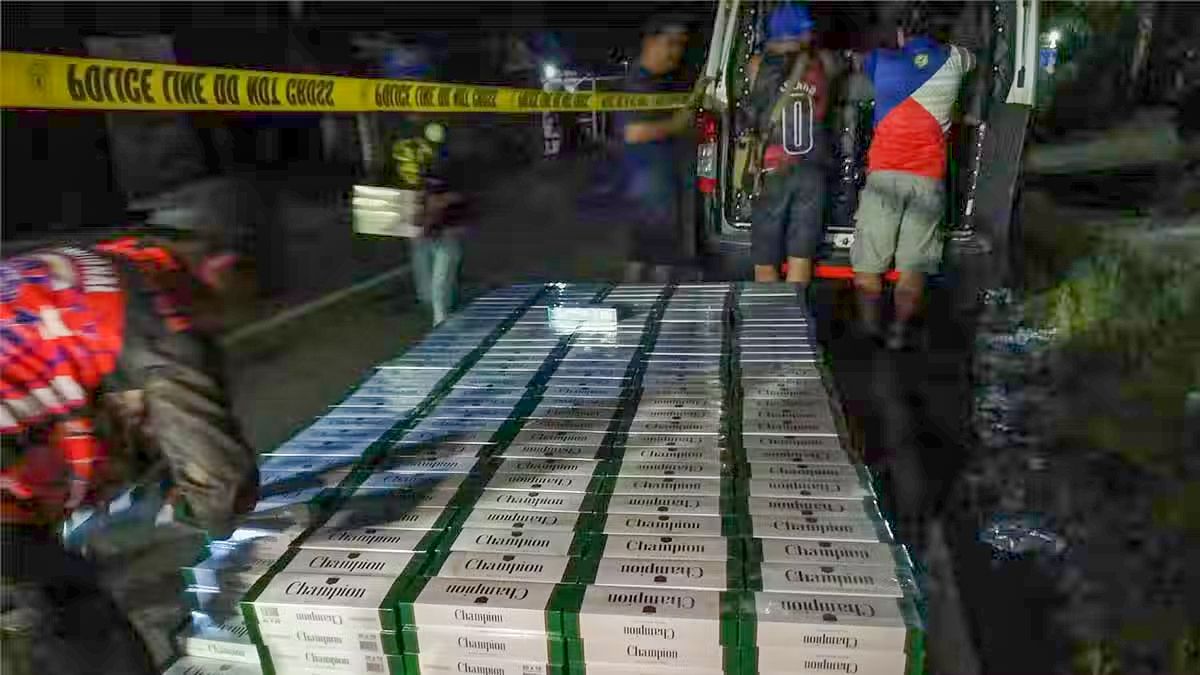
A police officer and businessman have been taken into custody following the discovery of nearly P1.9 million in contraband cigarettes at a checkpoint in Zamboanga del Norte. The operation unfolded late Friday evening when law enforcement personnel stopped a white Nissan van attempting to evade inspection in Barangay Gatas, Kalawit, revealing one of the Philippines' persistent struggles with cigarette smuggling networks that span regional supply chains.
The joint enforcement operation was conducted by the Zamboanga del Norte 2nd Provincial Mobile Force Company (ZNPMFC) along with supporting law enforcement units. At 10.05pm on July 31, officers flagged the vehicle for routine inspection at a checkpoint along the route. Rather than complying with the stop, the driver pressed the accelerator and attempted to bypass the checkpoint, immediately triggering pursuit protocols that prompted authorities to chase down the fleeing van.
Officers managed to intercept the vehicle a short distance from the initial checkpoint location, initiating a search that would expose the full extent of the smuggling operation. The discovery inside the van proved substantial: inspectors found 1,630 reams of cigarettes carefully concealed throughout the vehicle. The Bureau of Customs assigned a market value of P1,867,980 to the contraband based on its price index, establishing the economic scale of what officials had prevented from entering the illegal distribution network.
Lt. Col. Edwin Verzon, commanding the ZNPMFC's 2nd Provincial Mobile Force Company, disclosed details of the operation and the suspects involved. The first individual detained is a 34-year-old police officer assigned to Police Station 10 under the Zamboanga City Police Office and a resident of Barangay Talon-Talon in Zamboanga City. His involvement in the smuggling operation raises serious questions about internal discipline within the Philippine National Police and the vulnerability of law enforcement to organised smuggling networks. The second suspect is a 36-year-old businessman from Barangay Tumaga, Zamboanga City, presumably acting as a logistics or distribution coordinator in the operation.
The arrest underscores the entrenched problem of cigarette smuggling in the Mindanao region, where porous borders and established criminal networks facilitate the movement of contraband from foreign sources into domestic markets. The Zamboanga area, positioned strategically between the Philippines and key shipping routes, has long served as a gateway for smuggled goods. The evasion attempt itself demonstrates how participants in these networks operate with apparent coordination and contingency plans, suggesting a broader criminal infrastructure rather than isolated opportunistic activity.
Cigarette smuggling represents a significant revenue loss for the Philippine government, undermining excise tax collections and creating unfair competition for legitimate tobacco distributors. When approximately two million reams of cigarettes enter the black market annually across the country, the cumulative fiscal impact becomes substantial. The involvement of a uniformed officer in this particular case illustrates how smuggling rings recruit insiders who can provide operational intelligence, create safe passage through checkpoints, or facilitate distribution through law enforcement channels.
The interdiction operation demonstrates renewed commitment from provincial authorities to combat organised smuggling, yet the persistence and sophistication of these networks suggest that supply-side interventions alone remain insufficient. The quick response and pursuit capability displayed by ZNPMFC personnel reflect training and resource deployment focused on combating this specific crime category. However, the ability of a police officer to become involved in such operations points to broader governance challenges requiring comprehensive anti-corruption measures and stricter vetting protocols within law enforcement agencies.
The case carries implications extending beyond local enforcement. Organised cigarette smuggling typically operates through transnational supply chains, with manufacturing occurring abroad and distribution networks spanning multiple provinces and regions. Understanding how individual smuggling operations connect to larger criminal enterprises remains critical for developing strategies that disrupt these networks at critical nodes. The presence of commercial actors alongside law enforcement participants suggests diverse operational models within smuggling syndicates.
For Malaysian readers and Southeast Asian observers, this arrest highlights how cigarette smuggling remains a persistent transnational challenge across the region. Similar operations occur in Malaysian ports and overland routes, with contraband typically originating from North Africa, Eastern Europe, or illicit manufacturing facilities. The involvement of corrupted officials in both countries reflects how organised crime exploits institutional vulnerabilities, making regional cooperation and information-sharing essential for effective interdiction.

