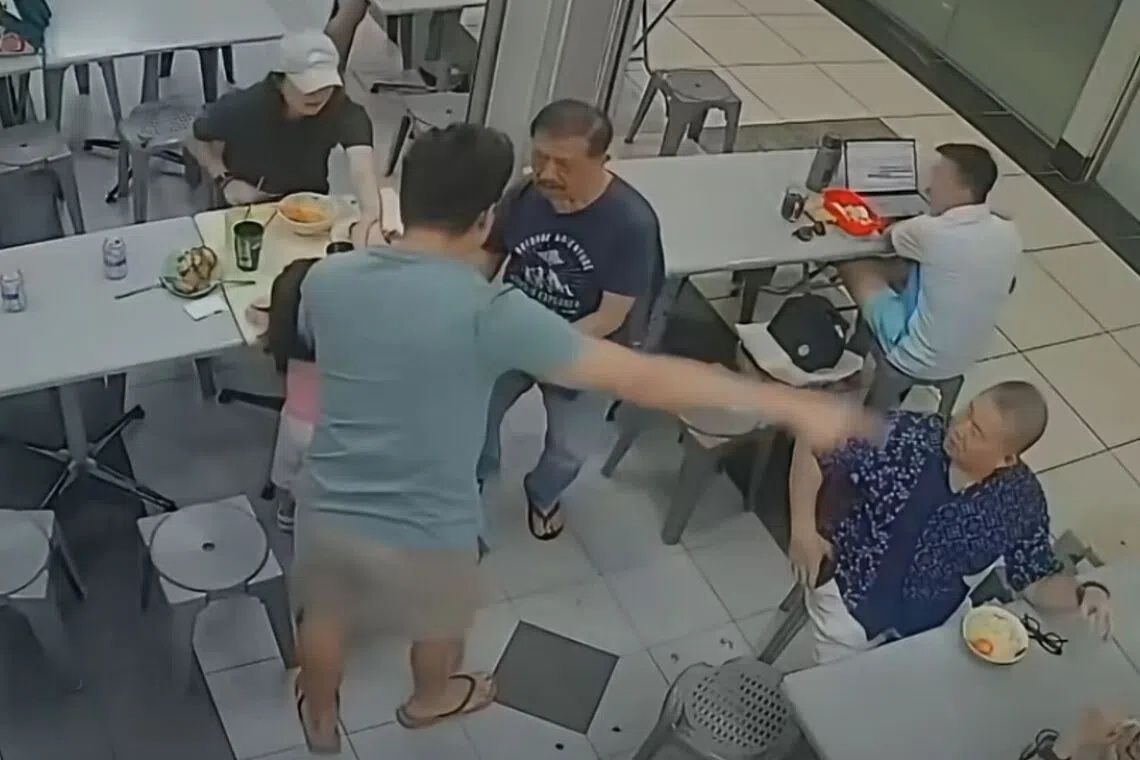
Singapore police have launched an investigation into a physical altercation at a coffee shop in the East Coast district involving an elderly man who was allegedly shoved to the ground after patting a young girl on the head. The incident has drawn attention to questions of personal boundaries and proportionate responses to perceived transgressions in public spaces, particularly involving elderly residents and children.
The police confirmed on Sunday, August 16, that a formal report had been lodged and investigations remain active. The case emerged into public view through a Facebook post by a user identifying himself as the elderly man's son, who shared security camera footage of the encounter and appealed for information about the identity of the man who allegedly pushed his father.
According to the son's account, his father is in his 70s and experiences significant mobility challenges, requiring assistance while walking. Despite these physical limitations, the elderly man remains active in his family's coffee shop operations, helping out at their food stall. The incident occurred while he was moving through the busy coffee shop environment, navigating between tables as he conducted his daily activities.
Footage from security cameras reveals the sequence of events leading to the physical confrontation. The elderly man can be observed making his way through the establishment, steadying himself by holding onto tables on either side as he progresses. His careful, deliberate movements underscore the walking difficulties mentioned in the post. As he passes a table where a girl is seated, he reaches out and pats the child on the head—a gesture that, while common in many Asian cultures as an affectionate or blessing-like action towards children, evidently triggered concern among those at the table.
A woman sitting with the girl immediately responded by attempting to deflect his hand, signalling her displeasure at the contact. Her intervention prompted a swift escalation. A man who had been at the table, and had temporarily left it, quickly returned upon noticing the interaction. He verbally confronted the elderly man before physically pushing him to the ground, an action that caused the elderly man to fall in the public area of the coffee shop.
Despite the initial physicality of the encounter, a reconciliation of sorts followed. The man who had pushed the elderly customer subsequently apologised for his actions and even offered the elderly man a drink. However, this post-incident civility did not negate the physical consequences. The son reported that his father suffered severe back pain in the aftermath, a particularly concerning outcome given his age and pre-existing mobility issues.
The son's Facebook appeal on August 15 at 7:14 pm sought to identify the man involved and appealed to the online community for assistance. In a follow-up post the next morning at 9:55 am, the son expressed gratitude for the outpouring of concern and information from netizens, though he noted that he still lacked definitive identification of the individual responsible.
The incident raises important questions about how community members should respond to actions they perceive as inappropriate, particularly when involving children. While protection of minors is paramount in any society, the incident highlights the tension between vigilance and proportionate response, especially when the person in question is an elderly individual with physical limitations. The fact that the man did not inflict intentional harm—the interaction appeared to be a casual, albeit uninvited, gesture—contrasts sharply with the forceful physical response.
Cultural context matters significantly here. In many Southeast Asian societies, including Malaysia, patting a child on the head as a gesture of affection, blessing, or acknowledgement is a fairly common intergenerational interaction, though norms around such casual physical contact have been evolving. The woman's immediate attempt to stop the contact suggests modern sensibilities about bodily autonomy and unwanted touching, even benign-seeming gestures.
For Malaysian readers and Southeast Asian observers, this incident reflects broader regional discussions about changing social norms, the protection of children's personal space, and appropriate community responses to perceived boundary violations. The case also underscores the sometimes-contentious relationship between elderly residents and younger generations in urban settings, where different generational expectations about public behaviour and personal interaction can collide.
The police investigation will likely examine whether the man's response constituted an appropriate and lawful defence of the child, or whether his physical retaliation exceeded reasonable bounds. Singapore's legal framework will determine how such cases are typically classified and what remedies or consequences might apply to both parties involved.
As the investigation proceeds, the incident serves as a reminder of the importance of clear communication and measured responses in public spaces where multiple generations and cultural perspectives coexist. For the elderly man and his family, the priority remains recovery from the physical injury sustained, while the broader community grapples with questions about boundaries, respect, and proportionality in everyday interactions.

