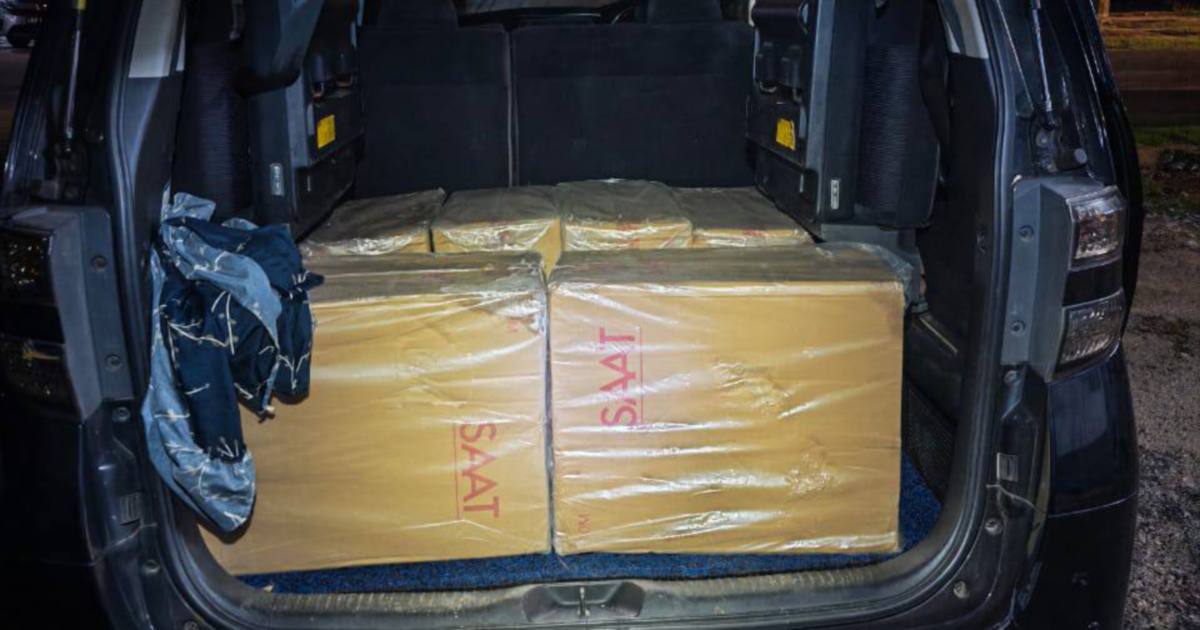
The General Operations Force (GOF) executed a significant anti-smuggling operation in Kota Baru early this morning, intercepting a Toyota Vellfire and recovering approximately 60,000 cigarettes suspected of evading customs duties. The seized merchandise, estimated to be worth RM112,200, represents a substantial blow against the illicit tobacco trade that continues to plague Malaysia. A 37-year-old male driver was detained at the scene near Pasir Tumboh Bridge following the interception, with preliminary investigations underway to determine the full scope of the smuggling operation and identify any potential links to wider distribution networks.
The recovery highlights the persistent challenge faced by revenue authorities across Malaysia in combating the underground cigarette market, which has become increasingly sophisticated in recent years. The illicit tobacco trade operates through well-organised supply chains that circumvent legitimate retail channels, depriving the government of substantial tax revenue while fuelling underground commerce. Kelantan, with its strategic location near state borders and numerous entry points, has historically served as a transit point for contraband goods moving between regions. The morning raid demonstrates ongoing operational focus on monitoring major transport arteries where smuggled products are commonly moved.
Duty-unpaid cigarettes remain among the most frequently seized contraband items across Southeast Asia, with enforcement agencies identifying them as a key revenue leakage point. The economics of illicit tobacco trafficking are compelling for criminal syndicates: the difference between domestic and international retail prices creates substantial profit margins, while the relatively low detection risk compared to other narcotics makes cigarette smuggling an attractive venture. Malaysian authorities have increasingly recognised that disrupting these supply chains requires coordinated efforts across multiple agencies and at various points in the distribution network, from border interception to local retail surveillance.
The Vellfire, a popular multi-purpose vehicle frequently used for commercial transport, has featured prominently in recent contraband seizures across Malaysia. The vehicle's spacious cargo capacity and relatively inconspicuous appearance when operated as a commercial vehicle make it suitable for concealing significant quantities of illicit goods. Intelligence suggests that smugglers deliberately select common vehicle models to avoid drawing attention during transit, particularly during early morning hours when traffic volumes are lower and checkpoints may be less active. The GOF's interception near Pasir Tumboh Bridge suggests targeted intelligence gathering or routine enforcement procedures had identified this specific vehicle as a transport risk.
Revenue officials estimate that illicit tobacco consumption in Malaysia accounts for a considerable portion of the total market, with contraband cigarettes priced substantially below legitimate products, creating unfair competition for licensed retailers and manufacturers. The tax differential between duty-paid and duty-unpaid cigarettes can exceed fifty percent, representing lost government revenue that might otherwise fund public services. This underground market ultimately creates an uneven commercial landscape where legitimate businesses operating within regulatory frameworks struggle to compete against illicit operators who bear no compliance costs.
The apprehension of the driver initiates a criminal investigation that will likely explore his role within any larger smuggling network, potential connections to organised crime groups, and the intended destination for the seized merchandise. Preliminary interviews with the detainee will attempt to establish the supply source, whether the cigarettes originated from neighbouring states or crossed Malaysian borders, and the intended distribution points. Such investigations frequently reveal interconnected operations involving multiple parties across different geographic areas, suggesting that a single vehicle interception may represent merely one component of a broader trafficking enterprise.
Kelantan's position within Malaysia's northern corridor presents unique enforcement challenges, as proximity to state boundaries facilitates cross-jurisdictional movement of contraband and complicates coordinated law enforcement. The state has witnessed increased smuggling activity partly due to its geographic configuration and established trafficking routes that have operated for decades. Enhanced inter-agency cooperation between GOF, Malaysian Customs, state police forces, and other relevant authorities remains essential for addressing systematically what individual seizures can only interrupt temporarily.
The RM112,200 valuation reflects wholesale pricing for the contraband cigarettes, though the ultimate retail value of these products would substantially exceed this amount had they successfully entered the illegal distribution market. This represents not only immediate fiscal impact but also broader economic implications for legitimate tobacco businesses and government revenue streams. Repeated seizures of this magnitude throughout Malaysia suggest that enforcement operations, while important symbolically and operationally, address only a fraction of the overall illicit trade volume that successfully penetrates markets.
Authorities indicated that investigations remain ongoing and further developments may emerge as questioning of the detained driver progresses. The case represents the continuing commitment by revenue enforcement agencies to intercept smuggled merchandise at operational nodes before distribution networks can disperse contraband to downstream retailers and consumers. Success in disrupting supply chains depends partly on public cooperation in reporting suspicious commercial activity, with anonymous hotlines established to facilitate information sharing without requiring formal identification.

