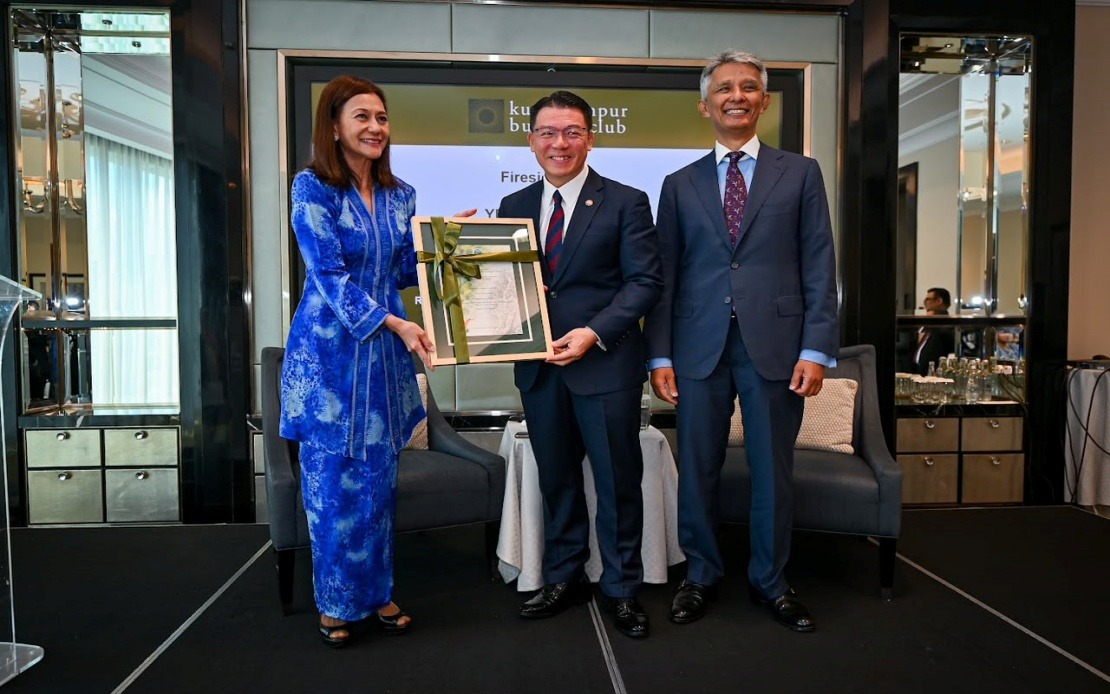
Malaysia's ability to sustain its economic momentum depends fundamentally on unwavering commitment to policy continuity, according to Housing and Local Government Minister Nga Kor Ming, who outlined the government's reform trajectory during a high-level business forum in the capital. Speaking at the Kuala Lumpur Business Club, Nga argued that the consistency demonstrated across governance, institutional development and economic management has become a cornerstone of the nation's appeal to both domestic and international investors seeking stability in an increasingly uncertain global environment.
The minister's remarks came during a fireside chat centred on urban economic development under the MADANI framework, bringing together senior business figures and policy stakeholders to examine how Malaysia's structural reforms are reshaping city economies and creating new growth pathways. This gathering reflected broader concerns within the investment community about whether Malaysia can maintain its trajectory of institutional strengthening and economic diversification amid shifting global supply chains and geopolitical pressures that continue to reshape Asian markets.
Nga underscored that a second term of governance under the same administration would furnish the platform necessary to deepen ongoing structural reforms while simultaneously building institutional capacity that has been eroded over previous decades. The timeframe required to implement transformational economic shifts—moving from commodity dependence towards high-value manufacturing, services and technology sectors—necessitates a stable political environment where medium and long-term planning can proceed without disruption. He contended that policy direction maintained across electoral cycles signals to capital markets that Malaysia's development agenda transcends short-term political calculations.
The MADANI government under Prime Minister Datuk Seri Anwar Ibrahim has recorded concrete achievements in several domains that have collectively strengthened Malaysia's economic position. The administration has engineered measurable improvements in governance indicators, most notably climbing the Corruption Perceptions Index, a metric closely watched by multinational corporations assessing operational risks and governance quality in their investment locations. Simultaneously, international credit rating agencies have assigned stronger ratings to Malaysia's sovereign debt, reflecting improved fiscal credibility and disciplined budget management that has reduced investor anxieties about currency volatility and debt sustainability.
Malaysia's standing as an investment destination has markedly improved, Nga noted, supported by transparent policy frameworks, institutional reinforcement and the political stability that investors increasingly value as geopolitical competition intensifies across Southeast Asia. The country has successfully attracted capital by positioning itself as a stable alternative to more volatile regional peers, a competitive advantage that depends entirely on consistent implementation of announced reforms and predictable policy direction. Any reversal or dilution of reform momentum would immediately undermine this advantage and risk capital reallocation to competing economies.
On the diplomatic front, the government has orchestrated strategic partnerships intended to broaden Malaysia's economic footprint and create mutual benefit arrangements with key global players. The RM52.73 billion strategic partnership framework established with Turkmenistan represents substantial engagement in energy security and infrastructure development, addressing Malaysia's long-term resource needs whilst creating commercial opportunities for local enterprises. Complementing this, energy collaboration initiatives with Russia represent another dimension of Malaysia's strategy to diversify partnership relationships and reduce dependency on any single geopolitical alignment.
These international engagements, Nga suggested, emerged directly from consistent application of a foreign policy doctrine emphasising mutual interest and strategic pragmatism rather than ideological rigidity or shifting alignments. The coherence of Malaysia's external relations has enhanced its negotiating position, allowing the government to secure arrangements that benefit both public sector objectives and commercial enterprise. This coherence cannot be maintained without political continuity and sustained commitment to established diplomatic frameworks.
Malaysia's trade performance has remained resilient despite global economic turbulence, sustained partly by the diversification efforts initiated across previous administrations but accelerated and consolidated under current governance. The nation's ability to navigate supply chain disruptions, regional trade tensions and cyclical downturns reflects underlying structural improvements and strategic positioning that require continued nurturing rather than abandonment. Interruption in reform implementation would risk squandering gains achieved through sustained institutional effort.
The minister's emphasis on continuity implicitly addresses concerns within the business community about the sustainability of Malaysia's reform agenda and whether political changes could reverse progress made in institutional development, anti-corruption efforts and economic reorientation. International investors have grown increasingly attentive to governance quality and policy predictability as sources of long-term return stability, making Malaysia's commitment to sustained reform orientation a material factor in capital allocation decisions across the region.
Nga's framing positioned policy continuity not as political self-interest but as economic necessity, arguing that structural economic transformation requires horizons extending across multiple years and demanding immunity from disruptive policy reversals. This resonated with the business audience's fundamental interests in regulatory stability and institutional predictability. The minister suggested that further deepening of structural reforms, strengthening of institutional frameworks and realisation of long-term transformation ambitions necessitate the stability and confidence that electoral continuity provides.
The MADANI framework itself, centred on principles of economic inclusion, institutional integrity and measured institutional development, represents a declared commitment to particular reform pathways that require extended timeframes for meaningful implementation and measurable outcomes. Investors monitoring Malaysia's progress on specific reform initiatives—whether in financial sector regulation, labour market flexibility, technology infrastructure or urban development—require assurance that announced timelines and institutional changes will remain on trajectory rather than subject to reversal or abandonment due to political upheaval.