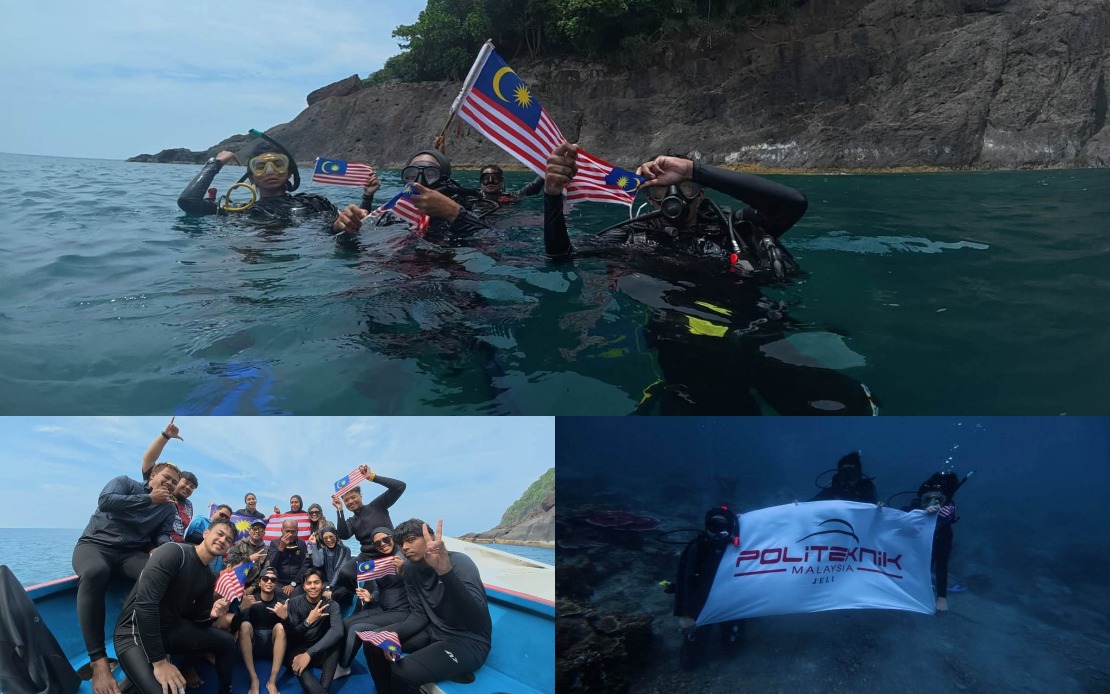
Politeknik Jeli Kelantan (PJK) has found an unconventional way to celebrate Malaysia's National Day by planting the Jalur Gemilang on the ocean floor. On August 31, staff and students of the Kelantan-based polytechnic marked the nation's 69th birthday through an underwater flag display positioned 18 metres below sea level off the coast of Pulau Tenggol in Terengganu. What might initially appear as a daring stunt is, in reality, a carefully orchestrated educational initiative that merges patriotic expression with serious vocational training—a model that demonstrates how Malaysian educational institutions are innovating to make learning both meaningful and memorable.
According to Mohd Adam Nashriq Bani Yamin, a lecturer in aquaculture at PJK, the underwater flag deployment was far more than ceremonial symbolism. Rather, it represented a deliberate fusion of technical competence-building with the cultivation of national pride among students. By executing this project, learners gained exposure to the precise demands of working in marine environments—a critical skill set for those pursuing careers in aquaculture and related ocean-based industries. The initiative reflected a broader pedagogical philosophy at PJK that integrates patriotic values with practical, industry-relevant training. This approach addresses a persistent challenge in technical education: how to inspire genuine commitment to both national identity and professional excellence among young people entering vocational fields.
The underwater flag display was not an isolated exercise but rather the centrepiece of a comprehensive scuba diving training programme that ran from August 27 to 30 at Dive Buddy Dungun. The programme, coordinated by the Aquaculture Technology Unit and the Department of Agrotechnology and Bio-Industry, brought together two lecturers and two fifth-semester students enrolled in the Diploma in Aquaculture Technology programme. All participants undertook structured training that culminated in internationally recognised certification, transforming a National Day celebration into a formal credential-building opportunity. This structure ensures that the experience carries tangible career value for students rather than serving as a one-off publicity exercise.
Water safety emerged as a cornerstone of the training initiative, reflecting PJK's commitment to equipping graduates with competencies that extend beyond conventional classroom instruction. The programme exposed students to realistic scenarios they may encounter after graduation when assigned to duties in aquatic or near-shore environments. By confronting these challenges within a controlled, supervised setting, learners developed confidence and decision-making skills essential for responding to emergencies in marine workplaces. Such preparation is particularly relevant in Southeast Asia, where aquaculture has expanded rapidly as an economic sector, creating substantial demand for skilled practitioners capable of managing both technical operations and unexpected hazards.
The certification pathway chosen—PADI Open Water Diver—carries significant industry weight. Dr Nabila Talib, a PADI Divemaster instructor from Dive Buddy Malaysia, conducted the courses, ensuring that the training met international standards. Participants who completed the programme obtained PADI certification, a qualification recognised globally and highly valued by employers in marine biotechnology, aquaculture research, and offshore development sectors. For PJK students, particularly those in the aquaculture technology track, this credential functions as a competitive differentiator in job markets where technical expertise and demonstrated safety competence directly influence hiring decisions. The polytechnic's decision to embed certification within educational programming signals confidence in graduate employability and responsiveness to industry hiring requirements.
Mohd Adam Nashriq emphasised that the skills acquired through this training extend far beyond recreational diving capability. Graduates equipped with both aquaculture knowledge and certified diving competency gain access to career pathways that remain closed to those lacking such combined expertise. Marine aquaculture management—encompassing tasks like monitoring submerged farming systems, conducting maintenance operations, and sampling crop conditions—frequently requires personnel capable of working safely underwater. Similarly, roles in marine research, ecosystem monitoring, and conservation initiatives increasingly demand professionals who can navigate both technical knowledge and practical water-based fieldwork. By facilitating this training, PJK substantially enhances the employment prospects and career trajectory potential for its students.
The symbolic dimensions of the project merit examination as well. By positioning both the Jalur Gemilang and the institutional PJK flag at eighteen metres depth, the polytechnic articulated a statement about institutional identity and national commitment. The underwater setting transforms what might otherwise be routine flag-raising ceremonies into something more thoughtful—an acknowledgment that Malaysian pride and institutional excellence manifest not merely through traditional expressions but through competence, preparation, and excellence in work performed under demanding conditions. This messaging resonates particularly strongly with younger Malaysians who increasingly value authenticity and substance over ceremonial formality.
The initiative also reflects broader trends within Malaysian vocational education toward experiential, project-based learning methodologies. Rather than confining aquaculture instruction to classroom lectures, laboratory demonstrations, and pool training, PJK extended learning into the actual operational environment where graduates will eventually work. This immersive approach has been shown in educational research to produce stronger knowledge retention, greater motivation among learners, and faster competency development compared to classroom-only formats. By coupling this pedagogical innovation with National Day commemoration, PJK created conditions where learning, patriotism, and professional development reinforce one another rather than competing for student attention.
The Pulau Tenggol location carries additional significance. Located off the Terengganu coast, the site represents the contested yet economically vital marine zone where Malaysia has invested substantially in aquaculture development. By conducting this training and symbolic display in productive marine waters rather than in protected research facilities or swimming pools, PJK students encountered the authentic conditions they will navigate professionally. The decision signals institutional recognition that genuine competency development demands engagement with real-world complexity rather than sanitised simulations.
Looking forward, this model offers replicable potential across Malaysia's polytechnic network. Other institutions with aquaculture, marine biology, or ocean engineering programmes might adapt similar approaches—embedding professional certifications, safety training, and patriotic symbolism within integrated experiential learning projects. Such initiatives simultaneously address multiple institutional objectives: developing industry-relevant competencies, building student engagement and retention, cultivating national pride grounded in genuine achievement, and generating positive publicity that reflects well on vocational education's capacity to produce capable, committed graduates. The underwater flag at Pulau Tenggol ultimately represents not merely a creative National Day gesture but a statement about how contemporary polytechnic education can authentically serve students, employers, and the nation simultaneously.

