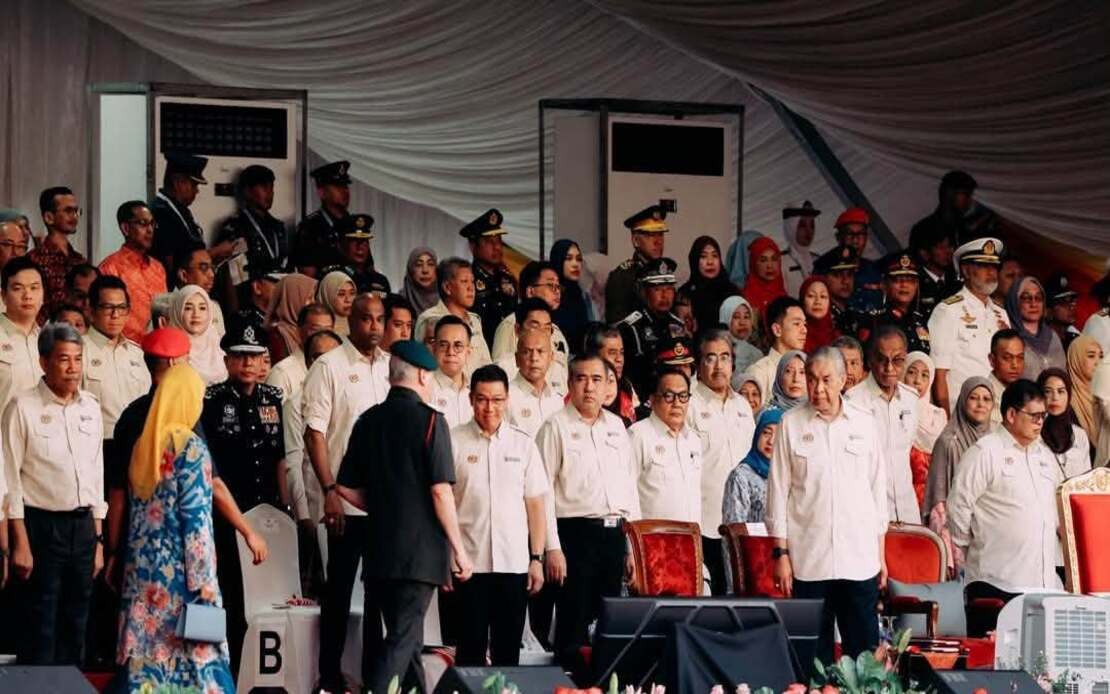
Malaysia's coalition government requires a foundation of political maturity and conscious recognition that governmental stability directly shapes national development outcomes, according to Domestic Trade and Cost of Living Minister Datuk Armizan Mohd Ali. In comments marking National Day, he highlighted how the country's transformed political terrain following the 15th General Election demands acceptance of a new reality where multiple parties share executive responsibility rather than a single dominant force governing alone.
The minister's remarks reflect a significant acknowledgment of Malaysia's evolving democratic structure. The transition from decades of single-party dominance to a genuinely collaborative governing arrangement presents both opportunities and operational challenges. Armizan framed political maturity as the glue binding together a diverse Cabinet where coalition partners maintain distinct party identities and organisational independence while functioning as a unified executive. This balance between preserving party autonomy and demonstrating governmental cohesion represents the core tension in any broad-based coalition.
One of Armizan's most striking observations concerns the disconnect between party-level competition and ministerial-level harmony. While party activists and rank-and-file members continue engaging in public disagreements—what he characterised as "exchanging barbs"—the senior leadership maintains professional and constructive interactions during Cabinet proceedings. This compartmentalisation, if sustained, could serve as a model for managing the inherent contradictions within coalition governance, where rivals in electoral contests must simultaneously function as colleagues in administration.
The minister drew explicit parallels to the 2018-2022 period, when Malaysia experienced three prime ministerial transitions and three complete Cabinet reshuffles within a single parliamentary term. That chaotic interval, which followed the collapse of the Barisan Nasional's long electoral dominance, demonstrated how political instability corrodes institutional effectiveness and investor confidence. The rapid succession of leadership changes created perpetual uncertainty about policy direction, strategic priorities, and even basic governmental continuity. Armizan's invocation of this cautionary history serves to underscore why maintaining current coalition arrangements, despite inevitable tensions, represents a pragmatic necessity for Malaysia's economic and developmental interests.
The concept of balancing individual and party political rights against collective nation-building responsibilities forms the philosophical core of Armizan's argument. In any democratic system, political actors possess inherent rights to organise, compete, and advance their positions. However, when those actors simultaneously occupy positions within a governing coalition, an additional obligation emerges—to prioritise the state's interests and policy effectiveness over factional advancement. This tension is particularly acute in Malaysia's context, where coalition partners represent distinct ideological traditions, ethnic constituencies, and policy preferences.
For Malaysian readers and business observers, the stability question carries tangible implications. A government capable of maintaining consistent policy direction, predictable regulatory frameworks, and coherent long-term planning attracts foreign investment, facilitates domestic business expansion, and enables effective implementation of development initiatives. Conversely, the instability of 2018-2022 created uncertainty that manifested in investment hesitation, policy reversals, and incomplete project implementation. The current administration's demonstrated capacity to function cohesively despite internal political differences therefore represents more than partisan positioning—it reflects a practical requirement for Malaysia's continued economic competitiveness within a fiercely contested Southeast Asian region.
Armizan's framing also addresses a broader audience encompassing civil servants, private sector leaders, and civil society actors. His assertion that "every citizen has their own role in the system of governance" extends the political maturity concept beyond the Cabinet itself to encompass the entire administrative and social ecosystem supporting national development. This inclusive perspective recognises that governmental stability requires buy-in from multiple institutional actors who collectively execute policy and manage public resources.
The minister's National Day commentary strategically positioned governmental stability as inseparable from national unity and independence celebration. By linking coalition functionality to the broader project of nation-building, he elevated the discussion beyond narrow partisan calculations to matters of collective national interest. This rhetorical strategy attempts to create social and political permission for coalition partners to subordinate internal rivalries to shared governmental purposes.
However, Armizan's optimistic assessment of Cabinet harmony merits scrutiny against visible tensions within the coalition. While ministerial meetings may maintain professional decorum, significant policy disagreements have periodically surfaced regarding economic priorities, social issues, and governance approaches. The sustainability of current arrangements depends on whether underlying policy compatibility proves deeper than surface-level cordiality, or whether fundamental ideological differences eventually force harder choices about coalition coherence.
The reference to learning from 2018-2022 also implicitly acknowledges that Malaysia's political system lacks institutional safeguards preventing rapid leadership transitions and policy chaos. Unlike systems with fixed parliamentary terms or constructive vote-of-no-confidence provisions, Malaysian parliamentary practice permits relatively fluid power dynamics that previously generated instability. The minister's emphasis on political maturity thus reflects awareness that stable governance depends partly on voluntary restraint and shared commitment rather than purely structural mechanisms.
For Southeast Asian analysts monitoring Malaysian political developments, Armizan's statements signal that the current coalition intends to project an image of functional stability despite acknowledged tensions. Whether this projection reflects genuine institutional adaptation or represents temporary accommodation of immediate political realities remains an open question. The coming months and years will reveal whether political maturity can sustain Malaysia's coalition arrangement through inevitable pressures and disputes that will test the proclaimed harmony of Cabinet interactions.
Ultimately, Armizan's message reflects a government leadership conscious that Malaysia's competitive position internationally and its citizens' welfare domestically depend on breaking the pattern of three-year cycles of governmental dysfunction. The challenge facing the Unity Government involves translating ministerial professionalism into durable institutional arrangements that can weather electoral cycles, policy disagreements, and evolving political dynamics without collapsing into the instability that characterised the previous administration.

