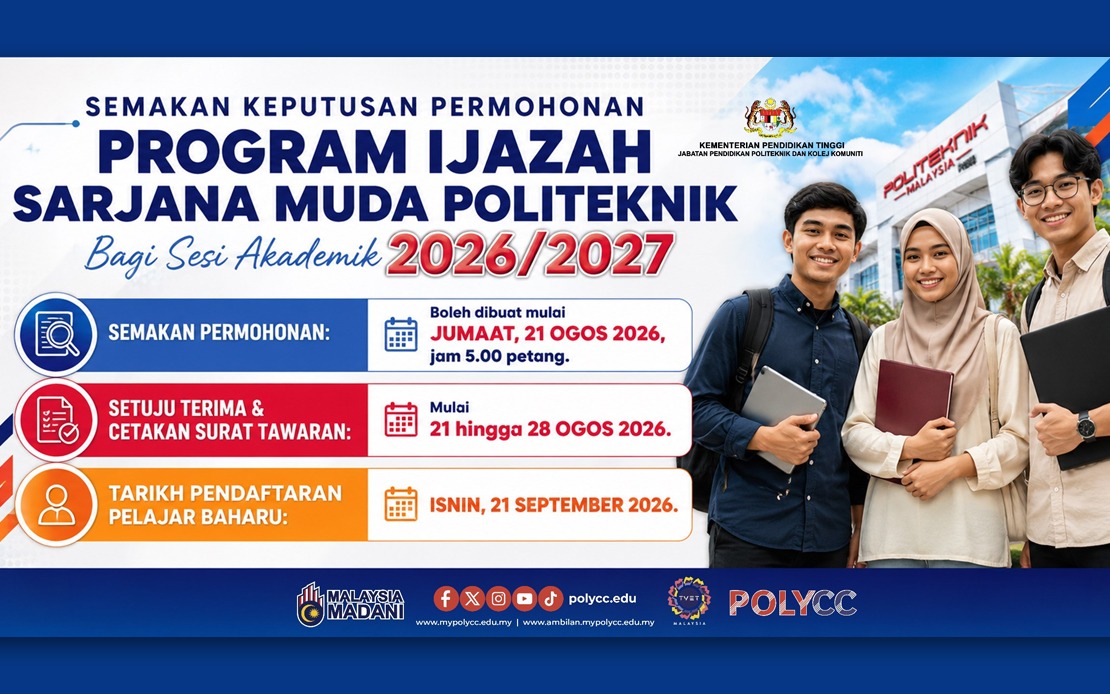
Results for applications to Bachelor's Degree programmes at polytechnics have become accessible from today, opening a critical window for prospective students to review their admission status and make enrollment decisions. Successful applicants are now required to formally accept their offers, with a deadline set for August 28 to complete this confirmation process. This intake cycle represents an important pathway for post-secondary education, particularly for candidates seeking specialised technical qualifications at the tertiary level.
The available programmes span a diverse range of disciplines aligned with Malaysia's economic priorities and industry demands. The twelve Bachelor's Degree offerings this session encompass Mechanical Engineering Technology, Civil Engineering Technology and Built Environment, Electrical and Electronic Engineering Technology, Visual Communication and Design, and Tourism and Hospitality studies. These fields reflect the nation's ongoing development needs in manufacturing, infrastructure, renewable energy, creative industries, and service sectors—areas where skilled bachelor-level technicians and technologists remain in considerable demand across the country and the broader Southeast Asian region.
Four polytechnic institutions are participating in this intake round, each serving distinct geographical regions and contributing to Malaysia's distributed technical education network. Politeknik Ungku Omar operates from Ipoh in Perak, serving the northern corridor. Politeknik Sultan Salahuddin Abdul Aziz Shah in Shah Alam, Selangor, caters to the central region and Klang Valley vicinity. Politeknik Ibrahim Sultan in Pasir Gudang, Johor, serves the southern peninsula, whilst Politeknik Sultan Azlan Shah in Behrang, Perak, provides additional capacity in the northern zone. This geographical spread ensures reasonable accessibility for qualified candidates across Malaysia's peninsula.
A total of 534 places are distributed among the various fields of study across these four institutions, representing a meaningful expansion of opportunities for diploma holders and qualified candidates seeking to progress to degree-level qualifications. The availability of over five hundred places demonstrates the government's commitment to expanding technical tertiary education capacity and meeting workforce development objectives. For many students, these polytechnic bachelor's programmes offer a practical alternative to university degrees, combining theoretical knowledge with applied skills directly relevant to employment.
The administrative calendar for new entrants has already been structured, with registration for successful candidates commencing on September 21. This timeline allows accepted students approximately three weeks to complete enrolment procedures, arrange accommodation if necessary, and prepare for the commencement of their studies. The staggered timeline between offer acceptance and actual registration provides sufficient lead time for institutional planning and student preparation.
Applicants who did not receive offers in this initial round need not regard this as final rejection. The polytechnic system has established a formal appeals process, allowing unsuccessful candidates to submit online appeals from today through September 4 through the same application portal. This mechanism provides a second opportunity for borderline cases or those who may have overlooked application deadlines or experienced technical difficulties. Results from the first follow-up offer round for appeal candidates will be announced on September 8, permitting those who successfully appeal to participate in the September 21 registration window alongside initially successful applicants.
The appeal process reflects a commitment to ensuring qualified candidates are not inadvertently excluded due to administrative factors or limited initial places. Prospective students should view the appeal option as a legitimate recourse, particularly given that some programmes may have experienced higher competition than others. The September 8 results announcement provides sufficient notice for new offers to be confirmed and for additional registrations to be processed before the formal intake date.
For applicants seeking clarification regarding their results, application procedures, or programme specifics, the Student Intake and Development Division within the Department of Polytechnic Education and Community Colleges stands ready to provide assistance. Direct inquiries can be directed to this department through official channels, ensuring that students receive authoritative guidance rather than relying on unofficial sources or third-party intermediaries. This direct access to official information is particularly important given the competitive nature of polytechnic admissions and the significance of these programmes for students' career trajectories.
The polytechnic bachelor's degree pathway occupies an increasingly important position within Malaysia's tertiary education landscape. These programmes bridge the gap between diploma-level qualifications and university degree programmes, offering specialised technical expertise that many employers actively seek. For students who may have pursued vocational or technical diplomas at polytechnics or other institutions, these bachelor's programmes provide natural progression pathways without requiring deviation into conventional university programmes. This alignment with the dual-track education system strengthens Malaysia's technical workforce development strategy.
For Southeast Asian context, Malaysia's expansion of polytechnic bachelor's offerings reflects broader regional trends toward technical education enhancement. As manufacturing, infrastructure development, and digital transformation accelerate across the region, demand for technologists and applied engineers with bachelor-level qualifications grows correspondingly. Malaysian institutions offering these programmes contribute to regional skill development and position their graduates competitively within an increasingly integrated Southeast Asian labour market. The combination of practical technical training with theoretical depth that these programmes provide creates graduates well-suited for both domestic employment and regional mobility.

