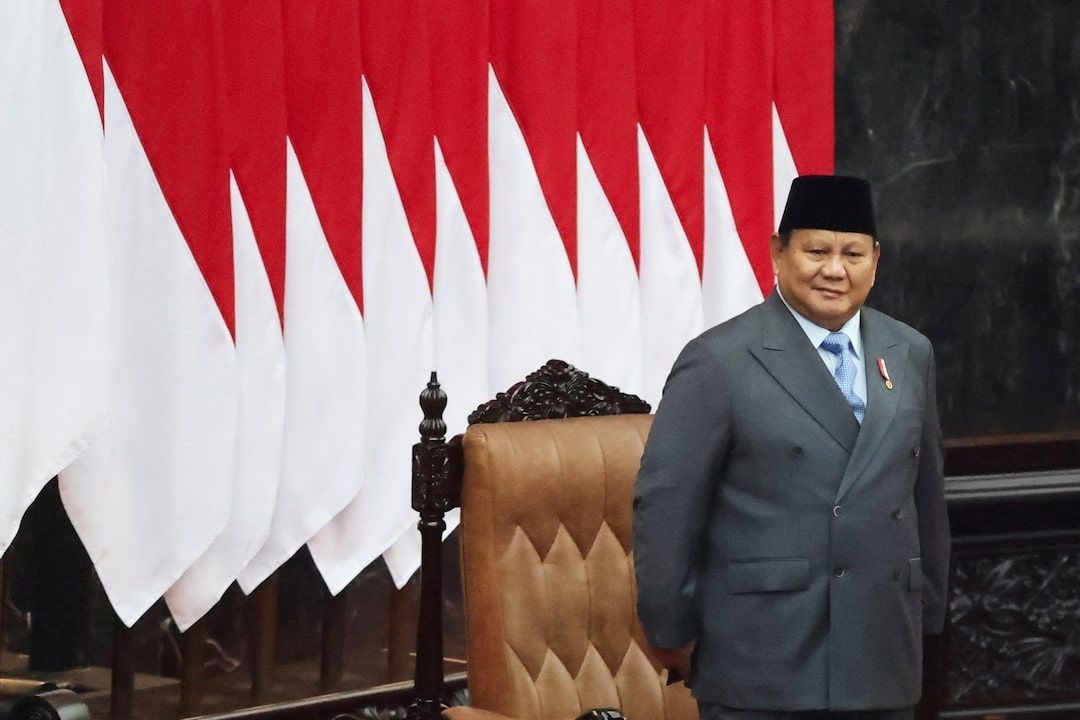
Indonesian President Prabowo Subianto faces a defining moment this Friday when he unveils his 2027 budget proposals, coming at a time when his political standing has eroded significantly and global markets have grown increasingly impatient with policy uncertainty. The former military commander, who swept to power last October with an ambitious economic reform agenda, now confronts a vastly different political and economic landscape than the one that welcomed his arrival with such optimism. His approval ratings have collapsed by nearly 30 percentage points in just eight months, slipping to 51%, a dramatic reversal that reflects growing public frustration over economic performance and the government's handling of law enforcement matters.
When Prabowo assumed office in October 2024, he carried with him sweeping electoral mandates and promises to galvanise economic growth, pledging to accelerate the economy from its current 5% trajectory to an ambitious 8% and implement a flagship programme of free meals for millions of schoolchildren. These commitments resonated with voters seeking decisive leadership and tangible improvements to living standards. However, the intervening months have tested the administration's capacity to deliver on these grand promises. The rupiah has weakened considerably, stock market performance has disappointed investors, and questions have mounted regarding the government's fiscal discipline and respect for the independence of Bank Indonesia. Even the free meals initiative, positioned as a cornerstone of the administration's social agenda, has faced budget reductions and operational challenges that have tarnished its implementation.
The economic headwinds facing Prabowo's government extend beyond temporary market fluctuations. Indonesia's fiscal deficit currently stands at approximately 2.8% of GDP for 2025, placing it on a trajectory to approach the constitutional ceiling of 3% again this year. This fiscal tightness leaves little room for the expansionary spending that might stimulate growth or fund the president's flagship programmes without triggering investor alarm about debt sustainability. Economists closely monitoring the situation have signalled that the 2027 budget presentation represents far more than a routine fiscal exercise—it constitutes a critical credibility checkpoint through which international investors will assess whether the administration can deliver coherent, market-friendly policies or whether it will continue the pattern of unpredictable announcements that have characterised much of 2024 and early 2025.
Irman Faiz, an economist at Bank Danamon, has observed that the window for policy surprises has effectively closed, with global capital markets having exhausted their patience for uncertainty. He emphasises that whereas investors might have absorbed various policy shocks during the honeymoon period following Prabowo's election, their tolerance has markedly diminished. The market is now hungry for clear signals about the direction of fiscal policy, the government's commitment to sustainability, and the concrete mechanisms through which the administration intends to achieve its growth objectives. Without a credible budget that convinces observers of governmental discipline and strategic clarity, further capital outflows and currency weakness may accelerate, potentially undermining the economic foundations upon which Prabowo's broader reform agenda depends.
Particularly contentious has been Prabowo's May announcement regarding the centralisation of critical natural resource exports under a state-run entity called Danantara Sumberdaya Indonesia. This declaration sent reverberations through international commodity markets and alarmed investors who feared state monopolisation of export channels might distort pricing, reduce efficiency, and invite retaliatory trade measures from major partners. Since the initial announcement, various members of the administration have suggested that Danantara Sumberdaya Indonesia would function primarily in a supervisory capacity rather than directly controlling export flows, yet the entity's precise mandate remains ambiguous. Commodity traders, particularly those engaged in the palm oil sector, remain deeply uncertain about how this centralised structure will operate in practice. The Friday budget presentation offers Prabowo an opportunity to dispel confusion and clarify whether the government intends to moderate its intervention in commodity markets or proceed with more assertive state control.
This ambiguity surrounding commodity policy exemplifies a broader challenge facing the administration: its struggle to balance nationalist development objectives with the market-friendly policies that global investors and trading partners expect. Prabowo's political base includes constituencies that view Indonesia's natural resources as strategic assets requiring state stewardship rather than privatised management. Simultaneously, international capital markets and the Fund have increasingly adopted the position that state intervention in commodity sectors typically generates inefficiencies and discourages investment. Resolving this tension through clear, implementable policy will require political skill and careful communication from the president, particularly given that his approval ratings now constrain his capacity to absorb further economic disappointments.
Yose Rizal Damuri, executive director of the Center for Strategic and International Studies, has highlighted that investors will scrutinise the budget presentation for signals regarding the government's commitment to clarity and consistency in economic policymaking. The broader policy environment matters enormously—whether the administration demonstrates capacity for transparent communication, whether it respects institutional independence, and whether its fiscal choices reflect economic realism rather than political expediency. These factors collectively shape investor perceptions of Indonesia's medium-term stability and growth prospects. Markets will be listening not only to the specific numbers presented in the budget but to what those numbers reveal about governmental thinking on inflation, growth, investment priorities, and the role of state intervention in the economy.
Arya Fernandes, head of politics and social change at CSIS, notes that Prabowo must confront a multifaceted credibility challenge that transcends budget arithmetic alone. He must convince a sceptical public that economic conditions can improve under his stewardship whilst simultaneously assuring international investors that his administration will not pursue policies that destabilise macroeconomic fundamentals. The president must address specific concerns regarding his signature programmes, particularly the free meals initiative, demonstrating both commitment and operational competence. He must also navigate the tension between his campaign promises of transformative economic change and the market realities that constrain radical policy shifts without triggering capital flight and currency collapse.
The timing of the budget presentation, occurring simultaneously with an Independence Day address, underscores the symbolic significance that both the government and the public attach to this moment. The morning speech on national independence will provide Prabowo an opportunity to frame his economic agenda within a broader national narrative, positioning fiscal discipline and growth acceleration as components of national renewal. The afternoon budget presentation must then translate that rhetorical vision into concrete numbers and policies that convince sceptics that the administration possesses both the competence and the commitment to deliver genuine improvements to Indonesian living standards without pursuing destabilising interventionist policies that alienate global capital markets.
For Malaysian observers and Southeast Asian policymakers more broadly, the Prabowo budget presentation carries important implications. Indonesia's economic trajectory shapes regional growth dynamics, trade flows, and currency movements that affect all ASEAN nations. Moreover, the broader question of how nationalist political mandates interact with market-oriented economic constraints represents a live issue across the region, with several countries navigating similar tensions. Should Prabowo succeed in crafting a budget that simultaneously addresses public demands for improved economic performance and investor concerns about policy stability, it would offer a regional model for reconciling political and market pressures. Conversely, should Friday's presentation fail to convince sceptics, it could trigger broader regional financial volatility and accelerate a reassessment of emerging market risk in ASEAN more generally.

