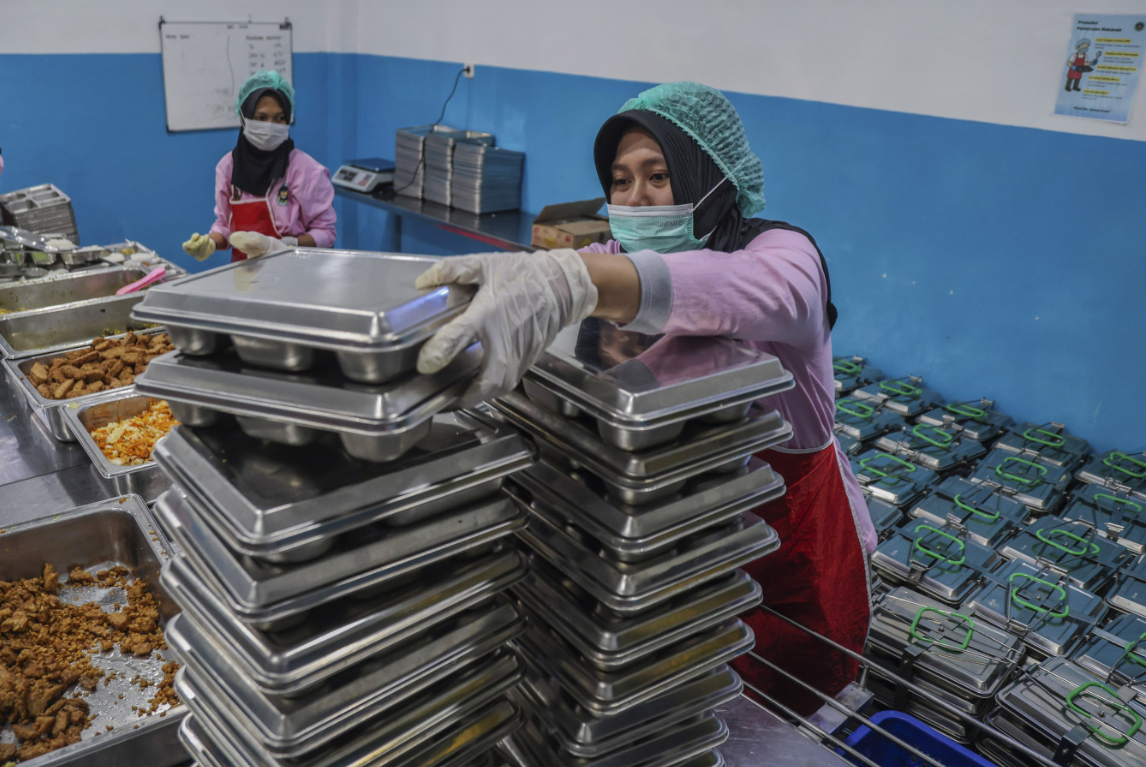
President Prabowo Subianto has ordered a comprehensive reassessment of two centrepiece social programmes, indicating the Indonesian government may substantially reshape how it delivers these initiatives in response to mounting public criticism and operational challenges. The directive emerged from a four-hour closed-door cabinet meeting on Wednesday at the presidential palace, where ministers overseeing the free nutritious meal scheme and Red and White cooperative programme gathered to discuss implementation concerns. The move represents a notable acknowledgement that these flagship projects, intended to showcase Prabowo's commitment to vulnerable communities, have instead become flashpoints for public discontent and administrative scrutiny.
The free meals initiative, budgeted at a minimum of Rp 268 trillion for 2026, aims to reach approximately 83 million beneficiaries across schools and vulnerable populations. Launched with the ambitious goal of combating malnutrition and childhood stunting, the programme has instead generated waves of street protests, food poisoning incidents, and a corruption investigation implicating senior figures from Indonesia's military and police establishment. These cascading controversies have transformed what was designed as a signature welfare achievement into a credibility challenge for the newly inaugurated administration, forcing it to confront fundamental questions about programme design and implementation capacity.
BGN deputy chief Agustina Arumsari explained that the President has instructed the National Nutrition Agency to conduct a meticulous evaluation of school-based meal delivery within a one-month timeframe. The assessment will examine eligibility determination systems, with the government contemplating whether to exclude higher-income households from the programme's scope. This signals a potential pivot toward more targeted assistance concentrated on genuinely disadvantaged populations, departing from the universal approach initially championed by the administration.
A significant concern driving the review relates to the psychological and social implications of selective meal provision in mixed-income classroom settings. Arumsari specifically flagged worries that providing meals to some students while their peers receive nothing could create stigma and inequitable conditions within schools. The administration's acknowledgement of these softer social dimensions—beyond mere nutritional metrics—suggests a maturing understanding of welfare programme design, recognising that effective poverty assistance requires sensitivity to dignity and peer relationships alongside material provision.
The government is simultaneously exploring operational alternatives to the current meal delivery model, including greater reliance on school canteens rather than dedicated meal kitchens established under the existing framework. Such modifications could reduce infrastructure costs, streamline supply chains, and leverage existing school facilities more efficiently. These considerations point toward a less centralised, more decentralised approach that may prove more sustainable and responsive to local conditions than the current nationwide system.
The review represents a tactical retreat from universal provision toward means-tested targeting, a pattern increasingly common across Southeast Asian welfare systems as governments confront fiscal constraints and implementation bottlenecks. Indonesia's massive population and geographic complexity create particular challenges for universal programmes, where logistical coordination and quality control across thousands of schools demand exceptional administrative capacity. The difficulties encountered suggest that ambition in welfare design must be carefully calibrated against institutional capability.
Meanwhile, Coordinating Food Minister Zulhas Hasan announced that the Red and White cooperatives will assume an expanded role as the government's primary distribution channel for various assistance programmes and subsidised goods. The cooperatives will additionally purchase agricultural commodities such as rice and corn when market prices dip below government-determined support levels, thereby stabilising farmer incomes and stimulating rural economies. These provisions attempt to integrate market stabilisation with welfare delivery through a single institutional vehicle.
The Red and White cooperative initiative, however, carries its own baggage of controversy. Mandatory military-style training programmes for cooperative managers have resulted in at least four deaths, generating public outcry and forcing the government to defend its approach to personnel development. These fatalities have punctured the programme's legitimacy and raised questions about the wisdom of imposing quasi-military discipline on civilian economic actors. The government's decision to expand these cooperatives despite this tragedy suggests institutional stubbornness or insufficient political will to fundamentally restructure the initiative.
For Malaysia and Southeast Asia broadly, Indonesia's experience with flagship welfare programmes offers cautionary lessons about the risks of ambitious, universalised schemes launched without adequate preparatory institutional work. While poverty reduction and improved nutrition are legitimate policy objectives, the implementation pathway matters enormously. Countries contemplating similar large-scale initiatives should study Indonesia's experience to understand how comprehensive planning, gradual rollout, and iterative adjustment might prevent the combination of costs, controversy, and credibility damage that has characterised these programmes.
The Prabowo administration's willingness to order reviews rather than stubbornly defend failing initiatives suggests some capacity for course correction, though critics argue the government should have conducted such assessments before nationwide launch rather than after mounting crises. The one-month review deadline appears tight for genuinely comprehensive evaluation of such complex programmes, raising questions about whether the assessment will produce substantive improvements or merely provide political cover for marginal adjustments.
These reviews will likely determine whether Prabowo can salvage his social welfare agenda or whether these programmes will become emblematic of his administration's overreach and management deficiencies. The outcomes will shape public confidence in his presidency during a critical early period when institutional legitimacy is still consolidating. Beyond Indonesia's borders, policymakers across Southeast Asia will watch closely to assess whether targeted revisions restore public support or whether deeper structural problems demand more fundamental redesign.

