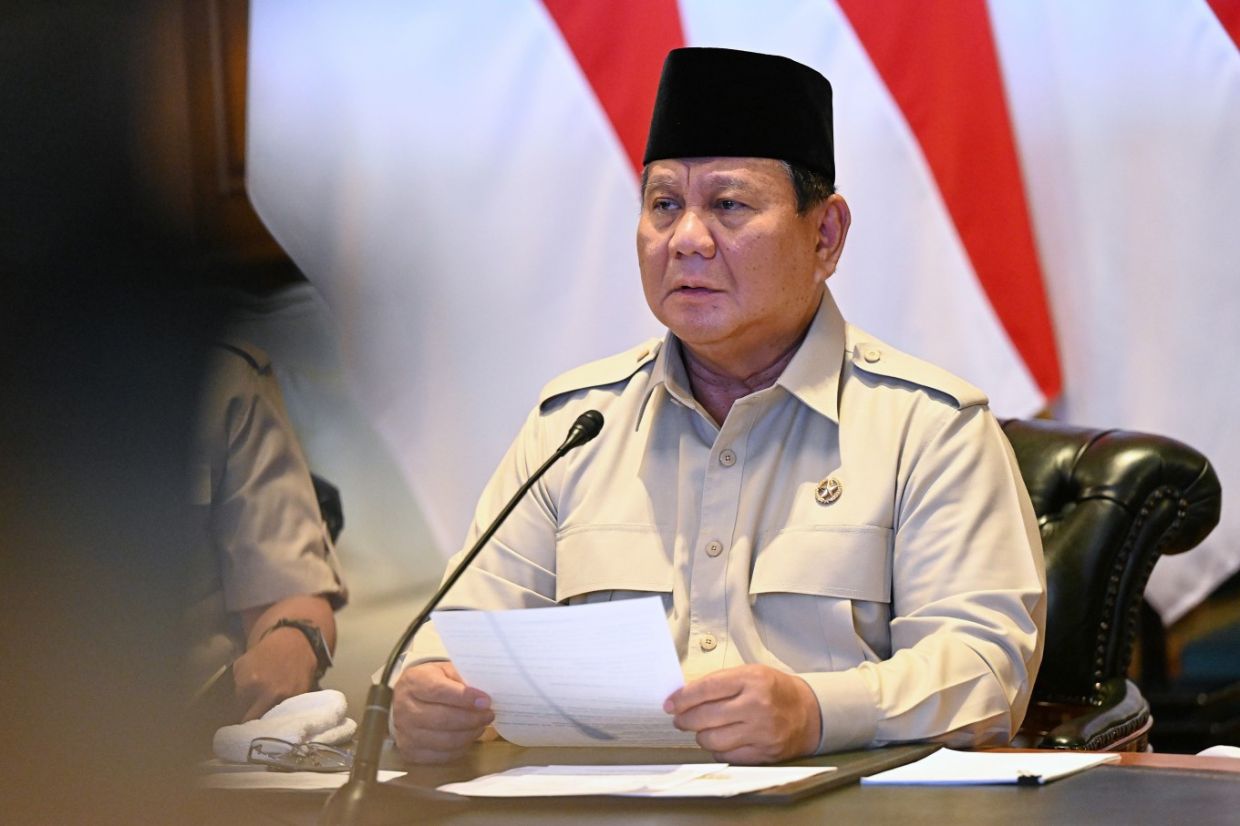
President Prabowo Subianto's extraordinarily long political honeymoon has finally ended. After nearly two years of soaring public approval numbers that would be the envy of most world leaders, fresh survey data from Saiful Mujani Research and Consulting (SMRC) reveals a dramatic downward correction, with his satisfaction rating plummeting to 51.1 percent in July 2026 from a peak of 81.2 percent just eight months earlier in November 2025. The accompanying rise in public dissatisfaction—from roughly 16 percent to 46.9 percent—suggests that the political goodwill that sustained the President through his early months in office has substantially evaporated.
What makes Prabowo's extended period of high approval ratings particularly striking is that it was not merely the residual glow of his 2024 election victory. The Indonesian leader managed to stretch and sustain his political capital well into his second year through a combination of deliberate policy choices and heavy public engagement. Most significantly, the launch of a free nutritious meal programme in January 2025 provided tangible evidence of his government's commitment to social spending, a move that resonated powerfully with ordinary Indonesians and appeared to prolong the goodwill that typically dissipates within months of any new administration taking office.
The trajectory of Prabowo's approval ratings stands in sharp contrast to those of his immediate predecessor, Joko "Jokowi" Widodo. When Jokowi began his first presidential term, he started from a similar approval baseline, but his numbers collapsed dramatically in the early months following a politically costly fuel price increase. Indikator data showed his approval plummeting from 62 percent at inauguration to just 41 percent shortly after. By comparison, Prabowo avoided any such early precipitous decline, instead maintaining approval ratings consistently in the 70 to 80 percent range throughout 2025. It was only much later in Jokowi's presidency—in May 2023 during his second term—that Indikator recorded his highest-ever approval at 81.7 percent, a level Prabowo achieved far more quickly and maintained for considerably longer.
When viewed through an international lens, Prabowo's extended honeymoon period appears even more remarkable. Donald Trump began his second presidential term in January 2025 with a historically low 47 percent approval rating, while both Barack Obama and Joe Biden experienced early and steep declines from their opening approval highs. Neither came remotely close to the sustained 70 to 80 percent range that characterised Prabowo's first year in office. The Indonesian president's ability to maintain such elevated approval ratings for such an extended duration is genuinely unusual in contemporary democratic politics, where the gap between campaign rhetoric and governing reality typically narrows quickly and often painfully.
Yet the current downturn, while dramatic in numerical terms, reflects nothing more exceptional than the normal forces of democratic accountability reasserting themselves. A 30-point drop in approval nine months into a second year of office represents a significant correction but falls well within the bounds of historical precedent. What typically drives such declines is the inevitable widening of the chasm between campaign promises and tangible delivered results. Prabowo's ambitious pledges to curb corruption substantially and lift Indonesia's GDP growth from its recent 5 percent level to an ambitious 8 percent are now being tested against the harsh realities of a weakening rupiah, a sluggish stock market, and growing public concerns about unsustainable state spending and potential threats to central bank independence. These are the economic fundamentals that ultimately shape how ordinary citizens experience their government's performance.
The SMRC survey, conducted from July 5 to 19, 2026 and encompassing 749 respondents, reveals the breadth of the public's shifting mood. Beyond the headline decline in overall satisfaction, the data exposes profound deterioration in specific areas of public perception. Economic sentiment has collapsed to a mere 15.7 percent positive sentiment in July, suggesting widespread pessimism about current conditions and future prospects. Political sentiment has cratered even more dramatically, falling from 35.8 percent positive in November 2025 to just 13.5 percent by July 2026—a staggering 22-point drop in less than a year. Even perceptions of law enforcement, which at 26.4 percent positive represents the strongest of the three categories, nevertheless indicate that fewer than one in four Indonesians feel confident about the judicial and security apparatus. According to Deni Irvani, SMRC's executive director, these three interconnected domains of public perception—economics, politics, and law enforcement—have collectively deteriorated sufficiently to account for the president's sharp decline in overall approval.
Prabowo has not passively watched his political fortunes decline. The president maintains an exceptionally high public profile through frequent televised speeches, a well-resourced communications operation explicitly designed to keep him constantly before the public eye, and a demonstrated willingness to directly challenge critics and journalists who question his administration. This strategy of sustained visibility and aggressive messaging worked effectively when the underlying economic narrative was sufficiently favourable to allow rhetoric to compensate for gaps between promise and performance. The president's media presence could distract from or reframe economic difficulties when public sentiment remained broadly favourable. However, the July 2026 numbers suggest that a ceiling on the effectiveness of this communications approach has been definitively reached. Repeated public appearances and forceful rebuttals to criticism cannot indefinitely substitute for tangible improvements in the material conditions that shape how citizens experience daily life.
It is worth acknowledging a legitimate caveat that Prabowo's supporters have raised: SMRC's founder, Saiful Mujani, has become an increasingly vocal government critic, a fact that naturally invites questions about potential methodological bias or selective presentation. This is a fair point for any observer to consider when evaluating any single polling organisation's findings. However, criticism of a pollster's personal politics does not automatically invalidate survey methodology, and SMRC has demonstrated a long track record of credible, professional polling across multiple administrations and political cycles, including years when its numbers were favourable to the Jokowi government. More importantly, SMRC's findings are not anomalous outliers that can be dismissed as reflecting individual bias. Indikator Politik Indonesia, an independently run polling organisation with its own professional reputation and separate ownership, conducted a larger survey of 4,250 respondents from July 14 to 24, 2026. That survey found satisfaction at 49.5 percent in July, down from 68 percent in April 2026 and 81 percent in December 2025—a trend line that remarkably closely tracks SMRC's findings. When two independently conducted polls converge on substantially similar numbers and show comparable downward trajectories, the notion that bias or methodology errors explain the results becomes extraordinarily difficult to sustain.
Historically, such approval declines are neither unprecedented nor necessarily catastrophic for sitting presidents. The annals of democratic governance contain numerous examples of leaders who experienced steep drops in popularity only to subsequently recover as economic conditions improved or as they implemented successful policy adjustments. A 30-point decline over nine months, while certainly substantial, does not doom a presidency or render recovery impossible. What is clear from the evidence, however, is that the extraordinary goodwill generated by Prabowo's early social spending initiatives—particularly the free nutritious meal programme—has been substantially exhausted. The political capital purchased by visible, tangible benefits that directly touched ordinary citizens' lives has been largely spent. What follows depends almost entirely on whether the Indonesian government can deliver actual, measurable improvements in the three areas where public sentiment has deteriorated most sharply: economic performance, political stability, and law enforcement effectiveness.
Behind the scenes, the administration is visibly grappling with these challenges. According to officials familiar with discussions at the Presidential Palace, Prabowo has convened the National Economic Council (DEN) to discuss remedial approaches to economic policy, the domain where public dissatisfaction has increased most dramatically. Proposals under consideration include expanding existing social assistance programmes, a strategy that effectively doubled down on the original free meals initiative that initially proved so politically successful. The government is also anticipating potential economic disruption from climate-related factors, with particular concern about an anticipated El Niño event's impact on agricultural production and food prices at a moment when household purchasing power is already under pressure. Fuel prices are being held steady rather than increased, a decision clearly motivated by recognition that additional price shocks could further erode public sentiment.
Simultaneously, Prabowo's inner circle has engaged polling consultants who were instrumental in his successful 2024 presidential campaign to advise on messaging and strategy during this period of declining approval. These advisors have reportedly counseled the president to prioritise improving public communication and undertaking a comprehensive operational review of government programmes that have encountered implementation difficulties. The free nutritious meal programme and the Red and White Cooperatives initiative—both flagship policies intended to demonstrate the government's commitment to ordinary Indonesians—have experienced teething problems that have undermined their intended political impact. One pollster involved in these discussions suggested that approval could potentially recover if such implementation problems are addressed and sufficient improvements materialise within the president's immediate policy circle. The coming months will reveal whether Prabowo can translate these recognition of problems into concrete improvements that ordinary Indonesians experience in their daily economic lives.

