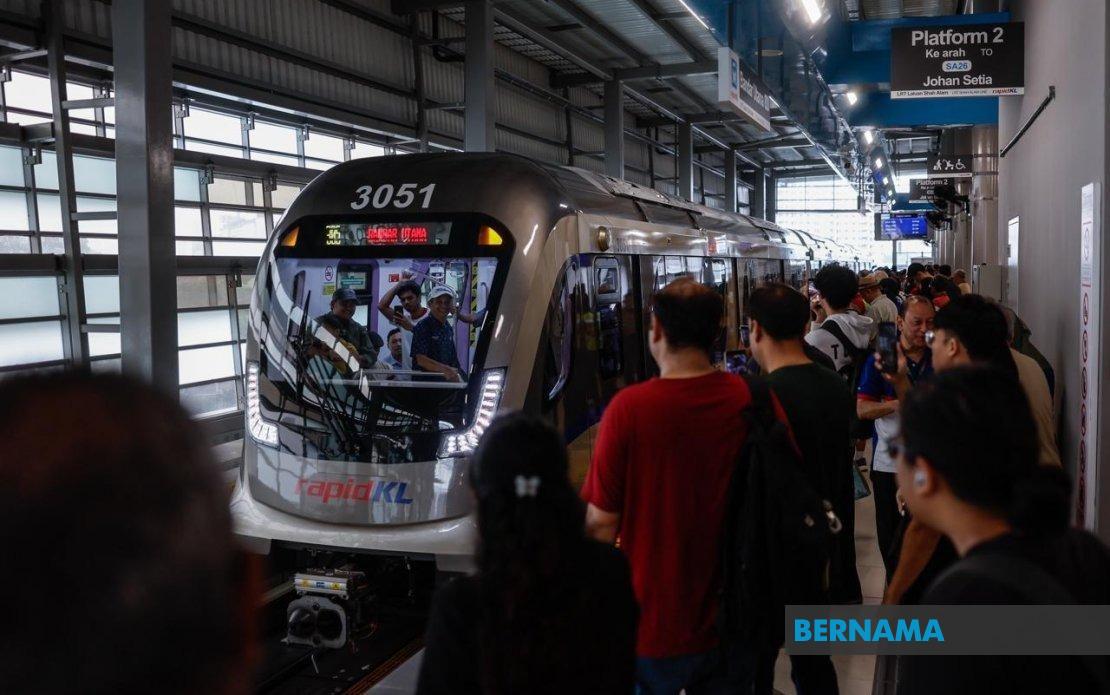
The Light Rail Transit 3 (LRT3) Shah Alam Line commenced operations today, marking a significant milestone for public transportation in the Klang Valley region. Prasarana Malaysia Berhad, the state-owned transport operator, initiated services at 6 am, with management projecting a cautious initial uptake of between 5,000 and 10,000 passengers on the opening day. This measured forecast reflects the operator's experience with new rail corridors, which typically require time to build ridership momentum as commuters become familiar with routes, stations, and schedules before incorporating the service into their regular mobility patterns.
Amir Hamdan, Prasarana's president and chief executive officer, outlined an ambitious scaling trajectory during his visit to Glenmarie 2 station, one of the line's major interchange hubs. The organisation targets 67,000 daily passengers within the first operational year, contingent on how rapidly commuters adopt the new service and integrate it into their transport choices. This growth projection reflects confidence in the line's strategic positioning within the Klang Valley's transport network, though management acknowledged that reaching such figures requires sustained marketing, service reliability, and competitive advantages over private vehicle use.
Early feedback from opening day commuters proved encouraging, with passengers expressing satisfaction about the comfort and convenience offered by rail travel compared to navigating congested roadways. Social media commentary highlighted appreciation for the ability to commute without the stress of traffic navigation, positioning the new line as a viable alternative to private transportation for sections of the travelling public. These initial endorsements provide qualitative validation for the infrastructure investment, though converting enthusiasm into sustained ridership demands consistent service quality and operational excellence.
Operational performance during the inaugural day demonstrated smooth functionality across core systems. Prasarana reported that train frequency maintained eight-minute intervals during peak hours, with all station facilities, automated gates, and ticketing mechanisms operating without significant disruption. This technical success represents the culmination of extensive testing and commissioning processes and sets a foundation for the reliability that long-term ridership depends upon. The operator's ability to maintain scheduled service on opening day, when teething problems frequently emerge, suggests solid preparation and workforce training.
The LRT3 Shah Alam Line's strategic value lies substantially in its role as a connector within Klang Valley's expanding rail network. Glenmarie 2 station provides crucial interchange access to the Kelana Jaya Line, whilst Bandar Utama station links to the Kajang Line, creating network effects that enhance the overall utility of public transport in the region. These interchange points represent critical nodes where operational performance directly influences user experience and repeat usage decisions. Prasarana indicated specific attention to managing passenger flows and transfer experiences at these key locations, recognising that bottlenecks or complicated transfers could deter potential riders.
Management emphasised that the current phase represents an observational period rather than a fully optimised operation. Prasarana committed to ongoing monitoring of ridership patterns, usage characteristics, and operational efficiency metrics. Rather than implementing maximum capacity measures from the outset, the operator adopted a graduated approach, with flexibility to increase train frequency or deploy additional rolling stock in response to demonstrated demand. This adaptive strategy suggests willingness to invest further resources should ridership exceed initial projections, whilst avoiding overcapitalisation if demand develops more gradually than hoped.
Amongst questions for future phases, Prasarana noted that gender-specific facilities such as women-only coaches remain under consideration rather than implemented immediately. The operator committed to evidence-based decision-making, gathering ridership data and qualitative feedback from diverse user cohorts before introducing such measures. This approach reflects broader industry practice where major service modifications typically follow demonstrated user demand and measurable operational challenges rather than precautionary implementation.
A significant support mechanism for initial adoption emerged from Prime Minister Datuk Seri Anwar Ibrahim's announcement of free transit provisions. Effective from today through July 31, passengers enjoy complimentary travel on the LRT3 Shah Alam Line and its associated feeder bus services operated by Prasarana. This one-month promotional period substantially lowers barriers to trial usage, allowing commuters to evaluate the service without financial commitment. Such initiatives have proven effective in other transit systems for normalising rail usage and building habit formation, though the sustainability of ridership post-subsidy depends on the service delivering genuine value and convenience.
The LRT3 Shah Alam Line's launch arrives within Malaysia's broader context of expanding urban rail infrastructure, following the successful operations of earlier lines and reflecting continued government commitment to public transport development. For the Klang Valley, increasingly congested with vehicular traffic, the new corridor represents infrastructure diversification and alternatives to road-dependent mobility. Successful integration and ridership growth could influence future transit planning decisions and demonstrate economic viability for similar regional projects.
The coming months will prove decisive for the LRT3 Shah Alam Line's trajectory. Prasarana's willingness to adapt frequency and capacity in response to actual demand suggests pragmatic management, though the true measure of success lies in whether commuters permanently shift modal choice toward rail. The free-ride promotion period provides a temporal window for habit formation, after which pricing becomes a consideration for continued usage. For Malaysian readers monitoring public transport development, the Shah Alam Line represents both tangible infrastructure progress and a test case for whether premium, modern rail corridors can overcome entrenched car-dependent commuting patterns in the urban Klang Valley.

