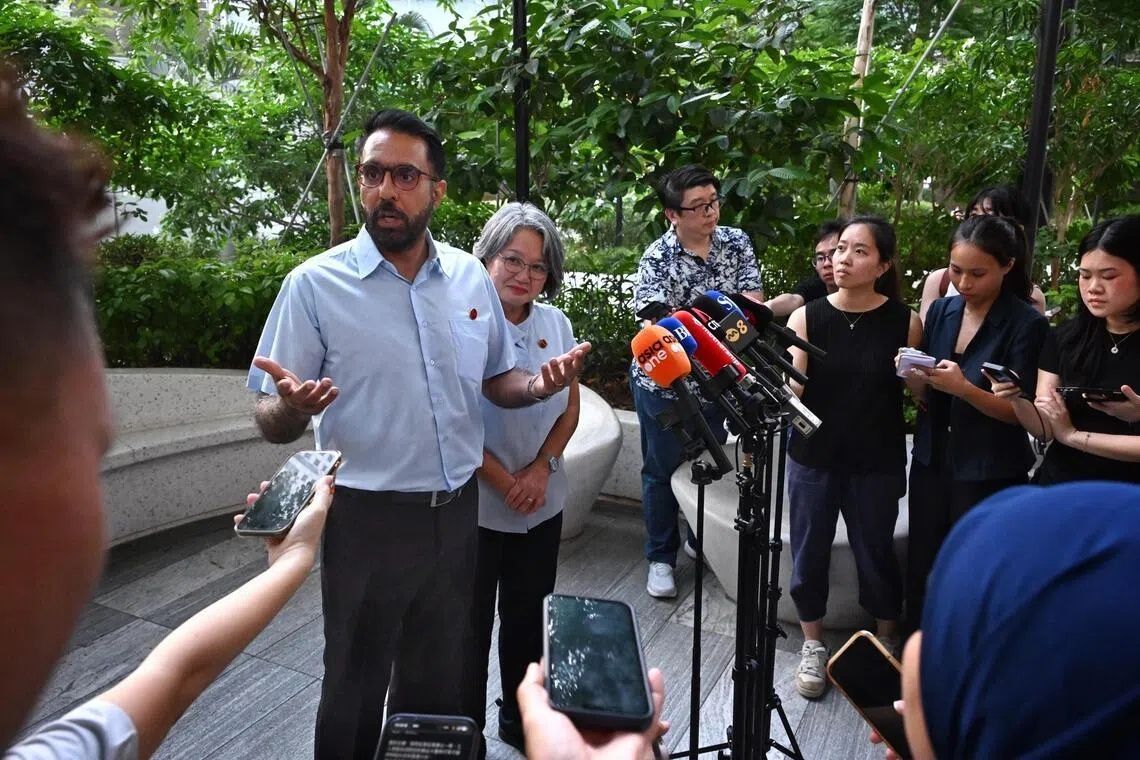
Pritam Singh has emerged strengthened from a critical internal challenge to his leadership of Singapore's Workers' Party, securing re-election without opposition on June 28 after party cadres decisively rejected calls for his resignation at a turbulent meeting held the same morning. The outcome marks a turning point for the opposition bloc's most senior figure, who has weathered considerable institutional and legal pressures since the 2021 parliamentary misstatement scandal involving former Sengkang GRC MP Raeesah Khan. Political observers view the comfortable victory as a watershed moment, suggesting that the party membership has fundamentally moved beyond the repercussions of that episode and is prepared to rally behind Singh's continuing stewardship.
The leadership challenge originated from a December 2025 petition signed by 25 dissatisfied cadres, representing a meaningful fraction of the party's inner circle of slightly more than 100 members. Organisers of the petition sought to compel Singh's removal, citing both his legal troubles and broader governance concerns. The special conference convened to address their grievances carried genuine uncertainty, with reports suggesting that organisers had spent weeks attempting to identify a credible alternative candidate. However, their search proved fruitless, and the secret ballot on Singh's continued tenure became the mechanism through which the party settled its internal dispute.
Gerald Giam, the Aljunied GRC MP who presided over the morning session, reported that Singh commanded support "well in excess of a supermajority" from the assembled cadre body. Party sources subsequently indicated that Singh had secured approximately 80 per cent of the vote, a margin that clearly demonstrates broad-based confidence rather than narrow survival. The discussion itself proceeded in orderly fashion, with Giam emphasizing that cadres had genuine opportunity to raise concerns and that Singh provided a comprehensive statement addressing the charges levelled against him. This procedural legitimacy—the demonstration that the party's democratic mechanisms were functioning and being respected—appeared almost as significant as the numerical outcome in validating the result.
Singh's framing of the vote's significance emphasized party unity and institutional cohesion. In media remarks following his re-election, he stressed that the Workers' Party must project rational responsibility and represent Singaporean constituents faithfully, language that implicitly acknowledged the damage inflicted by the Khan episode and positioned the cadres' decision as endorsement of a return to organisational normalcy. He notably declined to disclose the exact vote tally, preferring instead to characterise the outcome in qualitative terms suggesting comprehensive agreement. This rhetorical choice reflected both confidence in his standing and a desire to move forward without prolonging focus on the internal divisions that had surfaced.
Crucial to Singh's survival was early public endorsement from Low Thia Khiang, the former party chief whose own legacy became entangled in speculation about internal fractures. Low appeared before media on the morning of June 28, explicitly confirming his continued backing of Singh and effectively closing down weeks of rumour and uncertainty about whether the older generation of party leadership might seek his removal. This public demonstration of support from the previous generation of Workers' Party leadership carried outsized symbolic weight, suggesting institutional continuity and reassuring cadres that long-serving members accepted Singh's stewardship.
The June 28 gatherings also included the party's regularly scheduled biennial internal elections, which proceeded smoothly following the morning's fraught leadership vote. Sylvia Lim secured re-election as chair, a position she has occupied since 2003, and the central executive committee underwent its routine renewal. The 12 elected members of this decision-making body included a single newcomer: senior counsel Harpreet Singh, who contested the May 2025 general election as part of the party's Punggol GRC slate. Four committee members—including former Aljunied MP Faisal Manap, long-time member Tan Kong Soon, and Harpreet Singh himself—do not currently hold parliamentary seats, reflecting the party's institutional depth beyond its elected contingent.
Harpreet Singh's inclusion carried particular significance given his status as a rising figure within the organisation and his subsequent public commentary on the leadership vote. In a LinkedIn post following the election, Singh rejected the notion that cadres had voted with "blind loyalty," instead contending that they had conducted a disciplined assessment of Pritam Singh's fitness to lead. He highlighted the Workers' Party chief's steady performance under sustained political pressure and his accumulation of parliamentary victories as metrics favouring continued confidence. This framing directly engaged the most serious charge against Pritam Singh—the High Court's December 2025 upholding of his conviction for misleading a parliamentary committee regarding his handling of Khan's situation—by acknowledging the judicial judgment while arguing that leadership assessments require consideration of broader character and performance dimensions.
The circumstances precipitating the internal challenge remain significant context for understanding both its intensity and its resolution. Singh's legal trajectory has been steep: the High Court upheld his conviction in December 2025, Parliament declared him unsuitable for the formal Leader of Opposition role in January 2026, and Prime Minister Lawrence Wong subsequently removed him from that ceremonial position. In April 2026, the party's own disciplinary panel issued findings that Singh had violated two constitutional articles through his conduct relating to Khan's parliamentary misstatement, leading to a formal letter of reprimand from the central executive committee. This sequence of external and internal accountability mechanisms created a compressed timeframe in which Singh's suitability for leadership faced multiple layers of institutional judgment.
The Workers' Party's decision to decline the Prime Minister's invitation to nominate an alternative Leader of Opposition reflects both principled institutional positioning and practical calculation. By maintaining that the position should belong to the leader of Singapore's largest opposition party—which the Workers' Party remains—the party rejected implicit government pressure to distance itself from Singh while reaffirming his legitimacy as party chief. This stance proved consequential: had the party nominated a replacement, such action would have constituted implicit acknowledgment that Singh lacked credibility, potentially undermining his position in the subsequent internal elections. The refusal to capitulate on this symbolic question likely bolstered Singh's standing with cadres who viewed maintenance of institutional independence as paramount.
The aftermath of these dual June 28 meetings suggests that the Workers' Party has turned a corner in managing the extended aftershocks of the Khan episode. The party faces the practical task of consolidating Singh's authority among the dissident minority, potentially through dialogue with the 25 petitioners about underlying concerns. At the same time, Singh will need to focus organisational energy on substantive parliamentary opposition work and positioning for the next general election, due by November 2027. The test of June 28's outcome lies not merely in the vote margins achieved but in whether internal unity translates into effective political performance and whether the party can move beyond institutional self-examination to renewed public focus.
For Malaysian observers, the Workers' Party's navigation of internal challenge holds indirect relevance. Established opposition parties across Southeast Asia frequently struggle with generational transitions, leadership accountability, and the relationship between democratic procedures and operational cohesion. The manner in which the Workers' Party subjected its chief to open ballot, respected the outcome, and maintained its public institutional independence despite external pressure illustrates one model of how mature opposition organisations manage internal stress. Similarly, the decisive rejection of a recall attempt by a minority faction suggests that procedural legitimacy and transparent voting mechanics can resolve leadership crises without organisational fracture—a lesson applicable wherever opposition parties seek to strengthen their institutional credibility and resilience.

