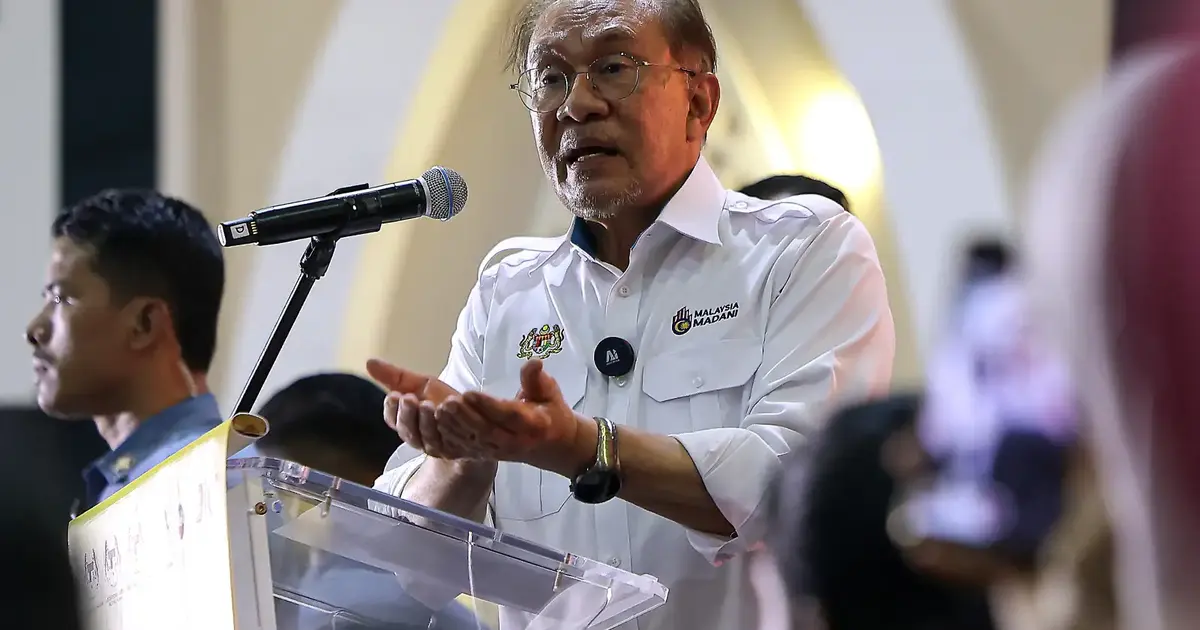
Prime Minister Anwar Ibrahim has pushed back against persistent criticism that efforts to protect Malaysia's ethnic minorities undermine the special constitutional position of Malays and Islam, framing the two objectives instead as complementary pillars of the nation's founding social contract. His remarks represent a deliberate attempt to recalibrate the political narrative around minority rights at a time when Malaysia's plural society faces recurring tensions over questions of identity, representation, and constitutional balance.
Anwar's position challenges a common rhetorical construction that has gained traction in Malaysian politics, particularly among segments of the Malay-Muslim base. This framing presents minority protections and Malay constitutional protections as inherently zero-sum, a notion the prime minister explicitly rejects. By articulating these as compatible rather than contradictory commitments, Anwar seeks to demonstrate that a government can simultaneously honour the constitutional guarantees enshrined in Article 153 of the Federal Constitution—which outlines special rights for Malays and Islam—while also extending substantive protections to Chinese, Indian, and other non-Malay communities.
The distinction matters profoundly for Malaysia's governance trajectory. The Federal Constitution, drafted at independence in 1957, represents a carefully calibrated compromise among the country's founding communities. Malays and Islam received explicit protections regarding religious matters, the position of the monarchy, and customary law, while Chinese and Indians secured citizenship rights and protections against discrimination in economic and social spheres. This bargain, though imperfectly realised in subsequent decades, forms the legal and philosophical foundation for Malaysia's multiethnic state. Anwar's framing acknowledges that neither set of protections need erode the other when administered in good faith.
The political sensitivity of this message cannot be overstated within Malaysia's contemporary context. The past two decades have witnessed the emergence of increasingly assertive interpretations of Malay-Islamic entitlements, partly driven by demographic anxieties and partly by deliberate political mobilisation around identity concerns. Opposition parties and civil society groups have capitalised on these sentiments, sometimes framing minority rights initiatives—whether in education, employment, or religious freedom—as threats to Malay-Muslim dominance. This politicisation of constitutional balance has complicated governance for administrations seeking to implement inclusive policies.
Anwar's intervention appears timed to address mounting pressure from both directions. Within his own coalition, the Democratic Action Party and other non-Malay political partners have grown more vocal about grievances affecting their communities, from vernacular education funding to recruitment practices in the civil service. Simultaneously, Malay-Muslim constituencies express concerns that inclusive policies signal capitulation on foundational constitutional commitments. By explicitly defending the constitutional position of Malays whilst endorsing minority protections, Anwar attempts to hold together a coalition that bridges these apparently opposed constituencies.
The practical implications of this rhetorical stance extend to several pressing policy areas. Educational access for non-Malay students, recruitment in federal institutions, religious freedom for non-Muslim minorities, and language rights in various forums all fall within the zones of potential controversy. A prime minister willing to declare that minority protections strengthen rather than weaken the constitutional order creates space for administrators to implement more inclusive policies without facing immediate accusations of abandoning Malay rights. This framing provides political cover for pragmatic governance.
However, the gap between prime ministerial rhetoric and implementation remains substantial. Malaysia's civil service continues to reflect significant demographic imbalances, with Malay-Muslim representation far exceeding their population share. Vernacular schools operate under chronic resource constraints compared to national schools. Religious minorities navigate complex bureaucratic processes for exercising their faith. While Anwar's words signal intent, translating this constitutional philosophy into concrete administrative changes requires sustained effort against entrenched bureaucratic cultures and political resistance from those who profit from zero-sum interpretations of rights.
Regionally, Malaysia's approach to minority protections carries symbolic weight. The country positions itself as a model of Muslim-majority democracy where religious minorities enjoy protections. Yet international observers frequently note the gap between constitutional promise and lived experience, particularly for religious minorities and indigenous communities. Anwar's articulation of compatibility between constitutional frameworks serves both a domestic audience—reassuring Malays that inclusion does not mean exclusion—and an international one, suggesting Malaysia takes its pluralistic character seriously.
The prime minister's intervention also reflects broader generational shifts within Malay-Muslim politics. Anwar himself represents a school of thought, influenced partly by his engagement with international Islamic scholarship and his experience of the 1998 financial crisis, that views inclusive governance and Islamic principles as compatible rather than opposed. This contrasts with earlier iterations of Malay-Muslim nationalism that often framed majority rights in explicitly antagonistic terms toward minorities. Whether this philosophical reorientation gains traction depends partly on whether it translates into tangible improvements in minority experiences and partly on whether it can neutralise opposition claims that it represents dilution of constitutional commitments.
Looking forward, Anwar's framing will face practical tests. Upcoming policy decisions around education, civil service recruitment, religious affairs, and language use will reveal whether the prime minister's words translate into substantive changes or represent rhetorical repositioning without institutional transformation. The success of his approach ultimately depends on convincing both Malay-Muslim constituencies that constitutional protections remain intact and minority communities that inclusion is not merely symbolic but reflected in resource allocation and institutional practice. This balance remains precarious but essential for Malaysia's continued functioning as a genuinely plural democracy.

