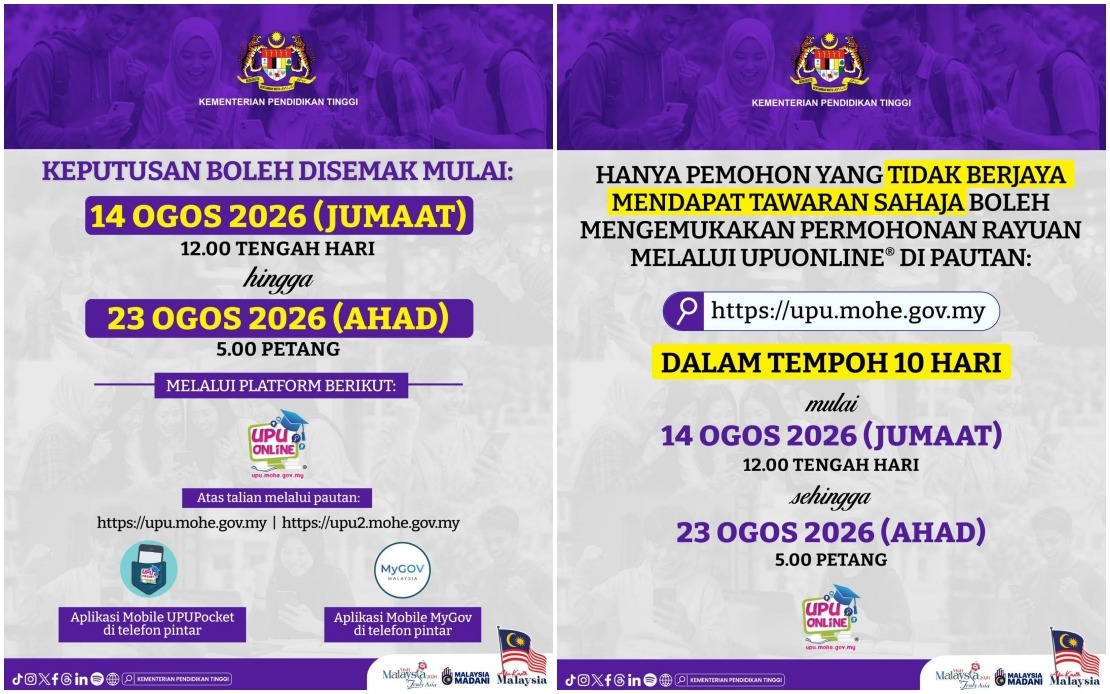
Tens of thousands of Malaysian students holding the Sijil Tinggi Persekolahan Malaysia (STPM) or equivalent qualifications will receive their public university placement decisions on August 14, marking a crucial juncture in the nation's higher education admissions cycle. The Ministry of Higher Education announced that results from the centralised UPUOnline application system will become accessible from noon that day through August 23, providing a ten-day window for successful and unsuccessful applicants to take action on their offers.
The announcement reflects the highly anticipated outcome of an application season that shapes the academic futures of Malaysia's top secondary school performers. Each year, thousands of STPM graduates compete for limited places at institutions including Universiti Malaya, Universiti Kebangsaan Malaysia, Universiti Putra Malaysia, and other public universities across the country. The 2026/2027 academic session will be no exception, with competition expected to remain intense given the expanding pool of STPM candidates nationwide.
Candidates wishing to check their results have multiple convenient options. Beyond the official UPUOnline portal accessible at https://upu.mohe.gov.my and https://upu2.mohe.gov.my, applicants can utilise the UPUPocket mobile application or the MyGov application on their smartphones, reflecting government efforts to democratise access to critical educational information. This digital-first approach accommodates the smartphone-dependent lifestyle of most young Malaysians while reducing congestion at physical counter services.
Once results are published, the confirmation process commences immediately. Between August 15 and 23, applicants must access their respective university websites to formally accept or reject their offers. This compressed timeline necessitates prompt decision-making by candidates, particularly those juggling multiple considerations such as programme preferences, location, career prospects, and family circumstances. Universities will begin issuing official offer letters to successful candidates from August 15 onwards, contingent on timely acceptance from students.
For those disappointed by rejection, the system provides a structured appeal mechanism that neither penalises unsuccessful applicants nor guarantees alternative placement. Candidates denied offers during the primary allocation round may submit appeals through UPUOnline between August 14 and 23, a ten-day period coinciding with the main confirmation window. However, the ministry emphasises that appeal selections depend entirely on programme vacancies that emerge after universities complete their new student registration, introducing an element of unpredictability into the appeals process.
The finality of initial offers represents a significant policy position that shapes institutional planning. Once applicants confirm acceptance during the prescribed period, no subsequent changes to chosen programme or institution are permitted. This inflexibility, while streamlining administrative operations and enabling universities to plan facilities and resource allocation with certainty, has historically attracted criticism from students whose preferences evolve after receiving offers or who discover programme mismatches upon detailed investigation. The policy effectively locks successful applicants into their selected paths, emphasising the importance of thoughtful application strategy before submission deadlines.
For Malaysian higher education stakeholders, the August 14 release date carries broader significance extending beyond individual student outcomes. University administrators rely on admission data to forecast enrolment figures, inform budget planning, and justify infrastructure investments to government bodies. Employers and professional bodies use aggregate admission patterns to gauge workforce pipeline quality and discipline-specific skill availability. Secondary schools monitor placement statistics as metrics reflecting teaching effectiveness and competitive standing within their regions.
The UPUOnline system's role as centralised gatekeeper for public university admissions underscores the government's commitment to standardised, transparent allocation procedures. Unlike decentralised systems where universities operated independent admissions, the integrated platform theoretically eliminates duplication, reduces applicant confusion, and ensures equitable consideration across institutions. However, centralisation also concentrates pressure on system infrastructure; technical failures during result release windows have occasionally inconvenienced applicants seeking timely information.
For Southeast Asian context, Malaysia's structured, time-bound admissions process contrasts with approaches elsewhere in the region. Some nations employ rolling admissions extending across multiple months, while others conduct highly competitive entrance examinations determining placement. Malaysia's STPM-based system, emphasising secondary achievement and subject performance, reflects historical British educational influences while increasingly incorporating complementary pathways including matriculation programmes and international baccalaureate qualifications competing for the same university places.
The appeals provision, though limited by vacancy constraints, represents recognition that initial allocation outcomes sometimes misalign with applicant capabilities or institutional needs. Previous cycles have seen situations where programmes faced under-enrolment despite rejection of qualified candidates in other disciplines, suggesting inefficiencies in demand prediction. The appeal window partially addresses such mismatches, though without guarantees of success.
Students awaiting results should prepare psychologically and practically for multiple scenarios. Successful applicants must resolve acceptance within five working days, necessitating prior consideration of financial implications, accommodation logistics, and programme suitability. Rejected applicants require contingency plans potentially involving appeals, private institution exploration, or alternative qualification pathways such as diploma programmes with lateral entry possibilities into degree programmes.
The timing of August 14 result release also influences institutional calendars significantly. Universities must process confirmations, issue formal documentation, conduct registration exercises, and complete orientation programmes before semester commencement, typically scheduled for late August or early September. This compressed administrative timeline demands efficient operations across multiple university departments simultaneously managing thousands of new students.

