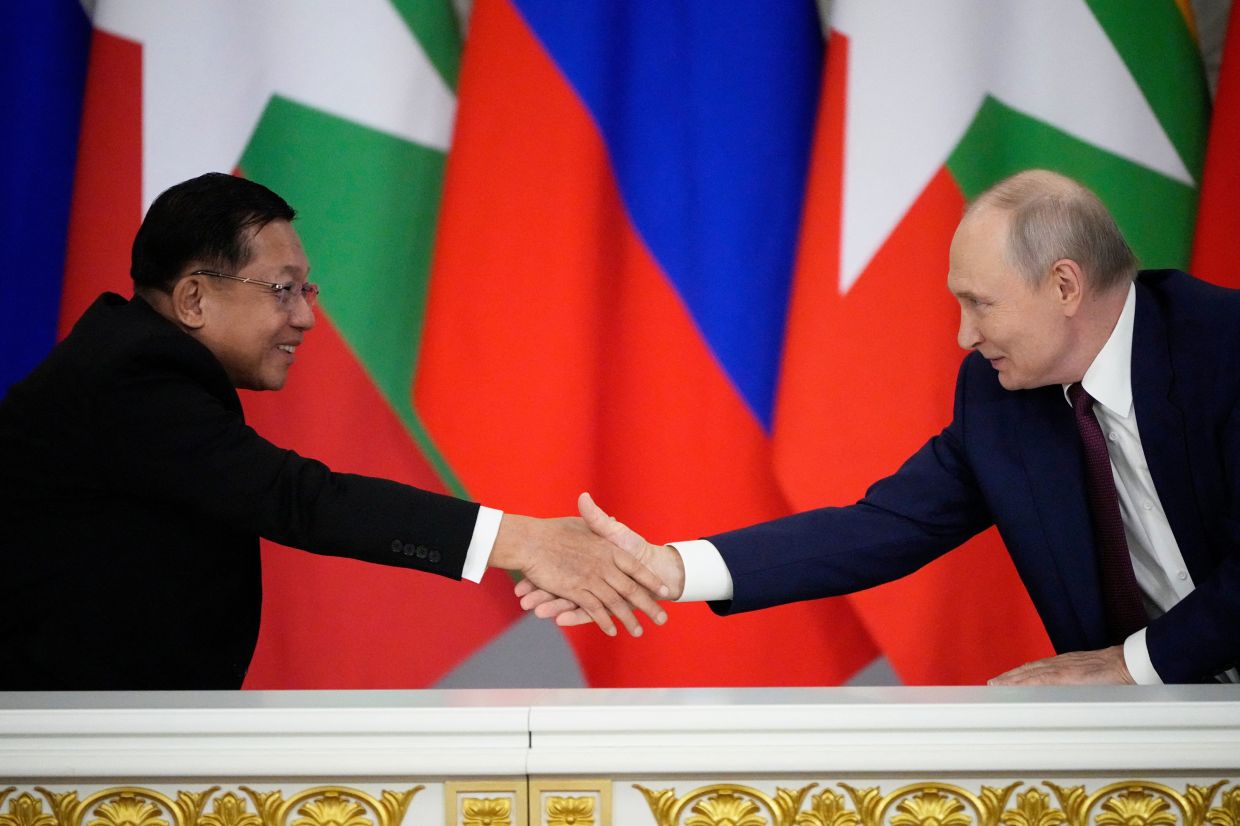
Russian President Vladimir Putin underscored the growing warmth of ties between Moscow and Myanmar when he received the country's leader Min Aung Hlaing at the Kremlin on Tuesday, August 18. The meeting marked Min Aung Hlaing's first visit to Russia since his formal assumption of the presidency in April, following an election that faced significant international criticism. Putin's characterization of relations as "especially trusting" reflects Moscow's determination to deepen its foothold in Southeast Asia at a moment when Western nations have largely sidelined Myanmar's military-dominated government.
The timing of this engagement holds particular significance for the region. Russia has positioned itself as one of the few major powers willing to maintain substantive diplomatic and economic relations with Myanmar since the military coup in 2021, a stance that contrasts sharply with the isolation imposed by Western democracies and international organizations. For Malaysia and other ASEAN members, Russia's active courtship of Myanmar raises questions about the geopolitical alignments taking shape in the region and the extent to which external powers are competing for influence over the Southeast Asian nation.
At the heart of the bilateral discussions lies Moscow's ambitious economic agenda for Myanmar. Putin outlined Russian intentions to construct a power generation facility and an oil refinery in southern Myanmar, along with involvement in geological surveys and hydrocarbon extraction projects. These infrastructure investments would represent significant long-term commitments and underline Russia's strategic interest in Myanmar not merely as a security partner but as a source of natural resources and a market for Russian expertise. The scale of Putin's delegation, which included senior officials from foreign policy, finance, energy, and defence ministries, emphasized that these were not mere diplomatic pleasantries but serious discussions anchored in economic substance.
The nuclear dimension of Russia-Myanmar cooperation adds another layer to their evolving partnership. Myanmar is collaborating with Russia's Rosatom State Corporation to develop a small nuclear power plant, an initiative that positions Russia as a provider of cutting-edge technology for Myanmar's long-term energy and industrial needs. While the project carries implications for Myanmar's development trajectory, it also illustrates how Moscow is using technological partnerships to entrench its influence in strategically important countries. For Southeast Asian nations monitoring nuclear energy development in the region, this cooperation exemplifies the broader pattern of Russian engagement seeking to expand beyond traditional security partnerships.
Military and defence cooperation remains a cornerstone of the Russia-Myanmar relationship. Putin explicitly referenced what he termed "close military and military-technical cooperation" with Myanmar, a statement that carries weight given Russia's track record as a substantial arms supplier. According to a United Nations report from May 2023, Russia has supplied advanced weaponry to Myanmar's military exceeding US$400 million since the 2021 coup. This arsenal strengthens Myanmar's military capabilities and creates dependencies that bind the country more tightly to Russian interests, a dynamic that reverberates across the region as other Southeast Asian governments assess the balance of military power.
Min Aung Hlaing's Moscow visit forms part of a broader diplomatic offensive aimed at rehabilitating Myanmar's international standing following the contested election. The Myanmar leader has embarked on an active schedule of overseas engagements, visiting China, India, Laos, and Thailand in recent months, all while simultaneously seeking to normalize relations with the United States and ASEAN. This balancing act reveals the precarious position of Myanmar's military government, which requires validation and economic support from multiple quarters while resisting international pressure to release Aung San Suu Kyi and restore democratic processes. Russia's willingness to provide such validation without demanding political concessions strengthens Min Aung Hlaing's hand in these diplomatic maneuvers.
The composition of Min Aung Hlaing's delegation underscores how comprehensively Myanmar is embedding itself within Russian structures. A high-level group comprising multiple ministers and the head of the Myanmar Space Agency travelled to Moscow, signalling that engagement spans civilian sectors beyond traditional military and diplomatic channels. The Myanmar leader's separate meetings with Prime Minister Mikhail Mishustin and Vyacheslav Volodin, speaker of Russia's lower house, provided additional opportunities to cultivate relationships across different branches of Russian governance. This multi-layered engagement strategy suggests Myanmar is working to deepen institutional connections that will prove resilient regardless of changes in individual leadership.
Liquefied natural gas emerges as another domain where Russia perceives significant potential. Putin's reference to "good prospects" for LNG cooperation signals Moscow's interest in either facilitating Myanmar's gas exports or securing access to those resources for Russian markets or third-party buyers. Given global energy transitions and the importance of LNG in regional energy security, this conversation has implications extending beyond bilateral relations. For energy-dependent Southeast Asian economies like Malaysia and Singapore, the direction of Myanmar's hydrocarbon development influences regional supply patterns and pricing dynamics.
This is not the first encounter between Putin and Min Aung Hlaing since Russia's invasion of Ukraine in February 2022. The two leaders have met at least four times since that watershed moment, with Putin's security adviser Sergei Shoigu notably becoming the first foreign official to visit Myanmar following the disputed election in February. These repeated high-level contacts during a period when the Kremlin faces international isolation underscore Moscow's determination to nurture relationships with countries that have refrained from condemning its actions in Ukraine or joining Western sanctions regimes. Myanmar's strategic location, military significance, and resource endowment make it a particularly valuable partner from Russia's perspective.
For Southeast Asia, these developments illustrate a broader pattern of great power competition intensifying within the region. Russia's courtship of Myanmar accelerates a process whereby countries like Myanmar face competing demands from China, India, the West, and now an increasingly assertive Russia. This multiplicity of suitors grants Myanmar's government tactical flexibility but also creates complex dependencies that can complicate regional stability and ASEAN coherence. How ASEAN manages a member state that is simultaneously deepening ties with Russia while seeking renewed engagement with Western nations remains a defining challenge for regional architecture in the years ahead.

