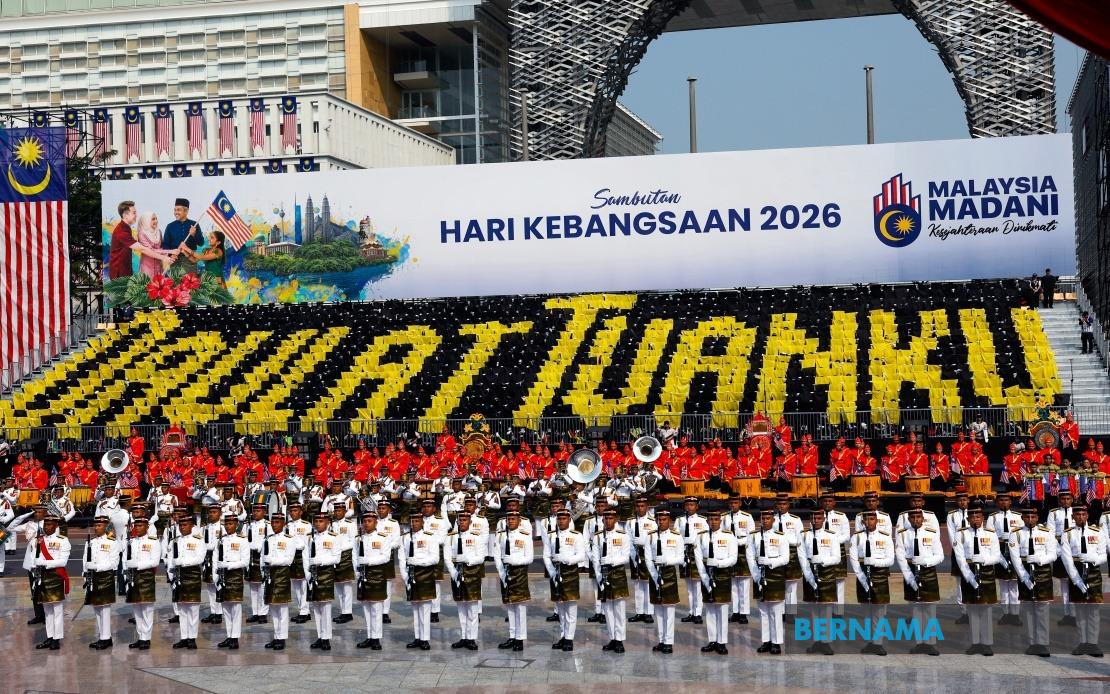
Dataran Putrajaya will transform into a focal point of national celebration tomorrow as Malaysia marks its 69th Independence Day with a carefully choreographed spectacle designed to reinforce patriotic sentiment and showcase the nation's capabilities. The Royal Malaysian couple, Sultan Ibrahim and Queen Raja Zarith Sofiah, will lead proceedings alongside Prime Minister Datuk Seri Anwar Ibrahim and his Cabinet, lending ceremonial gravitas to an event anchored on the "Malaysia MADANI: Kesejahteraan Dinikmati" theme, which emphasises shared prosperity and collective well-being.
The scale of tomorrow's gathering underscores the government's commitment to making National Day more than a perfunctory holiday. Organisers have mobilised 10,819 participants distributed across 76 contingents, complemented by 22 marching bands and 11 float vehicles. The display of state capacity extends to 328 military and aerospace assets drawn from land, naval, and air forces, alongside 112 working animals and 22 electric vehicles—a deliberate nod to contemporary environmental consciousness. This logistical coordination, beginning at 8:00 am, reflects months of planning to ensure seamless execution across multiple components addressing statehood, public well-being, security, and cultural expression.
The opening sequence will feature "Gema Inovasi MADANI," a performance coordinated by the National Department for Culture and Arts that attempts to bridge Malaysia's traditional and modern identities. Drawing on 150 musical instruments and 700 kompang frame drums, the performance will showcase percussion traditions representing the country's main ethnic communities. This artistic approach carries symbolic weight: by foregrounding traditional instruments in a contemporary context, organisers communicate a vision of Malaysia where heritage strengthens rather than impedes progress. The fusion concept reflects broader MADANI philosophy, which positions cultural continuity as compatible with innovation rather than antithetical to it.
Participating contingents reveal how the government structures national narrative around multiple reinforcing themes. The statehood component features uniformed services from the National Defence University and National Service Training Programme, anchoring the parade in institutional continuity and youth mobilisation. The National Resilience Leadership Academy's cadet officers represent the pipeline of future governance, while inclusion of the Johor Military Force—Malaysia's oldest military unit—invokes historical depth and institutional legitimacy. These symbolic choices frame the state as embedded in long-standing traditions of service and hierarchy while simultaneously projecting forward-looking aspirations.
The well-being and economic prosperity component diverges noticeably from traditional parade formality by incorporating private sector entities and consumer brands. Participation by Munchy's Malaysia, ZUS Coffee, MR. D.I.Y Group, and Carsome Sdn Bhd represents an unusual integration of commercial interests into state ceremony. This approach reflects the MADANI framework's emphasis on private-public partnership in delivering prosperity, positioning business not merely as economic actors but as stakeholders in national celebration. Such inclusion also broadens the parade's appeal beyond formal hierarchies, signalling that national progress encompasses entrepreneurial dynamism and consumer-facing commerce.
Public order and security components, represented by the Civil Defence Force, Road Transport Department, and Fire and Rescue Department, remind spectators of the unglamorous state functions that enable national stability. This deliberate visibility of protective institutions serves dual purposes: acknowledging essential workers often overshadowed by military pageantry while subtly reassuring citizens of state capacity to maintain order. The inclusion parallels international trends wherein contemporary nationalism incorporates civil society and emergency services alongside traditional defence imagery, reflecting post-9/11 securitisation frameworks where homeland protection pervades civilian life.
Cultural dimensions extend beyond opening performances into the parade's architectural presentation. Floats promoting the Visit Malaysia Year 2026-2027 campaign will display regional tourism assets, flora, fauna, and traditional attire, effectively turning the national parade into a travelling advertisement for domestic tourism. This convergence of patriotic ceremony with tourism marketing reflects economic realities: Malaysia's tourism sector remains pivotal to foreign exchange earnings, so National Day becomes an opportunity to cultivate international interest alongside domestic pride. The visual spectacle of regional diversity serves both nationalist and economic functions simultaneously.
Alliance with commercial airlines—Malaysia Airlines, AirAsia, Batik Air, and Air Borneo—further embeds national celebration within economic structures, while integration of animation characters Upin and Ipin, created by Les' Copaque, demonstrates calculated efforts to capture younger audiences. These creative partnerships extend National Day's reach beyond traditional state constituencies into family entertainment and commercial popular culture, ensuring multigenerational engagement rather than relegating the event to formal civic participation. The strategy acknowledges that modern national sentiment requires entertainment value alongside ceremonial solemnity.
The human graphics performance, coordinating 1,500 students from 36 Selangor schools into synchronised formations, represents another layer of mobilisation. School participation in state ceremonies has long served as pedagogical tool for instilling patriotic consciousness, but the scale and sophistication of this choreography—described as creating moving formations with music-synchronised visual changes—elevates routine youth participation into genuine artistic expression. This approach potentially fosters genuine emotional investment rather than rote compliance, allowing participants to experience nationalism as creative rather than merely prescriptive.
The Royal Malaysian Air Force's flyover will punctuate proceedings with unmistakable displays of state military capability, though framed within a defensive framework emphasizing sovereignty protection rather than aggressive projection. The airshow's timing as climactic finale ensures that memories of the day centre on images of fighter jets commanding national airspace, subtly reinforcing state territorial authority and defence capacity. This visual rhetoric proves particularly resonant given regional geopolitical tensions and maritime disputes, reminding both domestic and international audiences of Malaysia's military preparedness.
Singer Faizal Tahir's commissioned theme song "Aku Berjanji" (I Promise) concludes proceedings with musical reinforcement of civic commitment, the word "berjanji" invoking contractual obligation between citizen and state. This lyrical framing positions patriotism not as emotional sentiment but as reciprocal promise—citizens pledging loyalty while state pledges stewardship. The song's prominence as concluding emotional anchor suggests organisers view music as particularly effective vehicle for encoding national values.
Practical considerations underscore how state celebration intersects with environmental and security management. The Ministry of Home Affairs' advice to utilise public transport responds to massive road closures across Putrajaya's Core Island, affecting five major bridges and surrounding routes from 5:00 am on August 30 through 6:00 pm on August 31. This infrastructure disruption demonstrates the substantial urban impact required to stage such celebrations, potentially affecting commuters and commerce. Concurrently, recommendations that participants and spectators wear N95 masks due to current haze conditions, with organisers providing masks to over 10,000 participants, acknowledge environmental and health constraints that complicate outdoor patriotic ceremony in contemporary Southeast Asia.
Tomorrow's celebration ultimately represents more than ceremonial marking of independence; it constitutes a multi-layered communication strategy addressing diverse audiences through varied symbolic registers. Military assets emphasise security and state capacity; commercial participation signals economic dynamism; cultural performances invoke tradition while demonstrating innovation; youth mobilisation promises intergenerational continuity; and entertainment integration ensures popular accessibility. The MADANI framework unites these elements under a shared narrative of inclusive prosperity, positioning the state as capable of simultaneously honouring heritage, fostering economic growth, maintaining security, and enabling cultural expression. Whether spectators internalise this comprehensive vision or experience isolated elements remains ultimately unknowable, yet the scale of coordination suggests Malaysian leadership views National Day as consequential arena for nation-building.

