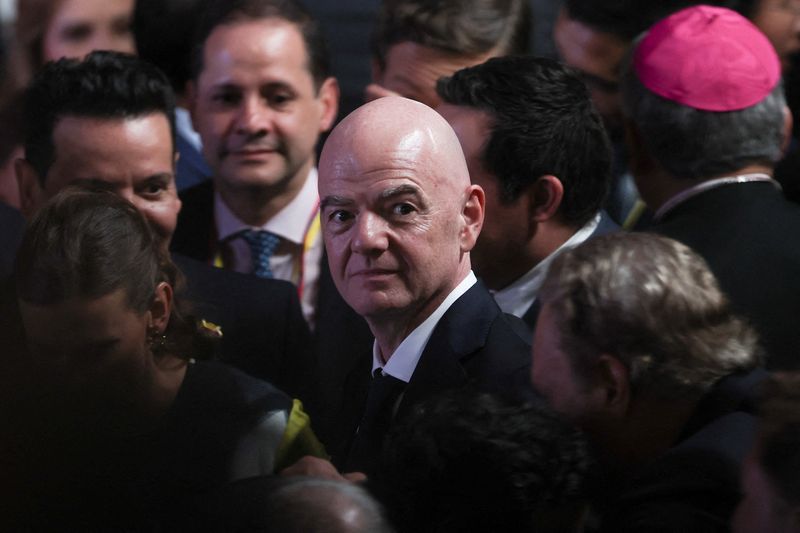
The institutional governance of Asian football has fractured visibly this week as Qatar pushed back against the Asian Football Confederation's participation in a coordinated assault on FIFA President Gianni Infantino's leadership. The rupture underscores deepening divisions within the AFC at a moment when the football confederation faces its most significant internal challenge in years, with three major confederations attempting to dislodge the incumbent leader ahead of elections scheduled for next year.
Qatar Football Association President Hamad bin Khalifa Al-Thani, who himself holds seats on both the AFC Executive Committee and the FIFA Council, submitted a formal letter to AFC President Sheikh Salman bin Ibrahim Al Khalifa alleging that neither he nor Qatar's national federation received advance notice of the confederation's decision to append its name to the joint statement. The timing and manner of the three confederations' announcement—UEFA, the AFC and CONCACAF releasing their critique simultaneously on Monday—caught the Qatari leadership by surprise, according to Al-Thani's correspondence reviewed by multiple news agencies. No draft was circulated among member associations for comment, he stressed, and no opportunity existed for federations to raise objections before the AFC formally committed to the position.
The substance of Al-Thani's objection cuts deeper than procedural niceties. His letter directly challenges the AFC's constitutional authority to claim that it speaks collectively for all 47 member associations without first obtaining their explicit consent. "A collective view must first be ascertained; it cannot be presumed, and it cannot be brought into existence by declaration," he wrote, articulating a legal principle that strikes at the heart of how the confederation operates. This framing transforms what might appear as a protest from one member into a broader institutional challenge: if the AFC can unilaterally issue statements in the name of all members without consulting them, what prevents the same federation from acting in ways that contradict the interests of individual nations?
The AFC did not respond to inquiries about Al-Thani's allegations, leaving his challenge effectively unanswered. This silence itself may constitute a strategic choice, suggesting that officials in the confederation's leadership prefer not to engage in public disputation that might further expose internal fractures. Yet the absence of a rebuttal allows Al-Thani's grievance to stand as the dominant narrative surrounding the AFC's intervention in FIFA's crisis.
Infantino, who launched his reelection bid for next year's FIFA election, has faced unprecedented organized pressure following his aborted proposal to fundamentally restructure FIFA's financial model. His scheme would have granted private investors access to approximately 20 percent of World Cup commercial rights, generating roughly $4.2 billion in capital. The three confederations—representing the vast majority of FIFA's national associations—issued a joint statement condemning both the proposal and Infantino's conduct, effectively calling for his removal before he seeks another term. This represented a rare show of unity among the otherwise frequently contentious regional bodies.
Yet that apparent unity masks significant fractures, particularly within Asia. Six heads of Arab national football associations, including Qatar and Morocco, issued a separate statement on Thursday expressing strong backing for Infantino. Notably, these leaders emphasized their appreciation for what they characterized as his efforts to advance football across all regions and strengthen the sport's capacity to unite communities globally. Four of the six signatories—Al-Thani from Qatar, Hany Abo Rida from Egypt, Fouzi Lekjaa from Morocco, and Ahmed Yahya from Mauritania—hold seats on the FIFA Council, giving their position considerable institutional weight within FIFA's governance structure.
The intervention by Arab federation chiefs reveals a significant geographical and strategic divide within Asian football. While the AFC leadership moved to align with UEFA and CONCACAF, a substantial faction within Asia's football establishment chose to distance itself from that position. Morocco, set to co-host the World Cup in 2030 alongside Uruguay and Paraguay, occupies a particularly delicate position, balancing its regional interests against broader AFC positions. The fact that Moroccan football leadership signed the pro-Infantino statement suggests that at least some nations within the AFC view the FIFA president as beneficial to their interests, particularly regarding future tournament hosting arrangements.
For Malaysian readers and Southeast Asian observers, the AFC's internal conflict carries practical implications for how Asian football will be represented in FIFA's governance moving forward. The confederation's ability to present a unified front diminishes when member federations openly challenge both the confederation's authority and its policy positions. This splintering could reduce Asia's collective influence over major decisions affecting the region's football development, from tournament allocations to governance reforms. Countries like Malaysia, which depend heavily on AFC coordination to advance their football interests at FIFA, face an environment of uncertain AFC leadership and unclear policy directions.
The broader context involves fundamental questions about FIFA's future direction and financial model. Infantino's proposal to privatize World Cup commercial rights represented a dramatic departure from FIFA's traditional structure and sparked concerns among confederations about governance, transparency and the equitable distribution of football revenues. The three confederations' opposition reflected their view that FIFA's decision-making processes had become insufficiently consultative and that Infantino had overstepped his authority by developing such a consequential proposal without adequate member engagement.
Qatar's challenge to the AFC positioning also reflects the nation's complex relationship with FIFA following its controversial hosting of the 2022 World Cup and its subsequent investments in global football governance. By staking out a position independent from other AFC members, Qatari leadership signals that it views its interests as distinct from those of the broader confederation and that it retains the capacity and willingness to operate independently within FIFA structures when it judges doing so advantageous.
The AFC's silence on Al-Thani's allegations leaves unresolved the fundamental question of how regional confederations should proceed when major policy conflicts arise. Should they seek unanimous approval from all members before issuing collective statements? Should they allow dissenting members to issue separate statements? These procedural questions carry profound implications for how football governance functions across Asia and globally. As the FIFA leadership crisis unfolds, the AFC's inability to present a coherent internal position may significantly weaken Asia's negotiating power in determining Infantino's political future and FIFA's institutional reforms.

