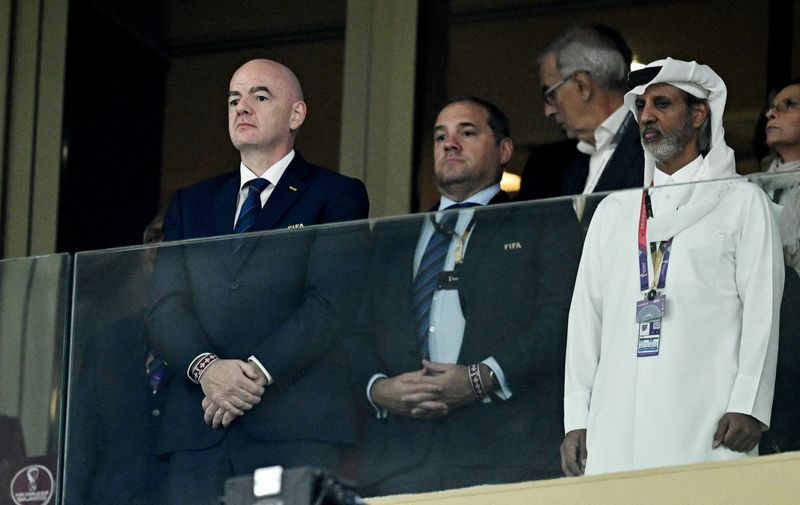
The Qatar Football Association has escalated tensions within Asian football governance by reiterating formal objections to the Asian Football Confederation's decision to publicly criticise FIFA President Gianni Infantino without first consulting its 47 member associations. In the latest instalment of an unusually transparent dispute, QFA President Hamad bin Khalifa Al-Thani has maintained that the AFC leadership overstepped its mandate when it joined UEFA and CONCACAF in signing an open letter targeting the embattled FIFA chief, who is preparing to contest reelection next year.
Infantino has become the focus of an unprecedented backlash within world football following the collapse of his FIFA Forward Enterprise proposal, which aimed to attract private investment into the World Cup tournament structure. The scheme was notably developed without meaningful engagement with confederation leadership or member nations, a process that critics argue highlighted a broader pattern of top-down decision-making at FIFA. The resulting coalition letter from three continental confederations questioned Infantino's leadership style and conduct regarding the aborted initiative, fundamentally challenging his authority at a critical moment in his political standing.
In his third formal correspondence on the matter, Al-Thani has dismissed the AFC's previous response as inadequate and evasive. He contends that the confederation's written reply essentially concedes that no genuine consultation occurred with either the AFC executive committee or individual member nations prior to the statement's public release. This procedural objection strikes at the heart of democratic principles within football governance, where confederations theoretically act as representatives of their constituent members rather than autonomous bodies with independent agendas. The distinction between organisational autonomy and membership accountability has become the central battleground in this escalating dispute.
The QFA president's argument gains particular force when applied to broader football politics. He notes that the AFC's defence of the letter rests primarily on justifications about the proposal's substance, FIFA's institutional conduct, and historical precedent, yet none of these arguments directly addresses the fundamental procedural question: whether member associations were properly consulted before their confederation's leadership committed them to a public position on such a significant matter. This framing transforms the dispute from a disagreement over Infantino's fitness for office into a constitutional question about how continental confederations should exercise power.
Al-Thani's position carries particular weight given his standing as both QFA president and a member of the FIFA Council, positions that provide him with direct insight into governance structures at multiple levels. His role on the AFC executive committee similarly grants him authority to speak on procedural matters affecting the confederation's internal operations. However, this double role has also made Qatar's position somewhat ambiguous—the nation is simultaneously an AFC member asserting membership rights and an insider challenging executive decisions, a duality that critics might suggest complicates Qatar's apparent impartiality.
The unusually public nature of this exchange represents a dramatic departure from traditional AFC conduct, which historically operates through private negotiations and behind-the-scenes diplomacy. Allowing such correspondence to circulate among the media indicates a fundamental breakdown in the confederation's traditional approach to internal dispute resolution. For Southeast Asian football observers, this public rupture within AFC leadership raises questions about institutional stability at a time when the confederation should be presenting unified governance to the global football community.
AFC President Sheikh Salman bin Ebrahim Al-Khalifa has robustly defended his authority to sign the joint letter without prior member consultation, arguing that he possesses both the constitutional right and the institutional responsibility to act decisively in protecting Asian football's interests. The Bahraini administrator has pointed to historical precedent, notably the AFC's public backing of Qatar's 2022 World Cup hosting, as evidence that confederation presidents routinely issue statements on matters of continental significance without exhaustive member consultation. He has also suggested that Qatar is engaging in obstructionist tactics by focusing on technical procedure rather than engaging substantively with the FIFA governance crisis.
Yet Al-Thani's counterargument distinguishes sharply between statements made in defence of Asia's institutional interests and statements attacking FIFA's elected leadership. He contends that when the AFC previously endorsed Qatar's World Cup bid, it was expressing a collective organisational position about a matter benefiting the confederation itself. By contrast, the letter attacking Infantino represents a political intervention in FIFA's internal affairs that extends beyond the AFC's institutional self-interest. This distinction suggests that different categories of statements may require different consultation thresholds—a principle that could reshape how confederations navigate future governance controversies.
The timing of this dispute intersects with a broader instability affecting FIFA's leadership. Infantino's reelection campaign faces genuine opposition for the first time in his tenure, with multiple confederations questioning his managerial competence. For Southeast Asian member nations, the AFC's internal fracturing over the letter raises practical concerns about the confederation's capacity to advocate for regional interests effectively. If the AFC is consumed by constitutional arguments about presidential authority, its ability to champion Southeast Asian positions in FIFA's upper echelons becomes correspondingly diminished.
Qatar's role in this controversy also reflects its complex positioning within Asian football. Despite being geographically and politically distinct from most AFC members, Qatar has invested heavily in football development and retained significant influence within confederation structures. The nation's decision to side with Infantino—among only six AFC members to do so—suggests that Qatar's interests may diverge from broader AFC consensus on FIFA governance. This realignment could have longer-term implications for how Qatar relates to its confederation, particularly regarding future continental tournaments or governance decisions.
Sheikh Salman's reference to previous AFC statements on World Cup hosting provides limited support for his position regarding the Infantino letter, as Al-Thani correctly observes. The previous statements advanced the AFC's collective interest in demonstrating Asia's capacity to host major tournaments. By contrast, the current letter intervenes in FIFA factional politics without advancing a clear AFC interest—unless one accepts that attacking Infantino serves the confederation's institutional welfare, a proposition that remains contested among membership.
The broader context reveals how the FFE proposal's failure has created unexpected fault lines throughout football governance. Infantino's initiative, whatever its merits, catalysed a challenge to FIFA's executive functioning that has rippled through continental structures. The AFC's public letter became a symbolic act of confederation independence, yet it simultaneously exposed questions about how confederations balance institutional autonomy with membership representation. Qatar's persistence in raising procedural objections reflects a conviction that governance architecture matters fundamentally to equitable decision-making in international sport.
Moving forward, the AFC faces pressure to clarify its constitutional position on executive authority and membership consultation. The confederation's silence regarding Al-Thani's latest correspondence suggests an institutional reluctance to engage further in public controversy, yet this approach risks leaving fundamental governance questions unresolved. For Malaysian readers and other Southeast Asian observers, the dispute underscores how continental football politics increasingly intersects with larger questions about democratic accountability and institutional legitimacy—issues extending well beyond the sport itself.

