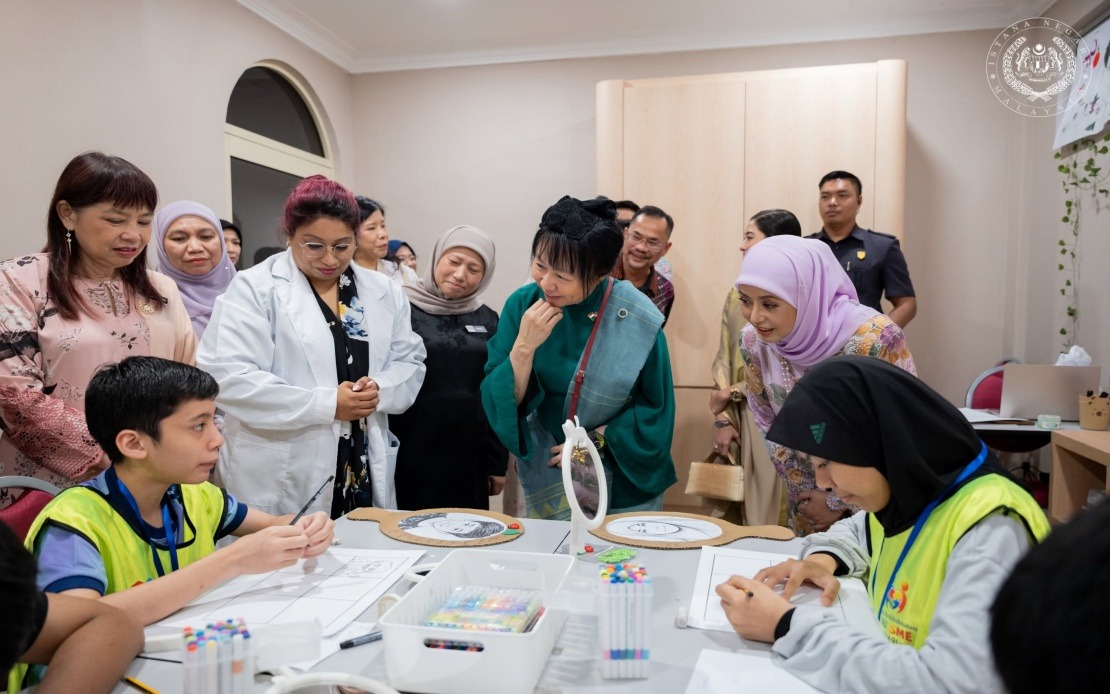
Her Majesty Raja Zarith Sofiah, Queen of Malaysia, received Singapore First Lady Jane Ittogi Shanmugaratnam at the Bangi Autism Service Centre near Kuala Lumpur on Thursday as part of the high-level state visit by Singapore President Tharman Shanmugaratnam. The engagement underscores the deepening social sector cooperation between the two neighbouring nations and reflects how both countries are prioritising disability support services at the highest levels of government.
The visit, which took place in the morning, formed part of a broader itinerary designed to strengthen bilateral relations during the Singapore President's official stay in Malaysia. Jane Ittogi was warmly received by Her Majesty upon arrival, joined by Tunku Tun Aminah Sultan Ibrahim in welcoming the distinguished visitor. The carefully choreographed programme demonstrated Malaysia's commitment to showcasing its autism support infrastructure to international partners and reinforced the shared understanding between the two nations regarding social welfare advancement.
Several senior Malaysian officials participated in the tour, reflecting the government's multi-agency approach to autism services. Prime Minister's wife Datuk Seri Dr Wan Azizah Wan Ismail attended the visit, alongside Women, Family and Community Development Minister Datuk Seri Nancy Shukri and Deputy Minister Lim Hui Ying. The presence of ministry leadership, including secretary-general Datuk Dr Maziah Che Yusoff and Social Welfare Department director-general Datuk Che Murad Sayang Ramjan, highlighted the significance accorded to disability and family services within Malaysia's governance structure.
During the facility tour, the Queen and Singapore's First Lady examined the centre's key operational areas, which include the Activities of Daily Living room, where individuals with autism learn practical independent living skills; the Occupational Therapy Room; and gymnasium facilities. This hands-on observation provided insight into Malaysia's holistic therapeutic methodology, which integrates physical development, occupational rehabilitation, and daily functioning capacity-building. Such comprehensive approaches are increasingly recognised as essential in autism service delivery across the region.
Minister Nancy Shukri used the occasion to disclose significant epidemiological data about autism prevalence in Malaysia. As of June of the previous year, 93,199 individuals with autism had been formally registered with the Social Welfare Department, representing a substantial increase from previous years. The minister projected that this figure would continue expanding as public consciousness regarding autism spectrum disorder improves and diagnostic services become more accessible across Malaysian communities. This upward trajectory reflects both genuine increases in identification and improved reporting mechanisms.
The rising registration numbers carry important implications for resource allocation and service planning across Malaysia and the broader Southeast Asian region. As families gain greater awareness of autism characteristics and access to screening programmes improves—particularly in urban centres—demand for intervention services is intensifying. Malaysian policymakers face mounting pressure to scale up infrastructure, training for healthcare providers, and support systems to accommodate this growing population. The Bangi centre's model provides one template for how public-private partnerships can address these expanding needs.
The Bangi Autism Service Centre operates through a distinctive collaborative framework involving government and non-governmental sectors. The National Autism Society of Malaysia and the Damansara Damai Community-Based Rehabilitation Centre partner with public agencies in delivering services. This hybrid approach combines government resources and regulatory oversight with the flexibility, specialisation, and community engagement that NGOs typically bring. Such partnerships have become increasingly important as demand outpaces government capacity, particularly in developing economies where public budgets face competing pressures.
For Singapore, which has invested substantially in autism services and early intervention programmes, the visit represented an opportunity to understand different implementation strategies and comparative effectiveness across the region. Malaysia's emphasis on daily living skills and occupational therapy aligns with international best practice, though resource constraints and geographic dispersal across peninsular Malaysia and Sabah-Sarawak present distinct operational challenges compared to Singapore's city-state context. Cross-border learning in social services strengthens regional capacity and allows policymakers to adapt successful models to their own circumstances.
The bilateral engagement also carries symbolic weight in affirming both nations' commitment to inclusive society principles. High-level official participation signals that disability support is not a marginal social policy concern but rather integral to national development agendas. For Malaysia, hosting the Singapore First Lady at a specialist autism facility demonstrated that the country takes seriously its obligations toward vulnerable populations and recognises the centrality of family support services to social cohesion. Such messaging resonates particularly across Southeast Asia, where disability rights advocacy continues strengthening.
Looking forward, Malaysia's expansion of autism services reflects broader regional trends toward deinstitutionalisation, community-based rehabilitation, and family-centred support models. Countries across Southeast Asia are transitioning away from institutional approaches toward community integration and skill-building focused on independence and social participation. The Bangi centre exemplifies this shift, prioritising practical functioning and community engagement rather than custodial care. As Malaysia's registered autism population continues growing, sustaining and expanding such models will prove essential for equitable service access.
The state visit provides momentum for deepening Malaysia-Singapore cooperation on social welfare innovation and policy exchange. Both nations face similar demographic pressures, rising incidence of developmental disorders, and resource constraints that demand creative solutions. Future collaboration could encompass staff exchange programmes, shared training initiatives for therapists and educators, and comparative research examining service effectiveness across different implementation contexts. Such partnerships strengthen the entire region's capacity to serve vulnerable populations effectively and compassionately.

