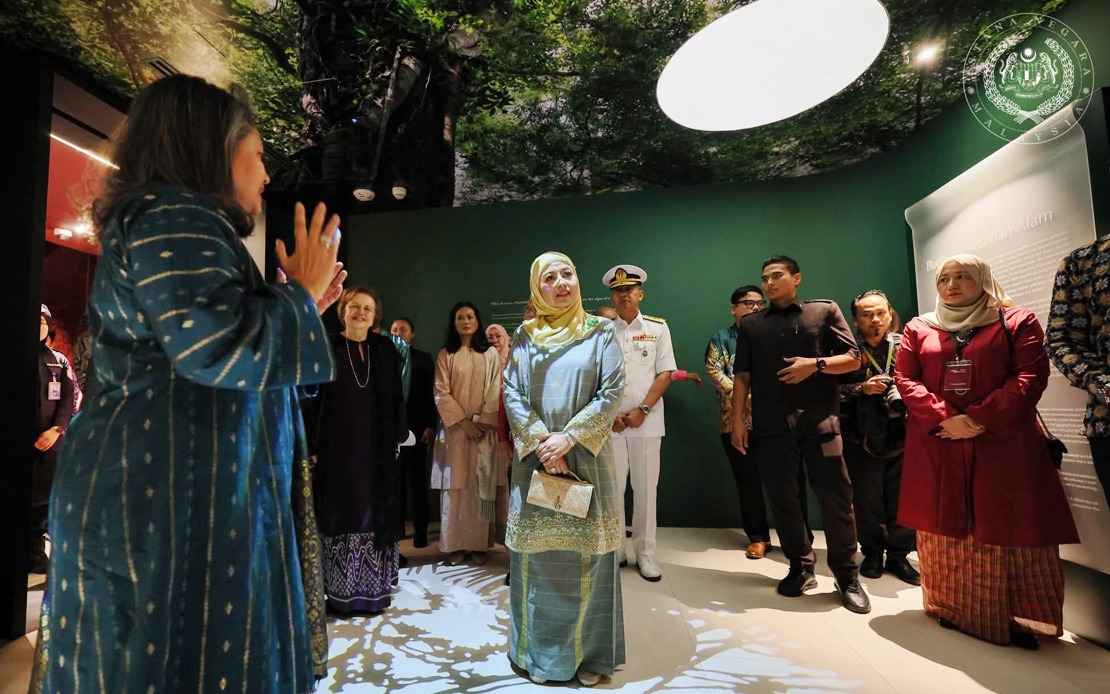
Her Majesty Raja Zarith Sofiah, Queen of Malaysia, formally inaugurated the Merdeka Textile Museum today at the Menara Merdeka Maybank complex in Kuala Lumpur, underlining the nation's commitment to safeguarding its rich cultural legacy for future generations. The ceremonial opening marks a significant moment in Malaysia's efforts to document and celebrate the textile traditions that have defined Malay identity across centuries, bringing together heritage preservation with contemporary museum practices.
The museum's establishment represents a collaborative initiative led by PNB Merdeka Ventures Sdn Bhd, a subsidiary wholly owned by Permodalan Nasional Berhad, one of Malaysia's largest government-linked investment vehicles. The institution's founding philosophy centres on elevating textile heritage beyond passive display, instead employing immersive storytelling methods and interactive cultural programming to engage visitors in meaningful dialogue with Malaysia's material culture. This approach reflects evolving museological standards that prioritize participatory learning experiences over traditional exhibition models.
During the opening ceremony, the Queen stressed the universal necessity of recognizing, treasuring, and transmitting national heritage across generations. She articulated a vision of cultural continuity in which traditional practices remain not as historical artifacts but as living dimensions of contemporary Malaysian identity. The Queen's remarks particularly emphasized the relationship between cultural expression and national values, positioning textile traditions as tangible manifestations of the principles and social structures that undergird Malaysian society.
The Queen further expressed hopes that the museum would establish itself as a premier destination for education and cultural inquiry, extending its influence beyond academic circles to inspire Malaysian women currently and in years ahead. She appealed specifically to younger citizens to engage actively with the nation's cultural inheritance, cautioning against the gradual erosion of traditions through neglect and generational disconnection. These statements articulated concerns about cultural preservation that resonate throughout Southeast Asia, where rapid modernization increasingly challenges the transmission of heritage knowledge to younger cohorts unfamiliar with traditional practices.
At the museum's core lies an extraordinary private collection donated by the Azah Aziz family, honouring the late Sharifah Azah Syed Mohammed Alsagoff, a woman whose life bridged Malaysia's colonial and post-independence eras. Azah Aziz was married to the late Prof Diraja Ungku Abdul Aziz Abdul Hamid, a towering intellectual figure in Malaysia's development, and served as mother to Tan Sri Dr Ungku Zeti Akhtar Aziz, who pioneered modern central banking practices as the former governor of Bank Negara Malaysia. The family's decision to donate this collection represents a deliberate act of public stewardship, transforming private heritage into a resource accessible to the broader Malaysian community.
The assembled collection comprises 240 individual garments and 69 pieces of traditional jewellery, each item documenting specific moments in Malay textile evolution and aesthetic sensibility. The inventory includes songket sarong, which represent some of Southeast Asia's most complex and labour-intensive weaving traditions, alongside Limar Baju Kurung and Tekat Emas pieces that exemplify embroidery techniques passed through generations of craftspeople, predominantly women. These pieces collectively narrate the story of Malay sartorial culture while simultaneously preserving the technical knowledge embedded within their construction.
The museum's physical infrastructure reflects international best practices in heritage conservation and presentation. Spanning eight distinct galleries, the facility provides thematic exploration of various textile traditions while remaining accessible to visitors with diverse levels of expertise. Beyond exhibition spaces, the institution incorporates a dedicated study centre housing a conservation laboratory where specialist technicians employ contemporary scientific methods to preserve delicate fabrics and prevent deterioration. This infrastructure supports long-term curation while enabling researchers to conduct detailed examination of textile materials, dye composition, and construction techniques that illuminate historical production practices.
Complementing conservation work, the museum maintains a comprehensive fabric library and textile knowledge centre that function as research resources for academics, designers, and cultural practitioners. These facilities enable comparative analysis across regional textile traditions while documenting craft techniques that remain partially transmitted through apprenticeship rather than written documentation. For Malaysian and Southeast Asian creative industries, such institutional repositories increasingly serve as vital repositories of traditional knowledge that contemporary designers reference when developing culturally-rooted contemporary works. This bridge between heritage preservation and creative production reflects emerging museum philosophy that resists framing tradition and modernity as opposing forces.
The ceremonial gathering included significant government representation, with Hannah Yeoh, Minister in the Prime Minister's Department (Federal Territories), attending alongside Tan Sri Shamsul Azri Abu Bakar, Chief Secretary to the Government. The presence of Raja Tan Sri Arshad Raja Tun Uda, chairman of the PNB group, underscored the initiative's positioning within Malaysia's broader development agenda. This institutional alignment signals recognition at the highest governmental levels that cultural preservation constitutes a legitimate and valued component of national development, rather than an ancillary concern subordinate to economic or infrastructure priorities.
For Malaysian readers and regional observers, the Merdeka Textile Museum's opening reflects broader Southeast Asian trends toward revitalizing heritage institutions and repositioning cultural preservation as contemporary practice rather than nostalgic retrospection. The museum arrives at a moment when rapid globalization, digital disruption, and generational shifts increasingly threaten traditional knowledge transmission systems. By combining scholarly conservation with public education and creative industry engagement, the institution attempts to situate textile heritage within living cultural practice rather than confining it to historical repositories. This approach carries implications for how Malaysia and neighbouring nations conceptualize the relationship between tradition and modernity, suggesting frameworks where heritage enhancement and national development advance in tandem rather than competition.

