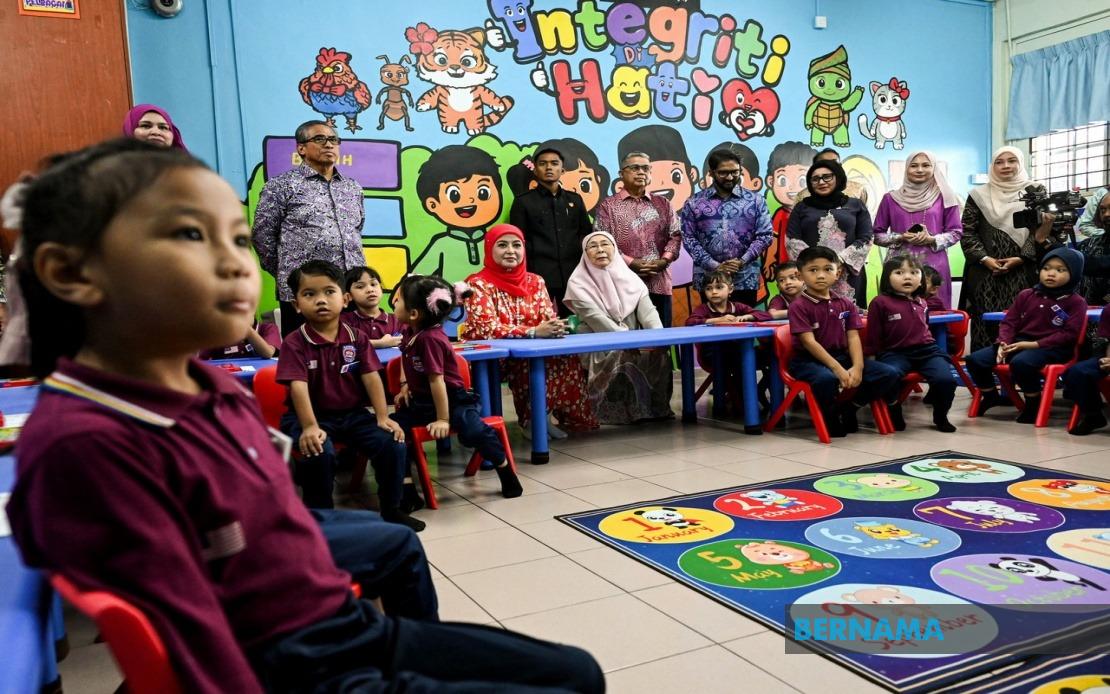
Her Majesty Raja Zarith Sofiah, Queen of Malaysia, officially launched the Children's Integrity Module at Tabika Perpaduan Taman Bukit Cheras in Kuala Lumpur on August 27, signalling the government's commitment to embedding ethical values at the foundation of childhood development. The event underscores a strategic pivot towards character-building education during the formative years, reflecting broader national concerns about civic responsibility and institutional trust that have become increasingly central to Malaysia's governance agenda.
The Queen's presence at the module's unveiling lent considerable gravitas to the initiative, with her arrival at 9.45 am accompanied by a high-level delegation including National Unity Minister Datuk Aaron Ago Dagang, Chief Secretary to the Government Tan Sri Shamsul Azri Abu Bakar, and Bandar Tun Razak Member of Parliament Datuk Seri Dr Wan Azizah Wan Ismail. Beyond ceremonial function, this gathering represented a convergence of education, integrity promotion, and political leadership, illustrating how the government views character education as intersecting multiple policy priorities.
Following the formal launch proceedings, Her Majesty toured classroom facilities where the module's curriculum was being demonstrated, observing firsthand how educators translate integrity concepts into interactive learning experiences for preschool-aged children. These practical demonstrations revealed the pedagogical approach underpinning MIKa, which transforms abstract ethical principles into age-appropriate activities and scenarios that resonate with children's daily experiences.
Tan Sri Shamsul Azri articulated the philosophical foundation guiding this initiative during his address, emphasising that integrity cannot be imposed through legislation alone but must take root through early habituation. His remarks reflected a developmental psychology perspective increasingly accepted in education circles: that establishing ethical frameworks during early childhood creates more durable and intrinsic commitments to principled behaviour than interventions attempted during adolescence or adulthood. This approach acknowledges that character formation operates according to different mechanisms in young children compared to older populations.
The Malaysian Institute of Integrity developed MIKa specifically for children between two and six years old, a demographic span covering the critical period when cognitive schemas and behavioural patterns begin solidifying. By targeting this age group, policymakers aim to establish baseline expectations around honesty, responsibility, and trustworthiness before competing influences and habits become entrenched. The module's focus on early childhood education reflects international best practices from jurisdictions that have similarly invested in values-based curricula during preschool years.
Ambitions for the programme's expansion are notably ambitious. Officials have projected that by 2030, MIKa will permeate Malaysia's entire early childhood education ecosystem, encompassing more than 31,000 childcare centres, kindergartens, and preschools nationwide. This expansion trajectory represents a substantial institutional undertaking, requiring coordination across private and public sectors and standardisation of training protocols for educators. For Malaysia's early childhood sector, this represents one of the most comprehensive curriculum rollouts attempted in recent years.
The module's development process involved intensive collaboration with thirty-five early childhood education specialists, signifying a research-informed rather than purely ideological approach. Alongside expert input, the initiative garnered support from multiple government ministries, statutory agencies, higher education institutions, and civil society organisations involved in early childhood education. This multi-stakeholder architecture suggests recognition that embedding integrity values across thousands of institutions requires consensus-building and institutional buy-in beyond any single government department.
Tan Sri Shamsul Azri framed the larger purpose of this initiative beyond technical skill acquisition or academic competency, positioning it as foundational to Malaysia's long-term national character development. His statement that the launch signified the beginning of efforts to cultivate a Malaysian generation distinguished by honesty, trustworthiness, responsibility, and principled conduct acknowledged that educational interventions represent investments in social capital and institutional reliability. These qualities carry direct implications for economic competitiveness, governance effectiveness, and social cohesion.
While the module targets institutional settings, Tan Sri Shamsul Azri also emphasised parental responsibility as complementary to formal education, noting that parents serve as primary role models whose demonstrated integrity shapes children's values more profoundly than curriculum content alone. This recognition that integrity education succeeds only when reinforced across multiple environments including households reflects systemic thinking about behavioural change. For Malaysian families, the implicit message positions parental conduct as integral to national integrity-building efforts.
For the early childhood education sector, MIKa's rollout presents both opportunities and implementation challenges. Childcare centres and preschools operating under varying regulatory frameworks and resource constraints will need support—whether through training programmes, educational materials, or monitoring mechanisms—to effectively deliver integrity-focused curriculum alongside existing academic and developmental objectives. The 2030 timeline permits gradual implementation, yet still requires sustained political will and resource allocation over an eight-year horizon.
The initiative carries broader implications for Southeast Asian education trends, positioning Malaysia among regional peers increasingly integrating values-based curricula into formal schooling. As countries across the region grapple with governance challenges and public trust concerns, early childhood education offers a preventative approach to fostering institutional integrity. Malaysia's large-scale commitment to this model may influence policy discussions in neighbouring jurisdictions facing similar governance concerns.
From a developmental perspective, embedding integrity concepts during ages two to six when children's moral reasoning capacities are nascent requires pedagogical sophistication. Educators must translate complex principles into concrete, observable actions—sharing fairly, following through on promises, admitting mistakes—that young children can understand and practice. The success of MIKa ultimately depends less on curriculum design than on the quality of implementation across thousands of diverse childcare and preschool settings with varying resource levels and professional expertise.
As Malaysia pursues this comprehensive character-education initiative, long-term impact assessment will prove crucial. Rigorous evaluation tracking MIKa participants' subsequent academic achievement, civic engagement, and institutional trust levels could provide valuable evidence regarding whether early childhood integrity education yields measurable societal outcomes. Whether this generational investment in values-based education produces the anticipated cultural shift toward greater honesty and trustworthiness remains an empirical question that will unfold across the coming decade.

