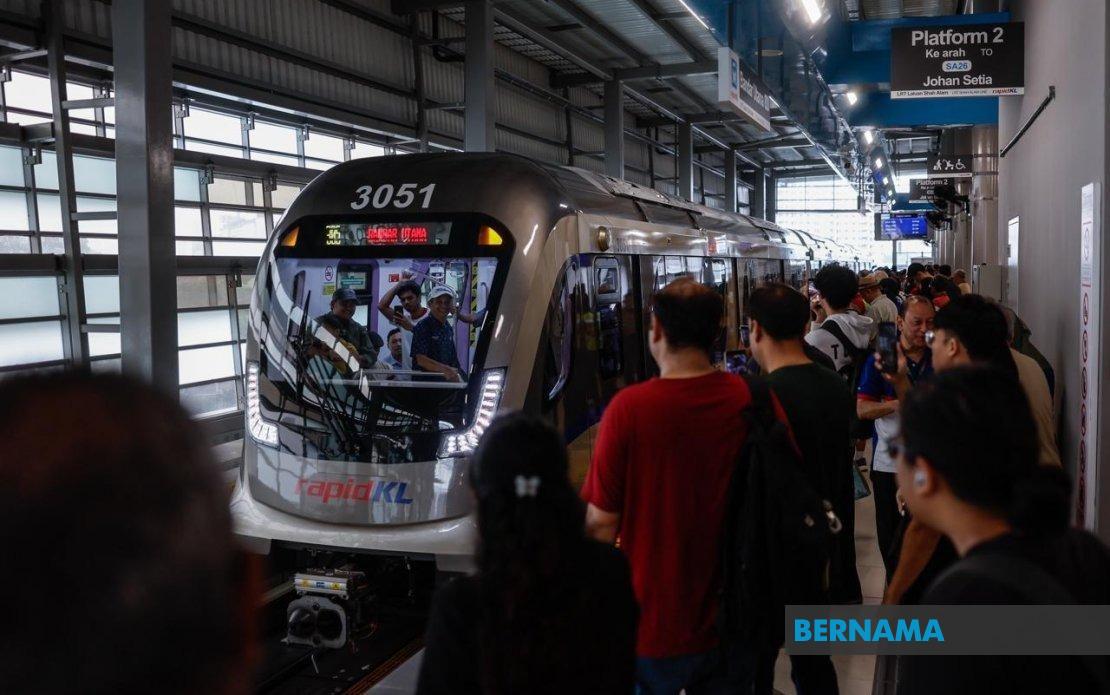
The operator of Malaysia's Light Rail Transit 3 Shah Alam Line announced on July 31 that it would prolong its free-fares initiative, maintaining zero-cost travel for passengers until August 14. Rapid KL disclosed the extension via its official social media channels, signalling a strategic decision to sustain momentum in promoting the newly operational corridor that spans Petaling Jaya, Shah Alam and Klang.
The rationale underpinning the decision reflects Rapid KL's commitment to encouraging broader adoption of the metropolitan rail network among commuters who may still be evaluating the service's reliability and convenience. By extending the promotional period beyond the original July 31 deadline, the transport authority seeks to remove financial barriers that might otherwise discourage trial usage among hesitant passengers. This approach acknowledges that behavioural shifts toward public transit demand sufficient exposure and positive experience accumulation before consumer confidence solidifies.
During this extended window, travellers will continue enjoying complimentary access not merely to the rail service itself, but also to feeder mechanisms including shuttle buses and Park N' Ride facilities stationed throughout the corridor. This bundled offering represents a comprehensive subsidy strategy designed to address the full journey experience rather than isolated transit components. By eliminating friction at multiple touchpoints—the first-mile problem, the final-mile challenge, and parking concerns—Rapid KL removes practical obstacles that commonly dissuade car-dependent commuters from switching modes.
The operator's promotional framing emphasises the potential for reduced commuting costs and enhanced quality of life for daily travellers across this strategically significant corridor. Petaling Jaya, Shah Alam and Klang collectively represent a substantial employment and residential nexus within the Klang Valley, meaning the LRT3 network theoretically addresses genuine travel demand among a sizable demographic. For cost-conscious commuters, the extended free period offers tangible respite from transport expenses during economically uncertain times.
Rapid KL's statement explicitly invokes public confidence in Malaysia's broader transport infrastructure, framing the Shah Alam Line as emblematic of national commitment to modern, comfortable mass transit. This positioning carries political resonance, particularly given the public sector's historical struggles with service reliability and passenger satisfaction. By extending the free period and actively promoting the line's capabilities, the operator attempts to reshape perceptions of public transport viability as an alternative to private vehicles—a critical objective given the Klang Valley's chronic traffic congestion.
The extension also serves promotional purposes for stakeholders beyond passengers themselves. Property developers marketing residential and commercial projects along the corridor benefit from enhanced transport accessibility narratives. Businesses seeking to relocate or establish operations increasingly consider transit connectivity as essential infrastructure, meaning improved LRT3 utilisation potentially unlocks investment opportunities across the three municipalities served.
Prime Minister Datuk Seri Anwar Ibrahim's June 28 declaration of free fares through July 31 represented the initial policy framework. His announcement during the official Shah Alam Line LRT3 launching ceremony at the Johan Setia LRT Depot in Klang underscored governmental endorsement of the infrastructure investment. The subsequent extension by Rapid KL indicates sustained political backing for the free-travel experiment, suggesting confidence that usage patterns during this period will justify continued operations and potential future fare-subsidisation schemes.
Operational considerations likely influenced the extension decision as well. Initial service periods often reveal capacity constraints, technical issues and passenger flow patterns requiring calibration. Extended free travel permits Rapid KL to accumulate more comprehensive data regarding peak demand, passenger demographics and service vulnerabilities while avoiding revenue pressure that might force operational cutbacks during this critical establishment phase. The extended period essentially functions as an extended pilot programme, generating operational intelligence that will inform future service adjustments and maintenance scheduling.
From a broader policy perspective, the extension aligns with national aspirations toward sustainable urban mobility and carbon footprint reduction. Klang Valley congestion contributes substantially to Malaysia's urban air quality challenges and economic inefficiencies stemming from lost productivity during commutes. Every vehicle removed from congested roadways through transit mode-switching theoretically generates positive externalities benefiting the entire metropolitan region, even if individual commuters incur no direct savings during the free period.
Rapid KL's guidance that passengers plan journeys systematically and observe all safety regulations reflects operational professionalism during a high-visibility promotional phase. Extended free travel frequently generates overcrowding and rule-compliance challenges; proactive communication about conduct expectations attempts to mitigate negative experiences that might otherwise undermine the initiative's core objective of building positive associations with the service.
The August 14 endpoint for the extended free period remains provisional. Should usage data and passenger feedback prove sufficiently positive, further extensions remain plausible, particularly if political priorities continue emphasising public transport expansion. Conversely, if utilisation patterns disappoint or operational challenges emerge, the deadline may mark transition toward standard fare implementation. This flexibility reflects contemporary policy pragmatism, acknowledging that infrastructure investments require iterative adjustment rather than rigid implementation of predetermined timelines.

