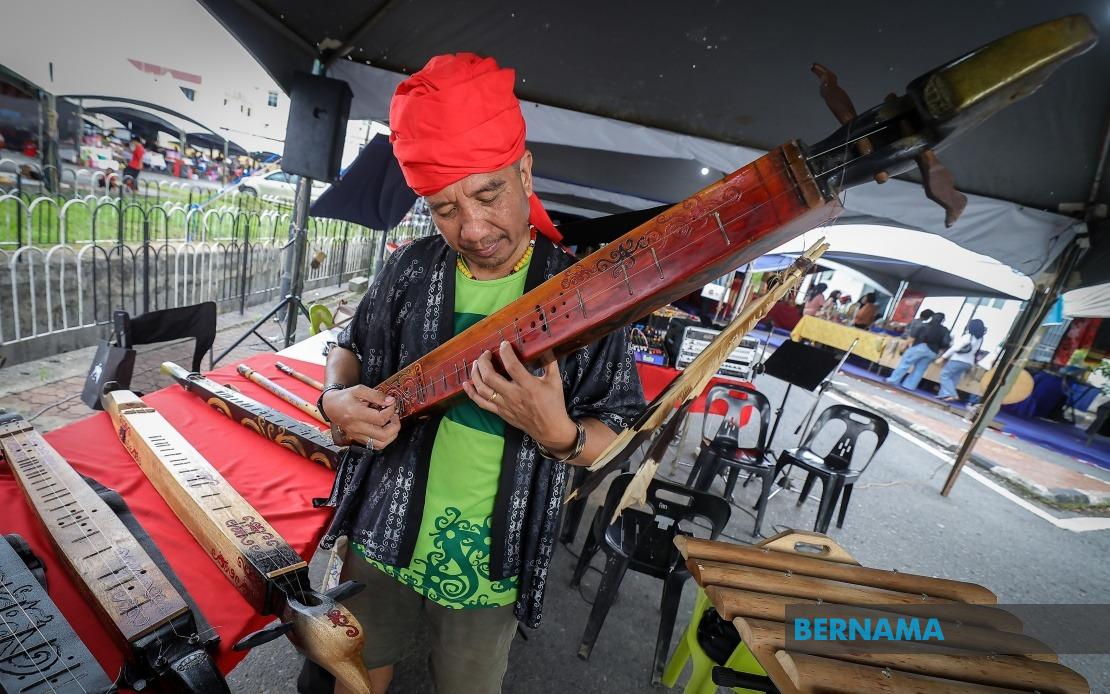
Sarawak-based musician Rining Peter Paris is amplifying the voice of an indigenous community through music, channelling nearly a decade of work preserving the Tapi', a traditional two-string plucked instrument central to Lun Bawang identity. His latest single, 'Sigar Suba', unveiled in July and performed alongside his band Bata' Uduh, represents a deliberate shift in artistic direction—one that places male representation and cultural pride at the forefront of his musical storytelling.
The 53-year-old composer crafted 'Sigar Suba' as a counterpoint to the feminine-centred themes that have dominated much of his earlier catalogue, including tracks like 'Busak Baku' and 'Busak Elai', which explored the beauty of traditional beadwork and natural landscapes. This new work deliberately celebrates the visual and cultural markers of Lun Bawang manhood, with lyrics composed entirely in the Lun Bawang language providing a meticulous inventory of traditional male regalia and their ceremonial significance.
The song's title itself carries layered meaning. 'Sigar' denotes a distinctive red headpiece worn by Lun Bawang men during important gatherings and celebrations, while 'suba' translates to the colour red. Together, these words encapsulate a single but iconic garment that serves as a visual anchor for cultural identity. The headpiece and accompanying attire—including the kuyu talun bark shirt, pelepet machete, and tusk ornaments—are woven into the narrative of the track, creating a detailed portrait of heritage through material culture.
Rining's motivation for this compositional turn stemmed from observing an imbalance in how Lun Bawang culture had been documented and celebrated in song. He recognised that while female cultural expression, particularly through adornment, had received artistic attention, a comparable musical tribute to male identity and tradition remained absent. This observation prompted him to commission 'Sigar Suba' as a corrective measure, ensuring that younger generations of Lun Bawang men would encounter their own cultural markers celebrated in contemporary music.
The musical arrangement blends traditional instrumentation with modern sensibilities, incorporating the Tapi' alongside the Pek Bu, Ruding, and xylophone while drawing influences from reggae and world music fusion. This strategic fusion serves a specific purpose: making the authentic sound of indigenous tradition accessible and engaging to younger audiences who might otherwise dismiss heritage music as archaic. By filtering ancient instruments through modern genres, Rining creates a bridge between generational listening habits and cultural preservation.
Rining's commitment to the Tapi' extends beyond performance into artisanal craftsmanship. As an instrument maker, he has individually crafted and distributed 66 Tapi' instruments across Malaysia and the international diaspora, with instruments now residing in households across Australia, the United States, and Canada. This hands-on production model ensures quality control and maintains the integrity of traditional construction methods while simultaneously creating economic opportunity within the community. The instrument's growing international footprint, including interest from Malaysian experimental musician Belle Sisoski, suggests emerging recognition of the Tapi' beyond regional Lun Bawang communities.
The strategic release of 'Sigar Suba' across major streaming platforms signals an understanding of how contemporary indigenous artists must navigate distribution channels to achieve meaningful reach. By securing placement on digital platforms alongside global music catalogues, Rining positions Lun Bawang cultural expression within the same legitimate cultural space as mainstream commercial music, rather than relegating it to niche or specialised categories.
Rining's longer-term vision extends to professional consolidation of his dual identity as musician and instrument maker. He has articulated an ambition to transition toward full-time engagement with Tapi' production and original composition by 2028, a five-year horizon that suggests considered planning rather than aspirational rhetoric. This timeline acknowledges the financial realities of sustaining cultural work while building sufficient reputation and income streams to make such a transition viable.
For Southeast Asian audiences, Rining's work carries particular resonance. Across the region, indigenous communities face sustained pressure to assimilate into dominant cultural narratives, with younger generations increasingly disconnected from ancestral languages, instruments, and ceremonial practices. The Lun Bawang experience reflects broader challenges facing the region's First Peoples. Rining's approach—embedding cultural markers within contemporary musical forms rather than presenting heritage as historical artifact—offers a template for how indigenous artists elsewhere might achieve cultural transmission without sacrificing artistic contemporaneity.
The emphasis on generational transmission is deliberate and urgent. Rining explicitly frames 'Sigar Suba' as a message directed at younger Lun Bawang people, particularly young men, to sustain connection with their inherited identity. This intergenerational communication strategy recognises that cultural survival depends not on preservation in amber but on active re-engagement by those who carry the culture forward.
The release of 'Sigar Suba' also reflects evolving perspectives within Malaysia regarding indigenous cultural value. Where such traditions were historically marginalised or treated as folkloric curiosities, there is growing institutional and commercial recognition of their artistic merit and commercial potential. Rining's ability to produce and distribute instruments internationally while accessing streaming platforms suggests an ecosystem increasingly supportive of indigenous cultural entrepreneurship.
Beyond the immediate musical achievement, 'Sigar Suba' documents a moment of cultural assertion—an indigenous artist claiming narrative space to define his community's identity on its own terms, using its own language, and celebrating dimensions of that identity previously underrepresented in artistic discourse. This act of documentation through music creates a cultural record for future generations while affirming present-day relevance. The track becomes both preservation mechanism and contemporary artistic statement, serving the dual function essential to sustainable cultural work in the modern era.

