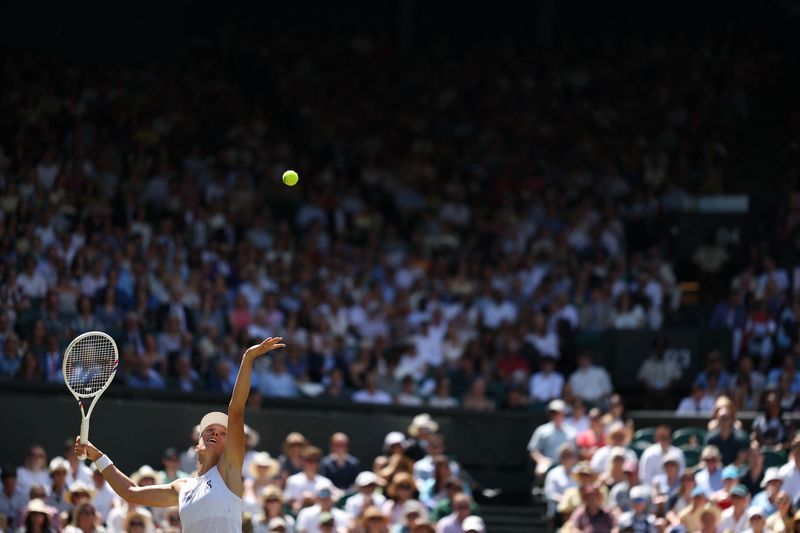
Alexandra Eala's breakout moment arrived under the bright London sun as the rising Filipino competitor dismantled Iga Swiatek's Wimbledon title defence on Saturday, claiming a commanding 7-6(9) 6-2 victory in their Centre Court encounter. The result represents a seismic shift in their recent head-to-head record and marks perhaps the most significant triumph of Eala's fledgling professional career, propelling her into the fourth round of tennis's most prestigious grass court championship.
Swiatek entered the tournament as the defending champion and third seed, having conquered her long-standing limitations on fast courts when she lifted the trophy twelve months earlier. That 2023 triumph had addressed persistent criticism about her effectiveness away from the clay surfaces where she has dominated global tennis. However, the 25-year-old Pole arrived at the All England Club in considerably diminished form, having suffered an early elimination at the Bad Homburg warm-up event just days before the main tournament commenced.
Eala's aggressive baseline game proved immediately problematic for Swiatek, whose own powerful groundstrokes typically serve as her primary attacking weapon. The lefthand-hitting Filipino unleashed sustained pressure from the back of the court during the opening set, forcing her opponent into uncomfortable positions and dictating rally construction with authoritative shot-making. The first set evolved into an absorbing examination of competitive will and tactical acumen, with both players resisting any concession and maintaining parity throughout.
The tiebreak sequence that concluded the opening set illustrated the intensity of their contest, with Eala ultimately prevailing 9-7 in the breaker after a lengthy back-and-forth struggle. The emotional toll visibly registered on Swiatek, who initially managed a forced smile but soon descended into visible frustration, directing comments toward her coaching staff in the stands and striking her chair with her racket in evident exasperation. By contrast, Eala basked in the approving roar from the crowd, having earned the admiration of the spectators through her fearless and aggressive approach.
Momentum shifted decisively in Eala's direction as the second set commenced. The Filipino competitor immediately seized the initiative, establishing an early double break to lead 3-0 and seizing control of the match's trajectory. This commanding start appeared to have settled the contest, though Swiatek briefly rallied with a break recovery that hinted at a potential resurgence in the late stages. Her hopes of a comeback proved illusory, however, as Eala's concentration never wavered and her serving held sufficiently firm to repel any serious threat.
The victory carries particular significance given their complex recent history. Eala had previously administered a defeat to Swiatek at the Miami tournament last year, only to see the Polish player exact revenge when they subsequently clashed on Madrid's clay courts. The grass court environment at Wimbledon, however, neutralized whatever advantages the European surface specialist might have possessed. Eala's game, built upon aggressive baseline exchange and powerful stroke execution, translated seamlessly to the faster court conditions where rapid ball movement and prompt decision-making determine outcomes.
This upset carries meaningful implications for the broader tennis landscape, particularly for Asian competitors seeking representation among the sport's elite. Eala's triumph demonstrates that emerging players from the region can compete effectively against established top seeds when tactical preparation and mental composure align favorably. For Philippine tennis specifically, the achievement represents a landmark moment in an era when Southeast Asian representation at Grand Slam events has expanded considerably.
Eala's progression to the fourth round pairs her against 2024 runner-up Jasmine Paolini in an intriguing matchup that will test whether the Filipino's current momentum can sustain against another formidable opponent. Paolini's recent ascent to the Wimbledon final and her established credentials on grass courts present a more daunting challenge than even Swiatek represented. Nevertheless, Eala's demonstrated ability to execute under pressure and maintain focus during extended high-intensity exchanges suggests she possesses the tactical tools necessary for competitive engagement with world-class opponents.
Swiatek's elimination represents a disappointing chapter in her 2024 season narrative, coming at a moment when she had hoped to build confidence heading toward subsequent tournaments and the latter stages of the professional calendar. The early defeat at Bad Homburg had already raised questions about her current form, and this Wimbledon exit compounds concerns about consistency during the grass court portion of the tennis season. For the defending champion, the immediate priority becomes reassessing her preparation and performance trajectory as the year progresses.
The match itself exemplified Wimbledon's capacity to produce compelling tennis drama and unexpected outcomes, reinforcing why the championship remains deeply significant within professional tennis culture. Eala's composed execution and Swiatek's unravelling emotional state under pressure provided compelling narrative elements that elevated the contest beyond mere statistical measurement. The Filipino player's ability to absorb and respond to the champion's attempts at momentum shifts ultimately determined the outcome.

