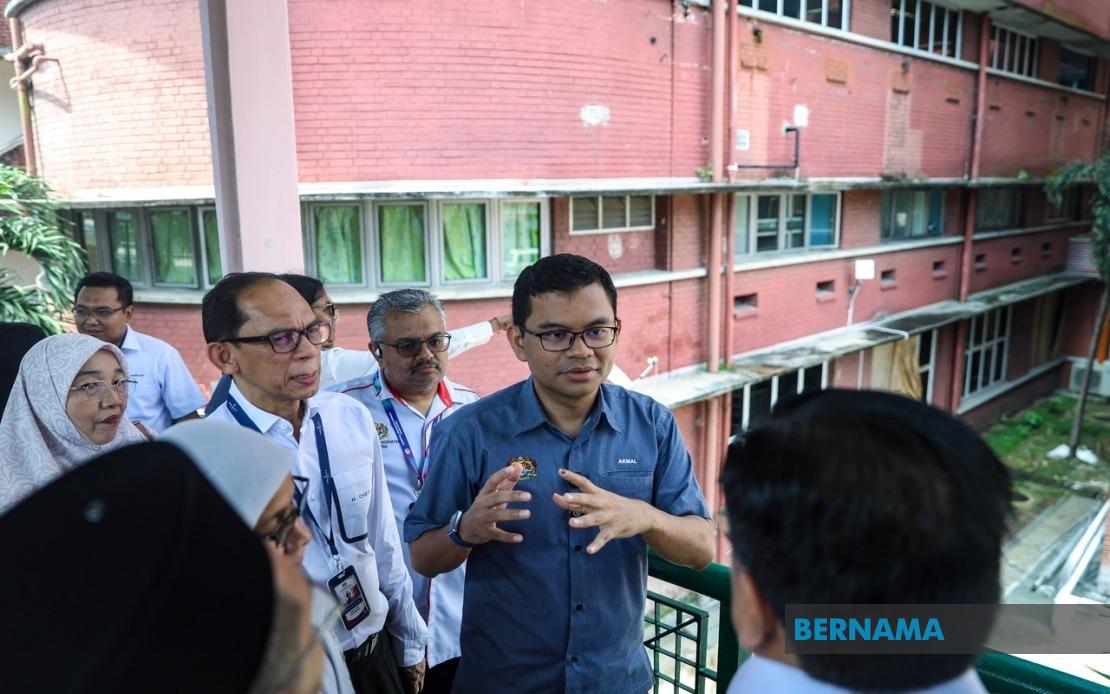
Seven substantial development initiatives valued at RM1.139 billion are currently reshaping healthcare infrastructure at Sultanah Aminah Hospital in Johor Bahru, with government officials emphasising the projects' potential to meaningfully expand the institution's service delivery capabilities. Economy Minister Akmal Nasrullah Mohd Nasir outlined the scope of these modernisation efforts during a recent inspection visit, highlighting how the coordinated initiatives aim to strengthen one of Johor's most significant public medical facilities whilst minimising operational disruption.
Among the most advanced components is the electrical infrastructure renewal, budgeted at RM159 million and already three-quarters complete. This foundational upgrade addresses the hospital's power systems and associated mechanical infrastructure, critical investments that often operate invisibly but underpin reliable clinical operations. The minister noted that the project had achieved 76.49 per cent physical progress, reflecting steady advancement despite the complexity of upgrading systems within an active healthcare environment where service continuity remains paramount.
The centrepiece of the expansion programme involves constructing an Ambulatory Care Centre paired with multi-storey parking facilities, alongside a phased Specialist Clinic Complex planned to dramatically increase the hospital's patient processing and treatment capacity. These interlinked components are budgeted at RM877.54 million, representing the lion's share of the overall investment. The timing of major hospital infrastructure projects presents inherent logistical challenges; the minister explicitly acknowledged this tension, stressing that coordinating construction activities with continuous patient care delivery demanded meticulous planning and coordination between government agencies and contractors.
According to Akmal Nasrullah, the formal letter of acceptance for appointing contractors to execute the Ambulatory Care Centre, parking, and Specialist Clinic Complex projects is targeted for February 2025. This timeline suggests that detailed design and tendering processes are advancing, setting the stage for active construction work to commence within the coming months. The phased approach to the Specialist Clinic Complex indicates a pragmatic strategy to manage both financial outlay and operational integration, allowing different sections to be completed and activated sequentially.
Operating theatre capacity emerges as a critical performance metric in the modernisation strategy. The current facility operates twelve operating rooms; the upgrade programme will add three additional theatres, bringing total capacity to fifteen. For a tertiary hospital serving a substantial population across Johor and surrounding regions, this twenty-five per cent expansion in surgical capacity carries profound implications for patient access and treatment wait times. Expanding operative capacity typically requires not merely physical construction but also recruitment of anaesthetists, surgical nurses, and support personnel—an important infrastructure dimension that extends beyond mere building work.
This substantial health sector investment sits within a much broader state development context. Over the past quarter-century, from 2000 through the current year, Johor has witnessed RM56.12 billion directed toward 613 development programmes and projects. The composition reveals a mixed portfolio: 154 represent entirely new initiatives whilst 459 constitute extensions or enhancements to existing facilities. This emphasis on augmenting and upgrading established infrastructure rather than predominantly building anew suggests a maturing development strategy focused on deepening capabilities within existing networks rather than geographic sprawl.
The current financial year's implementation pace indicates robust execution momentum. Through late July, approximately RM2.5 billion of the RM4.95 billion annual allocation had been expended, representing 50.51 per cent utilisation. This spending trajectory suggests the state is roughly on track to deploy the full annual budget, though accelerated expenditure during the final months of the fiscal year would be unsurprising given typical government budgeting patterns.
For Malaysian healthcare stakeholders, these Johor investments carry particular significance. The health system faces persistent pressures from an ageing population, rising chronic disease prevalence, and increasing patient expectations. Public hospital infrastructure upgrades directly influence bed availability, treatment timeliness, and the ability to incorporate modern diagnostic and therapeutic technologies. Sultanah Aminah Hospital, as a major public teaching hospital, serves as a training ground for medical and nursing professionals who subsequently work throughout the Malaysian healthcare system, making facility modernisation investments consequential for workforce development and competency enhancement.
The minister's emphasis on minimising service disruption during construction reflects growing recognition that healthcare infrastructure projects differ fundamentally from purely commercial development. Hospital construction occurs within operating clinical environments where mistakes or delays carry direct human consequences. Coordinating contractor activities, patient flows, emergency services access, and staff operations demands sophisticated project management protocols and genuine inter-agency cooperation.
These infrastructure commitments also signal government prioritisation of public healthcare expansion amid broader debates about private sector expansion and mixed healthcare economics. By directing over a billion ringgit toward public hospital modernisation in a single state, federal authorities demonstrate ongoing commitment to strengthening the public healthcare platform upon which majority Malaysian populations depend. This is particularly significant given competing budgetary pressures and alternative infrastructure priorities elsewhere in the economy.
Looking forward, the successful completion of these Sultanah Aminah Hospital projects would establish a template for healthcare facility modernisation applicable across Malaysia. Southeast Asian healthcare systems generally face similar pressures regarding aging infrastructure, capacity constraints, and the imperative to incorporate modern medical technologies. Malaysia's approach to managing large-scale hospital upgrades whilst maintaining service delivery could inform regional best practices and demonstrate feasible pathways for other nations pursuing healthcare infrastructure renewal within resource constraints.

