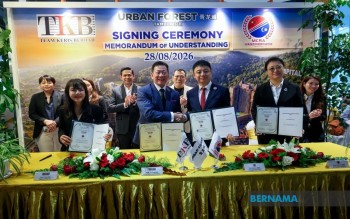
Team Keris Bhd is spearheading an ambitious RM1 billion urban forest project in Tambun that promises to reshape Perak's economic trajectory and international standing within the tourism sector. The 84-acre development, expected to reach completion within three years, represents a strategic pivot away from the state's traditional reliance on domestic tourism towards capturing high-value international visitor markets. By combining world-class accommodation, curated food experiences, and integrated hospitality services, the initiative positions Ipoh as a serious contender in Southeast Asia's competitive tourism landscape.
The project emerges from a collaborative framework involving Team Keris Bhd, RJJ Hotels Sdn Bhd, and the Malaysian Chinese Restaurant Association, each bringing distinct expertise to create a cohesive destination ecosystem. Rather than treating tourism infrastructure in isolation, the partners are engineering a comprehensive visitor experience that addresses the entire journey from arrival through departure. This holistic approach reflects an evolution in destination marketing philosophy, where isolated attractions give way to immersive regional experiences that command longer stays and higher spending.
Perak's existing tourism assets, including the Lost World of Tambun and established commercial developments, form the foundation upon which this urban forest will expand. According to Perak Tourism, Industry, Investment and Corridor Development Committee chairman Loh Sze Yee, the new development will catalyse a broader transformation of Tambun into a unified tourism hub. This complementary relationship is crucial for Perak's competitiveness; rather than competing with established attractions, the urban forest amplifies their appeal by providing sophisticated accommodation and dining options that justify international visitors dedicating extended time to the region rather than treating it as a day-trip from Kuala Lumpur or Penang.
The food and beverage component has been meticulously structured to reflect Malaysia's multicultural identity while maintaining international standards. Team Keris Bhd group executive chairman Datuk Lee Seng Hee outlined a strategic composition comprising 40 per cent operators affiliated with the Malaysian Chinese Restaurant Association and 60 per cent other Malaysian operators. This deliberate proportioning ensures representation of diverse culinary traditions while leveraging the MCRA's expertise in elevating Chinese cuisine to international standards. The framework also mandates that 30 per cent of overall food offerings cater to Muslim-friendly preferences, including halal dim sum innovations, addressing the increasingly important market segment of Muslim-majority tourists from across Asia and the Middle East.
Food itself has been identified as a primary driver of destination choice and visitor length of stay. By positioning Malaysian cuisine as a centrepiece attraction rather than an ancillary amenity, the urban forest capitalises on a global trend where culinary tourism consistently outperforms conventional attraction-based models. The strategy recognises that visitors seeking authentic experiences increasingly value meals as cultural touchstones and memory-making activities. Showcasing Perak's food traditions to international audiences creates a powerful marketing narrative that distinguishes the state from competitor destinations reliant on natural attractions or manufactured entertainment complexes.
The hospitality dimension leverages RJJ Hotels' extensive global network to funnel international visitors directly to Ipoh and Perak. Through its relationship with Jin Jiang Hotels, which operates over 200 million membership accounts across 50 countries and 40 hotel brands, the urban forest gains access to sophisticated international distribution channels and package tourism partnerships. RJJ Hotels CEO Yap Lip Seng emphasised the company's ability to eliminate logistical friction that traditionally deters independent travellers from visiting secondary cities. By offering end-to-end connectivity from major airports and bundling accommodation with dining and activities, the arrangement transforms Ipoh from a potential diversion into a primary destination worthy of dedicated travel planning.
The partnership structure specifically targets affluent visitor demographics from Australia, Britain, and the United States, markets with demonstrated spending power and preference for experiential travel. These are visitors accustomed to premium hospitality standards, sophisticated dining, and cultural engagement. By meeting these expectations through international-class infrastructure combined with authentically Malaysian experiences, Perak positions itself within a higher value segment than conventional Southeast Asian tourism, potentially generating superior returns on infrastructure investment and employment quality.
The Malaysian Chinese Restaurant Association's commitment extends beyond operational participation into genuine sectoral development. MCRA president Gao Houyun articulated an agenda encompassing training, skills development, and supply chain integration. This multi-layered approach acknowledges that sustainable competitive advantage requires not just showcasing existing capabilities but systematically upgrading local operators and suppliers. The association's emphasis on attracting ingredient producers to establish Perak-based manufacturing operations represents horizontal economic integration, creating value beyond hospitality through agricultural and food processing development.
Malaysia's halal certification framework emerges as a strategic differentiator with regional implications. Rather than limiting halal standards to a niche market segment, the urban forest positions them as a competitive advantage for market expansion across Southeast Asia and beyond. This framework allows Perak-developed culinary brands and products to access markets where halal certification represents legal requirement or significant consumer preference. By developing these capabilities within the urban forest environment, the state creates exportable intellectual property and branded experiences that extend economic impact well beyond Tambun.
The project's three-year development timeline suggests confidence in both financing and market demand validation, though execution risks remain substantial. Delivering an integrated tourism ecosystem requires flawless coordination across hospitality operators, food vendors, logistics providers, and regulatory agencies. The success metric extends beyond opening facilities to achieving the aspirational positioning as an international-class destination capable of competing with established Southeast Asian tourism hubs like Phuket, Bali, and Bangkok.
For Malaysia's broader economic strategy, the Tambun urban forest represents a decentralisation of tourism spending away from the Klang Valley and Penang. Historically concentrated infrastructure investment in major gateway cities perpetuates uneven regional development and limits secondary cities' capacity to generate independent economic activity. By catalysing Perak's emergence as a standalone destination, the project contributes to more distributed economic geography across the peninsula, potentially alleviating congestion pressures on Kuala Lumpur and Penang while generating employment and investment opportunities in central Malaysia.
The initiative also signals shifting attitudes toward domestic culinary assets, treating Malaysian food traditions not as peripheral amenities but as primary cultural and economic assets. This reframing has implications for rural food producers, artisanal manufacturers, and small operators who now encounter pathways to premium markets previously accessible only through mass-market hospitality chains. Success in Tambun could catalyse similar projects across Malaysia, gradually building a more distributed and culturally authentic tourism ecosystem that differentiates the country from competitors offering standardised luxury experiences.
Longer-term sustainability depends on maintaining authentic Malaysian character while meeting international comfort expectations, a balance many regional destinations struggle to achieve. The urban forest's structural design, incorporating partnerships with local operators and food associations, suggests conscious effort to avoid the cultural homogenisation that characterises many mass-tourism developments. If successfully executed, this model could establish a replicable template for equitable tourism development elsewhere in Southeast Asia, where international visitor growth need not require erasing local identity or displacing traditional economic actors.

