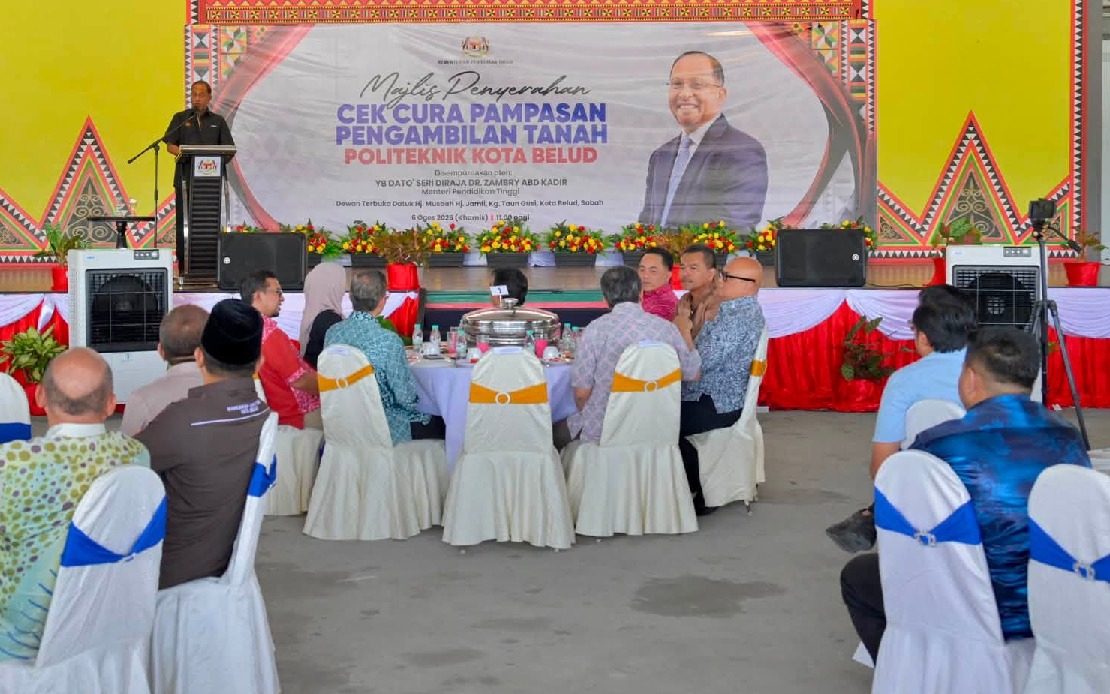
Higher Education Minister Datuk Seri Zambry Abd Kadir has confirmed that the RM250 million Politeknik Kota Belud will reach completion by 2030, marking a significant expansion of technical education infrastructure in Sabah. The announcement came during a land acquisition ceremony in Kota Belud on August 6, where compensation cheques were formally presented to affected landowners, signalling the official transition from planning into active construction phases. This development represents a substantial investment in the state's educational capacity and positions the institution as a pivotal training hub for emerging industries across Malaysian Borneo.
The pathway to this project reflects years of strategic planning within Malaysia's education sector. Zambry revealed that initial proposals for the polytechnic originated in 2017 through Datuk Seri Abdul Rahman Dahlan, who was the Member of Parliament for Kota Belud at that time. The intervening years have involved comprehensive land acquisition negotiations and preliminary administrative processes, with the completion of these foundational steps now clearing the way for construction to proceed. The ceremonial presentation of compensation to landowners underscores the government's commitment to resolving stakeholder concerns transparently before development commences.
The project is integrated within Malaysia's broader educational modernisation framework, specifically the Third Rolling Plan under the 13th Malaysia Plan, which commences next year. Zambry emphasised that pending approval through this planning mechanism, all implementation aspects of the polytechnic's development should advance according to schedule. This integration with national planning instruments ensures the facility aligns with nationwide workforce development strategies and secures sustained funding allocation throughout its construction and operational phases.
The curricula under development reflect Sabah's economic trajectory and global technological shifts. Programmes will concentrate on green energy, artificial intelligence, computer science, and technology-enabled agricultural systems—sectors identified as critical for the state's competitiveness and sustainability. This strategic focus positions graduates to participate in Malaysia's transition towards renewable energy infrastructure, digital economy expansion, and precision agriculture innovation. The emphasis on these forward-looking fields differentiates Politeknik Kota Belud from conventional technical institutions and addresses documented gaps in skilled workforce availability across these domains.
The institution's enrolment strategy demonstrates measured expansion planning. Initial intake is projected at approximately 500 students, with capacity progressively enlarged to accommodate between 1,000 and 1,500 learners at full operational capacity. This graduated approach allows the polytechnic to establish quality control systems, develop teaching expertise, and build industry partnerships systematically rather than attempting maximal enrolment immediately. For Malaysian polytechnics, which traditionally serve as bridges between secondary education and tertiary qualifications, this expansion signifies confidence in regional demand for vocationally-oriented higher education.
For Sabah specifically, this facility addresses longstanding infrastructure disparities in technical education accessibility. Students previously requiring polytechnic training faced the prospect of relocating to Peninsular Malaysia or international institutions, creating financial and personal barriers to skill acquisition. Politeknik Kota Belud will democratise access to advanced vocational training, enabling talented youth from rural and semi-urban areas to develop expertise without migration. This retention of talent within the state carries multiplier effects for local economic development and community stability.
The timing of this investment coincides with Sabah's diversification ambitions beyond traditional resource extraction industries. Government initiatives promoting renewable energy adoption, digital transformation of agricultural practices, and information technology expansion require substantial skilled workforces. Politeknik Kota Belud serves as a direct supply mechanism for these emerging sectors, creating feedback loops where industry growth attracts further investment, which in turn increases demand for graduate employment. This virtuous cycle positions the polytechnic as instrumental to sectoral development rather than merely educational provision.
From a Southeast Asian perspective, Malaysia's polytechnic expansion reflects regional recognition that technical education drives economic resilience and social mobility. As nations throughout ASEAN compete for knowledge economy dominance, investment in vocationally-focused institutions remains strategically vital. The Kota Belud project demonstrates Malaysia's commitment to technical skills development beyond traditional urban centres, potentially establishing templates for rural polytechnic expansion across the region.
The completion timeline extending to 2030 reflects realistic expectations for substantial infrastructure projects in Sabah's geographic and administrative context. While some observers might characterise an eight-year construction window as extended, such timescales accommodate environmental assessments, complex supply chain logistics for peninsular-based materials and expertise, and necessary iterative planning adjustments. Transparency regarding realistic completion dates builds stakeholder confidence more effectively than optimistic projections subsequently requiring extension.
Moving forward, successful execution will depend on sustained budget allocation despite potential economic fluctuations, recruitment of qualified academic staff in specialised fields where talent scarcity exists internationally, and meaningful industry partnerships ensuring curriculum relevance. Zambry's announcement signals governmental commitment, yet maintaining momentum through multiple election cycles and policy adjustments will ultimately determine whether this institution realises its potential as Sabah's premier technical training facility. The coming years will test whether integrated planning frameworks actually translate theoretical educational goals into tangible community benefits and measurable workforce development outcomes.

