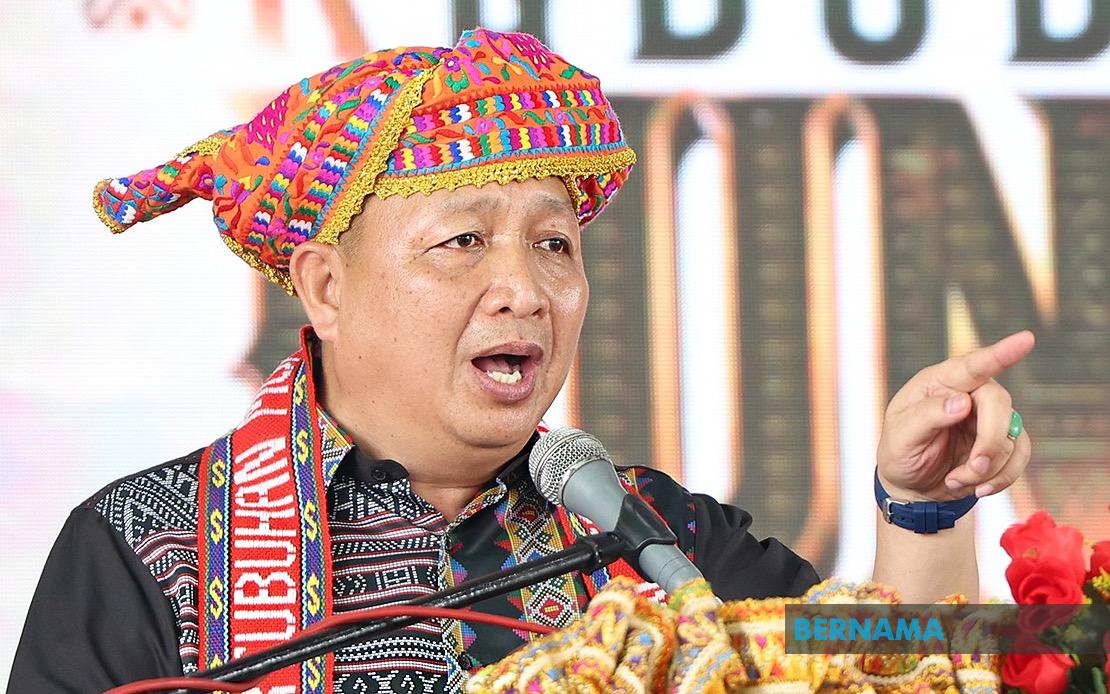
The Federal government has committed RM4.06 billion towards expanding rural water access across Sabah through the Rural Water Supply (BALB) initiative, a significant investment that Deputy Prime Minister Datuk Seri Dr Ahmad Zahid Hamidi announced at the Rungus Cultural Festival in Kudat on August 8. This substantial allocation represents a deliberate strategy to address longstanding water scarcity challenges affecting remote communities in one of Malaysia's largest states, where geographic isolation and infrastructure constraints have historically limited service delivery to the poorest households.
Kota Marudu Member of Parliament Datuk Wetrom Bahanda, who also leads the Malaysian Momogun Rungus Association, highlighted that the funding mechanism itself carries strategic significance. Rather than routing implementation through the Rural and Regional Development Ministry's (KKDW) headquarters in Putrajaya—the conventional approach for federal rural projects—the government has opted to transfer funds directly to Sabah's state administration. This departure from standard practice reflects recognition that local authorities possess superior understanding of ground-level conditions and can more accurately identify communities with greatest need.
Wetrom's remarks underscore the broader policy shift toward decentralised governance in infrastructure development. By empowering state governments to manage project execution independently, the Federal government aims to reduce bureaucratic delays that have traditionally hampered rural service expansion. For Sabah, where interior settlements are frequently scattered across challenging terrain, this flexibility permits tailored solutions responsive to specific geographic and demographic circumstances rather than standardised approaches designed for peninsular contexts. The allocation thus signals confidence in state-level capacity to oversee complex water infrastructure projects effectively.
Beyond water supply expansion, the KKDW's support for Sabah encompasses complementary road infrastructure investments that strengthen connectivity across rural districts. Multiple highway and feeder road projects—including the Sonsogon-Megandai route, Mangin Road, Jalan Rendemon, Jalan Teringai, Jalan Sembayan, and the corridor linking Jalan Raditiden to Pampang Poring—are receiving active ministry funding. These improvements constitute essential foundation work, as improved roads facilitate not only passenger movement but also agricultural product distribution and commercial activity among interior communities traditionally isolated from major markets.
The interconnection between water infrastructure and road development reflects integrated thinking about rural transformation. Without adequate water supply, agricultural productivity remains constrained and quality-of-life improvements stagnate. Simultaneously, poor road conditions obstruct delivery of water infrastructure components and limit technicians' ability to maintain systems. By advancing both priorities simultaneously, the Federal government addresses multiple dimensions of the rural development challenge that has historically concentrated poverty and limited opportunity in districts like Kota Marudu and Kudat.
Wetrom emphasised that these districts have persistently ranked among Malaysia's poorest, with limited income generation opportunities and restricted access to basic services. The cumulative effect of water supply enhancement and road network expansion potentially enables transformational progress. Improved water access permits expanded agricultural activities and supports small-scale industrial development. Enhanced road connectivity facilitates product marketing and enables residents to access employment opportunities in nearby towns. Together, these infrastructure investments create enabling conditions for broader socioeconomic development.
The commitment also extends to political reorganisation objectives within Sabah's administrative structure. The Federal government has formally recognised local aspirations to elevate Matunggong subdistrict to full district status, a designation that would unlock dedicated development allocations and administrative infrastructure. This elevation represents acknowledgment that population concentration and economic activity in the Matunggong area justify enhanced governance capacity. District-level status typically triggers automatic eligibility for specific federal programmes and infrastructure funding channels unavailable to subdistrict administrations, thereby amplifying development benefits for residents.
For Malaysian policymakers, the Sabah Rural Water Supply initiative provides a significant case study in infrastructure delivery mechanisms. The decision to delegate implementation authority to state governments rather than retaining centralised control reflects lessons from previous experiences where federal-level project management struggled to accommodate local variations and ground-level complexities. This structural adjustment, if replicated across other states facing rural development challenges, could substantially improve implementation speed and appropriateness of infrastructure solutions.
The RM4.06 billion investment assumes particular importance within Southeast Asia's development context. Rural water scarcity remains endemic across the region, affecting hundreds of millions of people in countries from Indonesia to Myanmar. Malaysia's experience in mobilising substantial capital for rural water infrastructure and adjusting governance structures to enhance effectiveness offers relevant lessons for neighbouring governments addressing similar challenges. The willingness to invest heavily in remote communities despite electoral pressures toward urban concentration demonstrates commitment to national cohesion and equitable development.
For Sabah specifically, the allocation represents recognition that the state's vast interior regions cannot indefinitely sustain conditions of basic service deprivation. Water-related diseases, agricultural limitations, and population exodus to urban areas constitute escalating costs of infrastructure inaction. By frontloading investment in fundamental services like water supply, the Federal government attempts to create conditions enabling sustainable settlement and livelihood development across Sabah's interior, thereby strengthening economic contributions from historically marginalised areas while improving quality of life for residents who maintain deep cultural and environmental connections to their communities.

