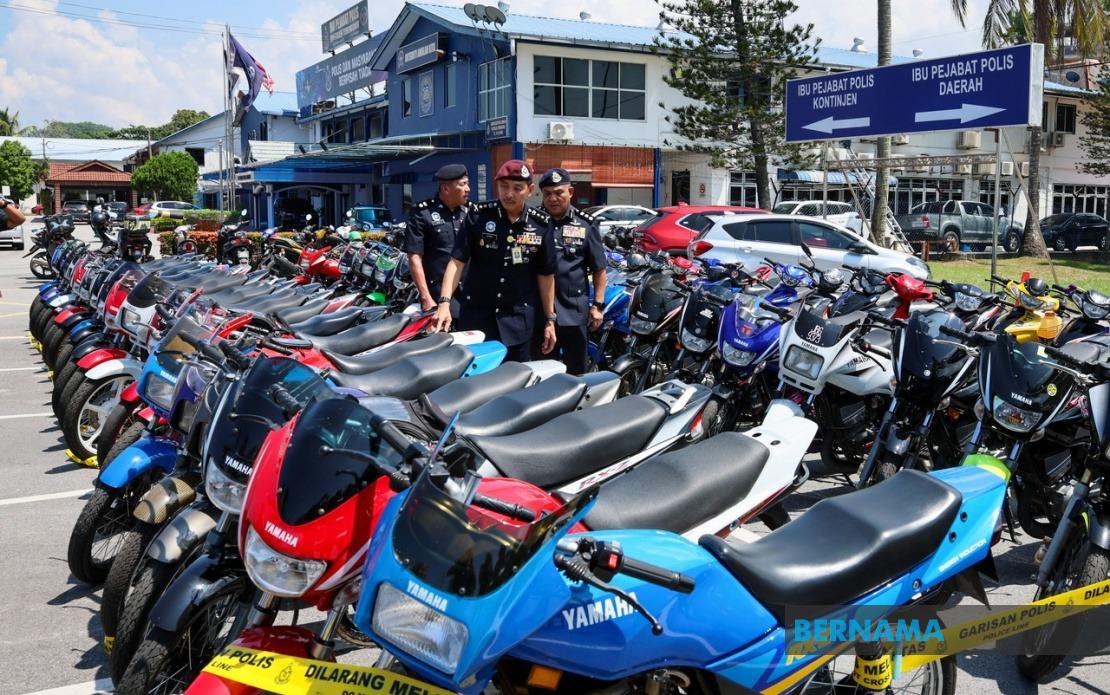
A prominent road safety activist has sounded an alarm over the mounting toll of casualties at Malaysia's largest motorcycle gathering, demanding that government agencies, authorities and event organisers implement a structured safety framework to address the growing crisis. Shahrim Tamrin, who previously served on the board of the Malaysian Institute of Road Safety Research (MIROS), made the plea following the RXZ Members 8.0 programme held last weekend in Kuala Nerus, which attracted more than 200,000 participants from across the nation and resulted in 46 motorcycle accidents within a four-day period.
The scale of the recent incident reflects a troubling upward trajectory that stretches across three consecutive years of the event. Data from the Bukit Aman Traffic Investigation and Enforcement Department revealed that fatal accidents have accelerated dramatically, from two deaths recorded during the 2024 edition to five in 2025, and then jumping sharply to 11 fatalities during this year's gathering from July 30 to August 3. This progression underscores what Shahrim characterises as a deteriorating safety crisis rather than occasional mishaps, with the accumulating body count demanding intervention at the policy level.
The 46 accidents documented during the RXZ 8.0 programme comprised a breakdown that exposed the severity of incidents occurring at the Gong Badak Motor Racing Circuit and the surrounding areas of Kuala Nerus. Of the total, fatal accidents accounted for nearly a quarter of all incidents at 23.91 per cent, while serious injuries represented 10.87 per cent, leaving the remaining 65.22 per cent as minor collisions. Such proportions, when applied to an event drawing over 200,000 riders—the largest iteration since the programme's inception in 2017—present a public health emergency that transcends conventional traffic enforcement.
Shahrim's proposed intervention blueprint extends far beyond traditional policing methods, instead positioning event safety as a comprehensive planning exercise akin to large-scale infrastructure projects. The framework he advocates encompasses advance participant projections to gauge crowd flow, detailed mapping of primary entry and exit routes to prevent bottlenecks, identified rest areas strategically positioned throughout the gathering zones, pre-positioned ambulance deployment stations, establishment of a dedicated emergency response centre with real-time coordination capacity, and a structured communications infrastructure to disseminate critical safety information across the dispersed rider population. Additionally, a pre-event risk assessment would identify vulnerability points before the gathering commences, allowing authorities to allocate resources more effectively.
Beyond the immediate event period, Shahrim emphasises the necessity of a rigorous post-event safety audit that would systematically analyse patterns in accident causation, geographic hotspots where collisions concentrate, temporal clustering of incidents, underlying human factors related to rider behaviour, mechanical deficiencies in motorcycles, and measurable efficacy of enforcement operations. Such an evidence-based approach stands in sharp contrast to reactive measures implemented only after tragedies occur. The activist insists that audit findings must be publicised before subsequent iterations of the programme, enabling organisers and authorities to implement targeted improvements grounded in empirical data rather than assumptions or immediate responses to fatalities.
Parallel to safety management at the gathering itself, Shahrim has flagged environmental and regulatory concerns that authorities must address concurrently. Residents near the Gong Badak venue lodged complaints regarding excessive noise and smoke emissions, pointing to enforcement gaps in noise standards and exhaust regulations applicable to participating motorcycles. This dimension of the problem reflects how large-scale motorcycle events create externalities affecting surrounding communities, necessitating stricter adherence to existing environmental compliance frameworks during such occasions.
A particularly complex issue underpinning the RXZ programme's safety challenges involves the technological status of participating motorcycles, predominantly Yamaha RXZ models that have remained iconic fixtures of Malaysia's motorcycle culture. Many of the RXZ machines currently on the roads date between 20 and 35 years into their operational lifespan, having accumulated multiple ownership transfers and undergone restoration or modification procedures that have rendered their documentation incomplete or inconsistent with registration authorities. Shahrim advocates that the Road Transport Department (JPJ) devise mechanisms facilitating re-registration of roadworthy RXZ motorcycles, contingent upon inspection by the Computerised Vehicle Inspection Centre (Puspakom) to confirm mechanical integrity.
However, Shahrim cautions against a blanket approval approach that would allow any restored or modified motorcycle onto public roads without scrutiny. He stipulates that motorcycles modified in ways compromising safety should face one of two outcomes: restoration to original factory specifications or outright exclusion from registration. This differentiated approach addresses a fundamental tension in motorcycle culture between preserving heritage machines and ensuring public safety, recognising that vehicles operating on Malaysia's roads must meet minimum safety standards while maintaining valid road tax and insurance coverage. Without such discipline, enforcement of safety standards becomes arbitrary and ineffectual.
Mobilising institutional coordination forms another pillar of Shahrim's recommendations, particularly in marshalling and group leadership training. Police and JPJ should collaborate with RXZ clubs and programme organisers to ensure that marshals directing participant movements and club leaders supervising convoy formations receive standardised training in safe group riding protocols. This reflects international best practices in managing large mass-participation events where peer leadership among participants can reinforce official safety messaging more credibly than top-down enforcement alone.
Shahrim further suggests adoption of travel advisory mechanisms similar to systems deployed by highway operators during festive season peaks. These would communicate participant information regarding projected congestion periods, alternative routing options to avoid bottlenecks, and designated rest stops positioned at intervals that discourage fatigue-related accidents. Such communication infrastructure acknowledges that the RXZ Members programme operates as a significant mass transportation event, warranting the same logistical sophistication applied to managing holidaymaker movements across the country's highway network.
The activation of these recommendations would represent a watershed moment in how Malaysian authorities approach large-scale community gatherings centred on motorcycle culture. Rather than oscillating between permissiveness and punitive restriction, a comprehensive risk management framework positions safety as a collaborative objective requiring input from government agencies, organisers, riders, and community stakeholders. The ascending casualty figures from recent editions of the RXZ programme suggest that the status quo approach has demonstrably failed, and without structural intervention, the 2027 gathering threatens to extend this trajectory of escalating fatalities further.

