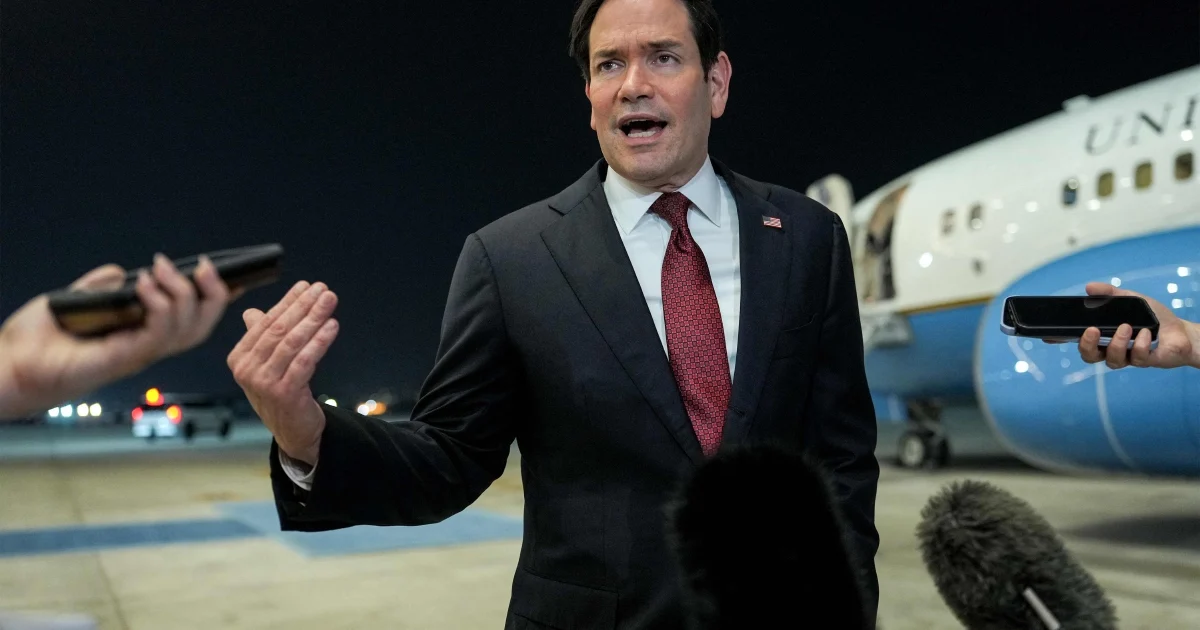
US Secretary of State Marco Rubio has flatly rejected any possibility of Iran charging tolls or transit fees on shipping vessels passing through the Strait of Hormuz, a position that underscores mounting friction between Washington and Tehran as diplomatic efforts to resolve the Middle Eastern conflict face mounting obstacles. The stance, delivered on Tuesday, reflects Washington's determination to maintain the historical principle of free passage through one of the world's most strategically critical waterways, which facilitates roughly one-third of global maritime oil trade and remains essential to the economic security of multiple nations across Asia and beyond.
The dispute over the Strait of Hormuz represents merely one dimension of a broader set of contentious issues now threatening to derail comprehensive negotiations aimed at achieving a ceasefire in the region. Beyond the question of maritime passage rights, delegations have become entangled in unresolved disagreements concerning Iran's nuclear programme and international inspections of its facilities, as well as proliferation concerns regarding Iran's ballistic missile arsenal. These interconnected disputes reveal the intricate web of security and geopolitical concerns that any durable settlement must address, and the difficulty of forging consensus when fundamental interests collide.
For Southeast Asia and the broader Indo-Pacific region, the stakes of these negotiations carry particular weight. Malaysia and other regional states depend heavily on the stable functioning of critical maritime chokepoints, with the Strait of Hormuz serving as a vital artery for energy supplies that power economies across the region. Any escalation of tensions or the imposition of unilateral fees on merchant traffic would directly threaten regional prosperity and supply chain stability. Energy prices would face upward pressure, and the precedent of allowing unilateral toll mechanisms on international waterways could invite similar demands at other crucial passages in Southeast Asia.
Rubio's categorical rejection of Iranian toll proposals carries implications that extend beyond the immediate negotiation chamber. The statement signals that Washington intends to maintain a firm stance on preserving the existing international legal framework governing freedom of navigation, even as it attempts to balance diplomatic engagement with Iran on other fronts. This approach suggests the United States views the question of maritime passage rights as non-negotiable, a redline that distinguishes between areas where compromise might be possible and those where American interests remain rigid.
The timing of these diplomatic frictions is significant. Early indications of strain in negotiations frequently foreshadow more severe difficulties ahead, particularly when disputes touch upon issues of principle rather than operational details. The nuclear inspections question, for instance, involves not merely technical arrangements but broader questions of verification and trust between parties with a history of mutual suspicion. Similarly, missile development concerns reflect asymmetric perceptions of security threats and strategic stability in the region.
Malaysia has long advocated for multilateral approaches to regional security challenges, and the current impasse in Middle Eastern negotiations may reinforce arguments for inclusive dialogue mechanisms that involve broader stakeholder participation. The country has experience mediating disputes and promoting regional stability through forums like ASEAN, and the lessons from Southeast Asian diplomatic successes might offer insights into how entrenched positions can gradually shift when structured dialogue includes sufficient flexibility for all parties to preserve core interests.
The Strait of Hormuz occupies a unique position in global commerce and security architecture. Roughly 21 per cent of petroleum products consumed worldwide transit through this waterway daily, making it arguably more critical to global energy security than any other single chokepoint. For Malaysia, which remains energy-intensive despite growing renewable energy investments, disruption to Hormuz shipping would translate into immediate economic consequences through elevated fuel costs and potential supply disruptions. The principle of free passage is thus not an abstract legal concept but a practical necessity for Malaysian prosperity.
Iran's proposal to impose tolls appears designed to extract economic concessions or assert control over a waterway that sits within its territorial waters but has historically operated under international conventions guaranteeing free passage. This represents a classic negotiating gambit—introducing demands that can later be withdrawn as a concession to secure other objectives. However, Rubio's immediate and unequivocal rejection suggests Washington will not engage in horse-trading on this particular issue, potentially narrowing the space for creative compromises that might otherwise unlock progress on other fronts.
The emergence of these disputes so early in negotiation processes raises broader questions about whether the conditions for successful agreement actually exist. Typically, when multiple flashpoint issues generate tension simultaneously, it indicates that underlying interests remain too divergent to accommodate mutual accommodation. The convergence of maritime rights questions, nuclear inspection protocols, and missile proliferation concerns into simultaneous disputes suggests these may be linked in ways that make partial settlements difficult without addressing the full scope of strategic competition between the parties.
For regional observers, these developments underscore the precarious nature of global stability when major powers remain locked in strategic competition. Southeast Asia's prosperity depends on open sea lanes and predictable international order, yet that order faces pressure from major powers pursuing contradictory objectives in the Middle East. Malaysia and its neighbours have limited ability to influence these distant disputes but considerable vulnerability to their outcomes, reinforcing the rationale for strengthening regional resilience and reducing dependence on any single external power for security guarantees.
Looking ahead, the trajectory of these negotiations will likely determine whether regional expectations for a near-term Middle Eastern settlement remain realistic or require substantial downward revision. If early disputes harden rather than soften through further negotiation, the timeframe for achieving comprehensive agreement could extend significantly, prolonging regional uncertainty and keeping energy markets sensitive to geopolitical risk. Alternatively, if parties demonstrate sufficient flexibility to compartmentalise disputes and build incremental progress, the negotiation process may eventually overcome current obstacles and produce durable arrangements.
The rejection of Iranian toll proposals thus constitutes far more than a minor diplomatic statement. It represents a fundamental assertion by the United States that certain principles remain non-negotiable, even as broader diplomatic engagement continues. For Malaysia and regional partners, the outcome of these negotiations will shape the environment within which they conduct commerce, manage supply chains, and maintain prosperity for years to come.