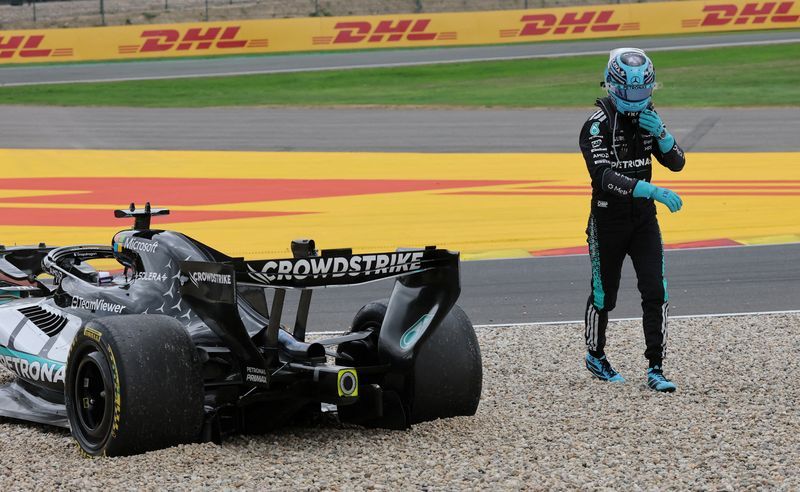
George Russell's hopes of mounting a serious challenge for the Formula One title suffered a severe setback at the Belgian Grand Prix when the Mercedes driver collided with Lewis Hamilton on the opening lap at Spa-Francorchamps and subsequently retired from the race. Starting from third on the grid in what promised to be a competitive display, Russell found himself powerless to prevent a catastrophic sequence of events that left him frustrated rather than merely disappointed by yet another race ending prematurely. The British driver's palpable resignation as he exited his car and walked away from the gravel trap—while Hamilton continued to race despite incurring a five-second penalty—underscored the mounting psychological toll of persistent mechanical failures undermining his campaign.
The mechanics of the collision itself proved less significant than the circumstances that precipitated it. Russell had executed a strong opening lap manoeuvre and positioned himself directly behind Red Bull's Max Verstappen, occupying a promising position in the order. However, what unfolded next represented a cascade of technical failures that he contends were beyond his control. As his car exited the first corner, the battery system inexplicably failed to recharge, leaving him with only 35 per cent power output when it should have been regenerating energy. This deficit compounded when his turbocharger refused to stabilise, leaving him without adequate power delivery heading into the demanding Eau Rouge section of the circuit.
By the time Russell navigated to the top of Eau Rouge, his battery indicator read zero—a perilous situation for any driver attempting to manage a car with severely degraded performance on one of Formula One's most challenging sections of track. The consequence was inevitable: three rival cars swept past him in rapid succession, a humiliating turn of events for a driver who had genuinely been challenging for better finishing positions. Russell's assessment that he ought never to have found himself in such a vulnerable position reflects the deeper frustration at play—not the racing incident itself, but the technical breakdown that forced him into a defensive posture entirely unmerited by his qualifying performance or early-lap pace.
The collision with Hamilton, while the immediate cause of his retirement, became something of a secondary grievance in Russell's post-race analysis. Stewards examining the incident determined that the seven-time world champion bore primary responsibility, imposing a five-second penalty that permitted Hamilton to continue racing. Russell acknowledged that while the former Mercedes teammate was "more to blame" than himself, neither driver had acted recklessly or with intent to collide. The incident appeared to stem naturally from the unpredictable dynamics created by Russell's sudden power loss—a racing accident rather than a racing incident born of aggressive driving or tactical miscalculation.
The emerging pattern of mechanical unreliability plaguing Russell's 2024 season represents a mounting concern for Mercedes as the championship battle intensifies. Russell has now failed to score points in three races this season, whereas Antonelli, the current championship leader, has experienced only two non-scoring finishes while establishing a commanding 25-point advantage with nine of 22 races completed. The disparity in reliability between the two Mercedes drivers—compounded by the clear performance gap between Antonelli's winning form and Russell's struggle—threatens to transform what should be a season of internal competition into a tale of wasted potential and mechanical bad fortune.
Russell's resignation about the recurrence of setbacks suggests he has begun to compartmentalise the emotional impact of repeated failures. "When it happens so often you just get used to it," he remarked with the weary acceptance of someone who has cycled through frustration multiple times. This psychological numbing—where disappointment loses its sting through repetition—indicates the strain of fighting not merely against rival teams but against the very machinery intended to deliver competitive performance. The distinction Russell drew between his emotional response and his analytical assessment of responsibility demonstrates a professional attempting to maintain perspective while watching his title hopes erode through no fault of his own driving.
The technical issues Russell encountered echo concerns he had flagged during Saturday's qualifying session, where he reported that his car exhibited serious difficulties maintaining performance on the straights. These were not isolated glitches but systemic problems suggesting deeper engineering challenges within the power unit or battery management systems. For Mercedes engineers, the task of diagnosing and rectifying issues that manifest inconsistently—activating under specific race conditions while remaining dormant during practice—presents a complex diagnostic puzzle that cannot simply be resolved through component replacement.
For Malaysian and Southeast Asian Formula One enthusiasts, Russell's predicament illustrates the sport's unforgiving nature, where technical precision operates as a third competing force alongside driver skill and strategic acumen. The sport's global audience in this region has grown substantially, particularly given the technical sophistication and engineering excellence that characterise modern Formula One. Russell's situation—a capable driver disadvantaged by mechanical failure rather than competitive shortcoming—serves as a reminder that championship outcomes can hinge on reliability as much as racecraft. His continued struggles threaten to reshape the title narrative if similar issues persist through the season's second half, potentially elevating Antonelli's path to the championship while margininalising Russell's realistic prospects despite his proven ability.

