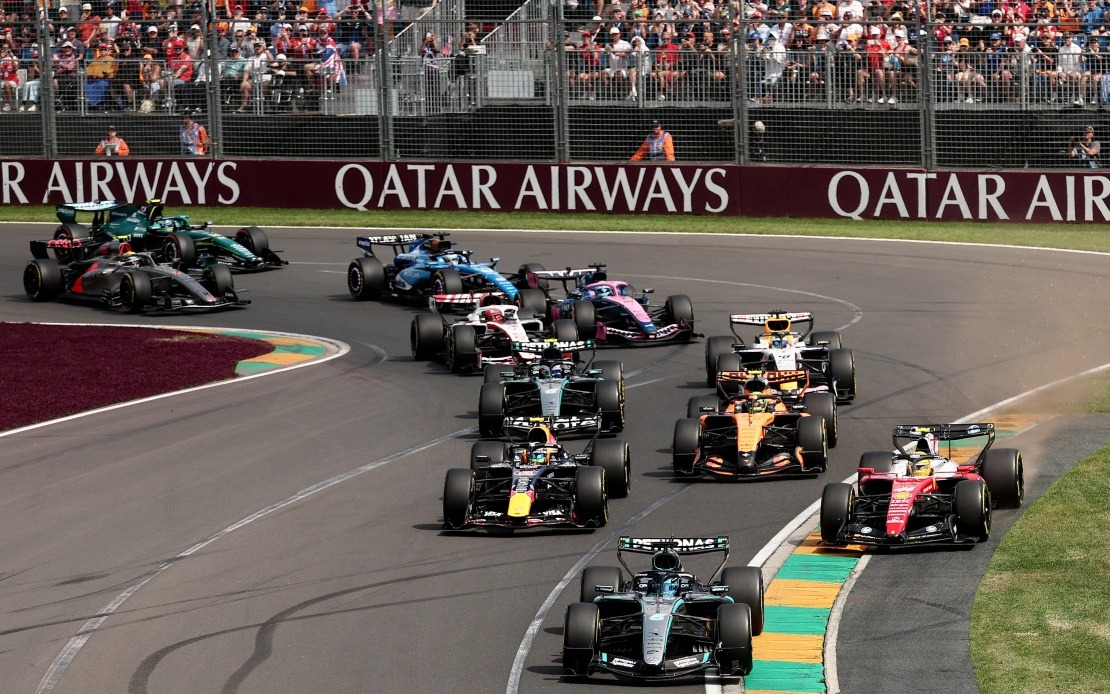
George Russell's Formula 1 championship aspirations took another crushing blow at Spa-Francorchamps on Sunday when a series of technical gremlins and a collision with Lewis Hamilton forced him out of the Belgian Grand Prix. The Mercedes driver's explosive radio tirade, captured during the race but kept off-air, laid bare his mounting frustration after a season punctuated by mechanical misfortune. Russell now trails the dominant Kimi Antonelli by 50 points with just four rounds remaining before the summer break, leaving his world championship dream hanging by a thread.
Antonelli's commanding performance illustrated the vast gulf that has opened between the young Italian prodigy and his increasingly beleaguered teammate. The teenager's sixth victory from ten races underscored Mercedes' overall competitive package, yet Russell's inability to extract consistent results has transformed what should be a manufacturer's title coronation into a season shadowed by internal strife. The disparity in fortune between the two drivers has raised uncomfortable questions about whether the problem lies with the car, the driver, or an unhelpful combination of both.
Russell's retirement sequence began on the opening lap when an engine glitch left him vulnerable to pursuing competitors. This early setback exposed him to pressure he could not manage, ultimately leading to contact with Hamilton that ended his afternoon. However, the deeper issue emerged when reviewing the data: a deployment puzzle within the power unit had already compromised his qualifying performance, leaving him half a second adrift of Antonelli when it mattered most. Mercedes initially suggested that Russell's driving technique had contributed to the malfunction, a theory swiftly abandoned once engineers examined the telemetry and found nothing untoward in his inputs.
The raw emotion captured on the team radio revealed a driver approaching the breaking point. Russell's expletive-laden message to the garage highlighted his bewilderment at losing battery charge down a straightaway where electrical power should have been fully available. His declaration that he is now "numb to disappointment" reflected a year-long accumulation of frustration, with one mechanical failure following another in a relentless cycle that has steadily eroded both confidence and points. For a driver of Russell's calibre, accustomed to fighting at the front, this streak of mechanical bad luck represents a unique form of psychological torture.
Mercedes team principal Toto Wolff addressed the crisis in measured tones, acknowledging Russell's emotional state while attempting to maintain perspective. Wolff defended his driver's standing within the team and emphasised Mercedes' unwavering support, but his comments also revealed the complexity of diagnosing and fixing modern Formula 1 power units. The new regulations have introduced systems so intricate that isolating individual component failures requires meticulous detective work. Wolff confirmed that engineers had identified a specific engine issue that restricted Russell's energy deployment into the final corner, a problem that manifested more acutely at Spa's demanding layout than it would at less power-sensitive circuits.
The technical diagnosis offered some clarity: Wolff estimated that the engine deficiency accounted for approximately half of Russell's qualifying deficit to Antonelli, suggesting other factors contributed to the overall gap. This admission underscored that Russell's struggles cannot be pinned entirely on mechanical failure, a reality that perhaps stung even more than technical explanations alone. The silver lining, in Wolff's assessment, was that identifying the problem at Spa meant Mercedes would not carry this particular gremlin into the Hungarian Grand Prix, a circuit less demanding on power deployment. Nevertheless, having identified the issue after the fact provides scant comfort when points have already slipped away.
Russell's mental state has become a concern for Mercedes as the season enters its critical phase. His description of feeling "numb to disappointment" suggests emotional exhaustion rather than mere frustration. For a competitor with championship aspirations, numbness represents a dangerous threshold—the point where disappointment ceases to motivate and instead induces resignation. Wolff's attempt to rebuild Russell's optimism tacitly acknowledges that the driver requires more than technical fixes; he needs psychological reinvigoration to maintain the mental sharpness essential for elite motorsport.
The contrast with Antonelli's ascendant trajectory could hardly be starker. The teenager has not merely won six races; he has won them despite the same machinery that has plagued Russell. This disparity inevitably invites uncomfortable speculation about driver performance, although context matters considerably. Antonelli has enjoyed a season relatively free from the accumulation of mechanical problems that have beset Russell, allowing him to maintain consistency and capitalize on his undeniable pace. Yet in Formula 1's zero-sum environment, excuses—no matter how valid—translate into lost points.
Hungary looms as a crucial juncture for Russell's championship hopes and Mercedes' credibility in resolving these reliability issues. Wolff's assertion that the team is "100 per cent behind" Russell carries weight only if measurable improvements materialise. The Budapest circuit's characteristics mean that the specific engine deployment problem identified at Spa will be less of a factor, offering Russell a chance to start fresh. However, the psychological damage of multiple failures has been done, and simply removing one mechanical issue does not erase the cumulative toll of a fractious season.
For Malaysian and Southeast Asian Formula 1 enthusiasts, Russell's plight illustrates a broader competitive reality: even the finest teams and drivers experience periods where external factors conspire against them. The unpredictability introduced by new technical regulations means that even Mercedes, traditionally the sport's most reliable manufacturer, struggles with novel systems. Russell's experience serves as a sobering reminder that in elite motorsport, talent and machinery must align; when they do not, the results can be devastating regardless of individual quality.
Looking ahead, the championship's narrative hangs precariously on whether Mercedes can restore Russell to competitiveness while Antonelli maintains his momentum. The team's engineering prowess is not in question—their ability to execute repairs and improvements will determine whether Russell can stage a comeback or whether this campaign represents a lost opportunity. For Russell personally, the next few races will test not only his technical skills but his resilience in the face of accumulated setback.

