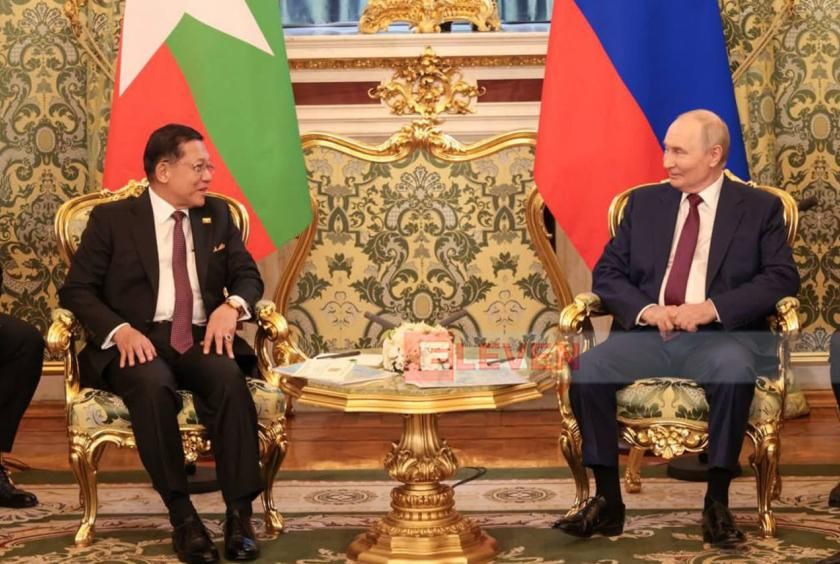
Russian President Vladimir Putin has signalled Moscow's strategic commitment to Myanmar by publicly declaring Russia's readiness to collaborate on natural resource extraction and offshore petroleum exploration, marking a significant expansion of energy cooperation between the two nations. The announcement, made during a media engagement on August 18 alongside Myanmar President U Min Aung Hlaing, underscores Russia's growing interest in securing energy partnerships in Southeast Asia at a time when Western sanctions have pushed Moscow to diversify its economic relationships beyond Europe and North America.
The energy dimension of Russia-Myanmar ties reflects broader geopolitical calculations on both sides. Putin highlighted the strategic importance of the energy sector as a cornerstone of bilateral engagement, noting that Moscow sees considerable potential not only in developing Myanmar's hydrocarbon reserves but also in exporting liquefied natural gas to the country. This arrangement would allow Myanmar to meet domestic energy requirements while potentially serving as a re-export hub for Russian LNG destined for other regional markets, creating mutual economic benefits that extend beyond simple commodity sales. Such infrastructure would deepen Myanmar's integration with Russian supply chains and increase economic interdependence.
Historical foundations underpin the contemporary relationship Putin outlined. He emphasized that Soviet assistance during the 1950s and 1960s—spanning social, economic and defence domains—established deep roots for present-day cooperation. Infrastructure legacies from the Soviet era, including hospitals and universities, continue servicing Myanmar's population, providing both tangible reminders and psychological anchors for continued partnership. This historical narrative is crucial context for understanding why Myanmar leadership, including the military junta currently governing the country, views Russia as a trusted partner distinct from Western powers, particularly given ongoing international criticism of Myanmar's internal governance.
Beyond energy, the cooperation framework encompasses multiple strategic sectors. Concrete projects already underway include coal-fired power plants and oil refinery developments, while future initiatives span industrial manufacturing—encompassing steel and fertiliser production facilities—and transportation infrastructure, notably a proposed deep-sea port in southern Myanmar. Russia's emphasis on industrial projects reflects an attempt to create complementary economic structures that lock Myanmar into longer-term relationships requiring sustained technological and financial engagement. The deep-sea port concept holds particular geopolitical significance, potentially providing Russian vessels improved access to Indian Ocean shipping lanes and limiting Western naval dominance in crucial Southeast Asian waters.
The nuclear dimension represents perhaps the most strategically sensitive element of the partnership. Putin referenced a nuclear power plant agreement signed in the previous year, characterizing it as pivotal for both nations. While framed as civilian energy infrastructure, nuclear cooperation carries profound strategic implications, potentially advancing Russia's influence over Myanmar's long-term energy independence and technological capabilities while establishing institutional mechanisms for deeper defence and scientific collaboration. For Malaysia and neighbouring countries, such developments warrant careful monitoring given the region's delicate geopolitical balance.
Technological cooperation constitutes an expanding frontier in bilateral ties. Putin outlined Russian company proposals spanning digital infrastructure, cybersecurity, and high-technology sectors, suggesting Moscow aims to position itself as a technology partner for Myanmar's modernisation agenda. This contrasts with Western efforts to isolate Russia technologically and represents an alternative pathway for countries seeking to reduce dependence on American or European technology platforms. For Malaysian observers, the emergence of Russian technology partnerships in Myanmar signals broader regional trends toward seeking non-Western technology providers.
People-to-people connectivity and cultural exchange mechanisms facilitate the relationship's deepening. A visa-free arrangement has enabled scientists, students, athletes and tourists to circulate between the countries, creating networks of personal relationships that transcend formal government ties. With 400 Myanmar students currently enrolled in Russian universities and 17,000 alumni having completed their education there, substantial human capital holds pro-Russia perspectives and maintains connections to Russian institutions. The planned opening of a Myanmar consulate in Vladivostok extends diplomatic infrastructure specifically designed to facilitate Far Eastern Russia-Myanmar engagement, indicating Moscow's interest in developing the relationship beyond its traditional European-focused foreign policy.
Cultural and religious outreach amplifies the soft power dimension. Russian Orthodox Christian church approval in Yangon, combined with established Myanmar cultural and religious centres in Russian regions and growing Russian language instruction at major Myanmar universities and military institutions, demonstrates a comprehensive approach to embedding Russian cultural influence. These mechanisms operate beneath the threshold of formal diplomacy yet substantially shape long-term perceptions and affinities between populations.
Military-technical cooperation represents a critical pillar frequently understated in public presentations. Putin's references to frequent military exercises in Myanmar waters and regular Russian naval visits indicate sustained defence collaboration that extends Moscow's military reach into the Indian Ocean and Southeast Asian maritime zones. This arrangement benefits Myanmar by providing advanced military training and equipment while simultaneously serving Russian strategic interests in demonstrating continued regional presence and capability despite international isolation.
The twelve memorandums of understanding signed during President U Min Aung Hlaing's visit institutionalise cooperation across multiple domains, creating legal frameworks that persist beyond individual political relationships. These formal instruments suggest systematic rather than ad hoc engagement, reflecting mutual strategic intent to cement partnership structures. For Malaysia, such proliferation of bilateral frameworks underscores the necessity of carefully calibrating its own regional diplomacy to maintain balance among great powers competing for influence in Southeast Asia.
Myanmer's position as a strategic node connecting South Asia, Southeast Asia and East Asia renders its alignment choices consequential for broader regional stability. Russia's comprehensive engagement strategy—spanning energy, defence, technology, infrastructure and cultural dimensions—aims to establish Myanmar as a reliable partner within Russia's sphere of strategic interest. This approach contrasts with more transactional Western engagement and helps explain why military-governed Myanmar, despite international isolation, maintains strong Russia ties.
For Malaysian policymakers and business interests, the deepening Russia-Myanmar relationship presents both challenges and opportunities. Enhanced Russian influence over Myanmar's resource development and strategic sectors could affect regional competition for energy resources and infrastructure projects. Conversely, diversified great power engagement in Myanmar, rather than exclusive Western or Chinese dominance, may preserve space for Malaysian initiatives and maintain strategic equilibrium in Southeast Asia's complex geopolitical environment.

