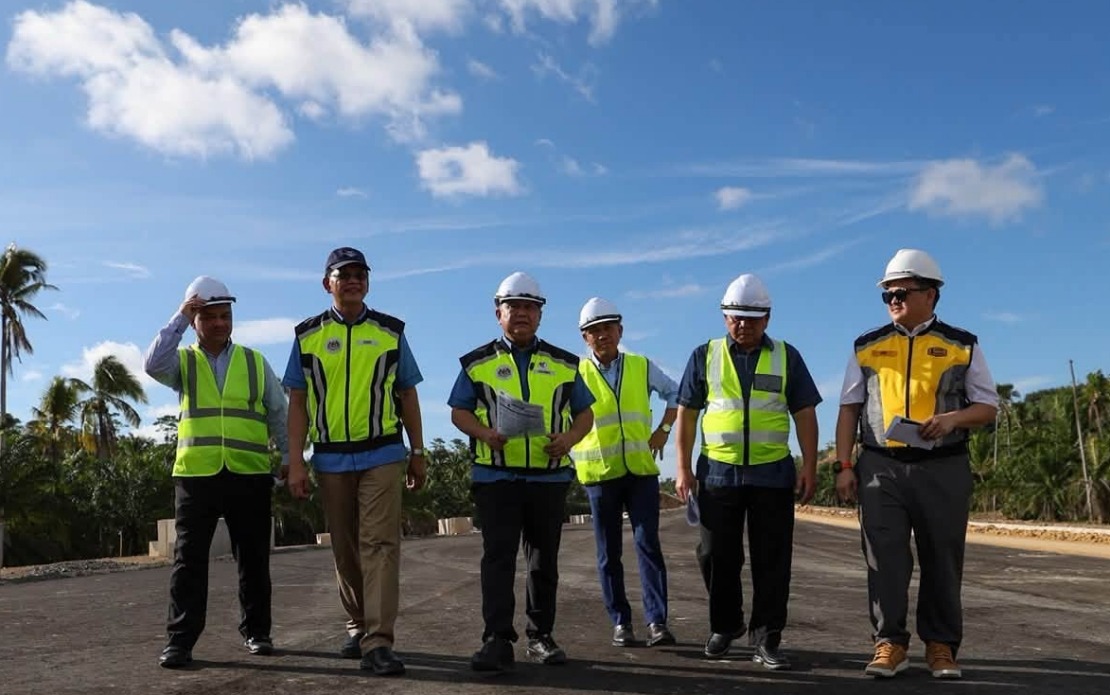
The contractor responsible for constructing Work Package 11 of the Sabah Pan Borneo Highway has formally submitted a recovery plan intended to address a 32-day shortfall that has accumulated during construction of the 7.3-kilometre Rampayan Laut-Sarang alignment. Works Minister Datuk Seri Alexander Nanta Linggi revealed the submission in a statement posted on Facebook, signalling that authorities remain committed to salvaging the timeline for this critical northern Sabah transport infrastructure project valued at RM167.48 million.
The alignment in question represents the Phase 1B section of the broader Pan Borneo Highway initiative, a decades-long endeavour to provide improved connectivity across Sabah and Sarawak. According to monitoring data compiled through mid-June, the segment had achieved 61.76 per cent physical progress, indicating substantial ground-level activity underway. However, this advancement falls behind the contractual schedule by 4.35 per cent, establishing the foundation for the recovery strategy now being implemented across the site.
Under the revised schedule, the Works Ministry aims to narrow the accumulated lag from the current 32 days down to just 14 days by August 2026, effectively recovering half of lost time before the contractual completion deadline of September 29, 2026 arrives. This compressed recovery target places considerable pressure on the project team to accelerate critical construction phases while maintaining the quality and safety standards essential to public infrastructure. The ministry has committed to sustained oversight of the recovery implementation, partnering with the Sabah Public Works Department, professional project consultants, and the contractor to ensure measurable progress towards these interim milestones.
The delays plaguing Work Package 11 stem from coordination challenges involving multiple utility service providers and government agencies. Utility relocation has emerged as a particular bottleneck, requiring intricate coordination with Sabah Electricity Sdn Bhd to relocate power infrastructure, the Sabah State Water Department to adjust water supply networks, and Celcom Timur Sabah Sdn Bhd to reposition telecommunications assets. These relocation efforts frequently intersect with active construction zones, necessitating careful sequencing to avoid safety incidents or service disruptions to communities already relying on these utilities. Compounding these infrastructure challenges are land acquisition complexities that have slowed access to portions of the alignment requiring construction work.
Minister Nanta underscored the critical importance of improved stakeholder coordination moving forward, calling for proactive and integrated problem-solving approaches rather than the siloed management that appears to have contributed to delays. His emphasis on resolving utility and land issues reflects an understanding that infrastructure megaprojects in East Malaysia operate within complex webs of competing interests, jurisdictional boundaries, and logistical constraints that demand executive-level attention. The recovery plan's success will likely hinge on whether these agencies can streamline approval processes and synchronise their operational schedules with construction timelines.
Beyond the technical completion metrics, Minister Nanta articulated the substantial benefits that the Rampayan Laut-Sarang alignment will deliver once operational. The route promises to shorten travel distances to Simpang Mengayau and Kudat by as much as 30 kilometres, representing a dramatic reduction for daily commuters and commercial traffic serving the northern Sabah region. Travel time savings of between 30 and 60 minutes per journey will accumulate into significant productivity gains for residents and businesses across this previously underserved area. These efficiency improvements carry particular significance for the tourism sector, as the improved routing will enhance access to the Tourism Belt and support implementation of the Northern Sabah Coastal Tourism Master Plan.
The infrastructure investment carries implications extending well beyond immediate transportation convenience. Enhanced road connectivity historically catalyses economic development in peripheral regions by reducing logistics costs, attracting investment capital, and facilitating labour mobility. For northern Sabah communities, the completed Work Package 11 alignment should unlock employment opportunities in tourism-related services, agriculture, and small-scale manufacturing that have remained constrained by geographic isolation. The ministry's framing of the project as an economic opportunity generator reflects broader recognition that transport infrastructure functions as foundational investment enabling sustainable regional growth.
For Malaysian policymakers monitoring mega-project execution in East Malaysia, the Pan Borneo Highway experience offers instructive lessons about the coordination demands inherent in large-scale development initiatives. The intersection of contractual timelines, utility provider schedules, government agency approval processes, and landowner negotiations creates dependencies that traditional project management frameworks sometimes struggle to navigate. The recovery plan approach—identifying delays early, developing corrective strategies, and securing stakeholder buy-in—represents standard best practice, yet its implementation in Sabah's context illustrates how even well-established methodologies require adaptation to regional realities.
The broader Pan Borneo Highway programme has experienced its share of implementation challenges across both Sabah and Sarawak, making Work Package 11's recovery trajectory particularly relevant to federal infrastructure planning in Borneo. As Malaysia pursues its commitment to balanced regional development, the ability to deliver major projects on schedule while accommodating the legitimate operational requirements of utility operators and respecting property rights will remain central to maintaining public confidence in infrastructure spending. The current recovery effort, if successful, could serve as a template for addressing similar challenges elsewhere in the megaproject portfolio.
Moving toward the September 2026 target, the Works Ministry has clearly signalled that quality and safety standards will not be compromised in pursuit of schedule recovery. This commitment distinguishes responsible project management from corner-cutting approaches that produce substandard infrastructure requiring expensive remediation. For Sabah residents anticipating the completed alignment, this assurance carries real meaning given the safety-critical nature of highway infrastructure and the extended service life expected from publicly funded transport networks. The ministry's willingness to publicly commit to quality standards while pursuing aggressive recovery suggests genuine confidence in the contractor's revised planning and the stakeholders' ability to execute coordinated solutions.

